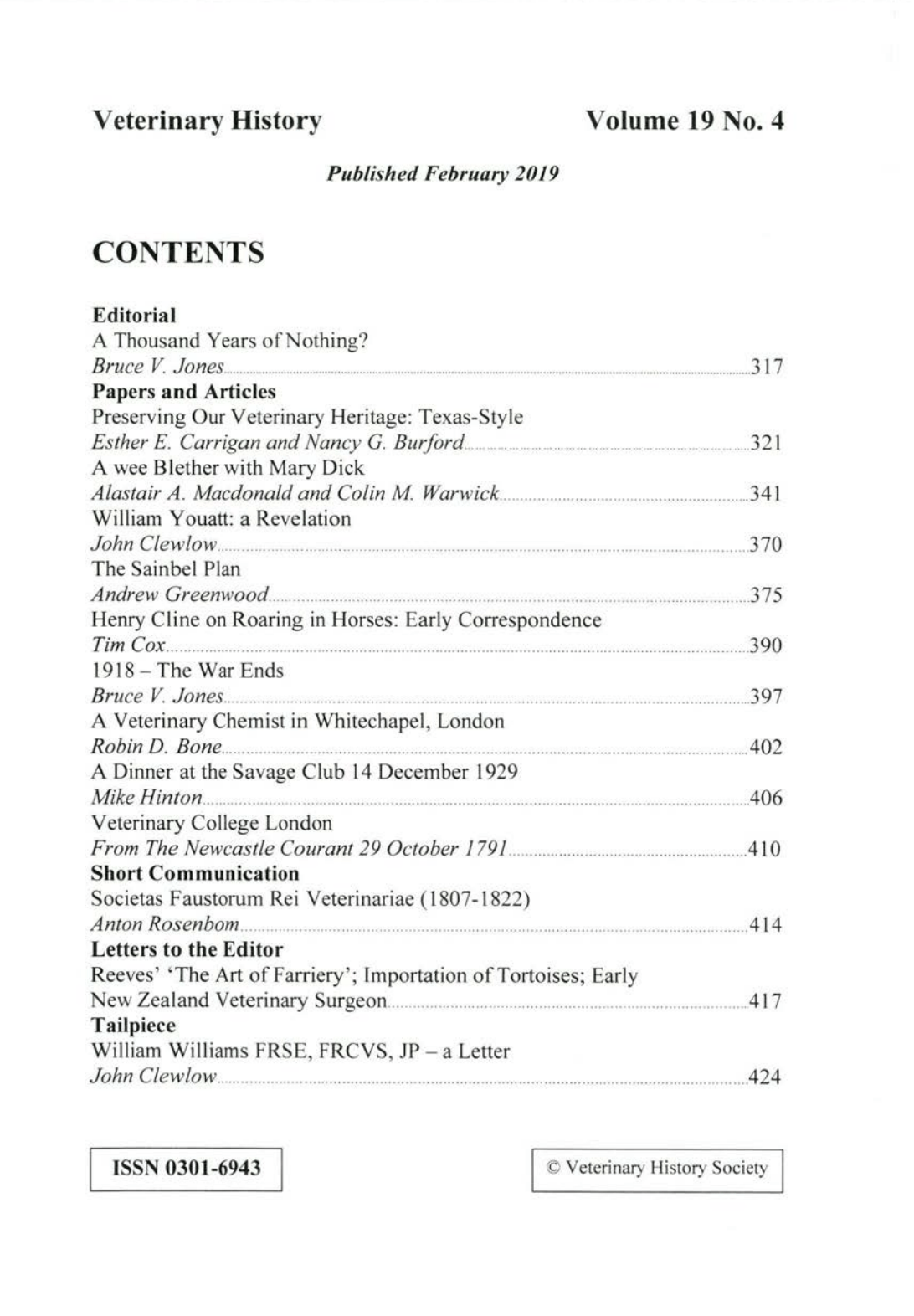
Preserving Our Veterinary Heritage: Texas Style
The veterinary library at Texas A&M University was established in 1949. Since then, it has grown significantly and has benefited both from new premises as well as acquiring many collections of veterinary texts. The collection now houses material from the 15th to 20th centuries, and although this is predominantly in English language, there have been more recent acquisitions of material from Chinese, Japanese and Middle Eastern sources.
Esther E Carrigan and Nancy G Burford
A Wee Blether with Mary Dick
The life of Mary Dick (1791-1883), sister of William Dick, reveals much about her brother and his involvement in veterinary education. Their father was a farrier and the family grew up as a neighbour to the only veterinary surgeon in Edinburgh. She was schooled in Leith Walk, and suffered the loss of several siblings during her early years. Her brother returned from the London Veterinary College in 1818 and established his veterinary school. Her life was marked by good health and she took a great interest in the welfare of students, often attending lectures. She witnessed the demise of her brother from dropsy and was subsequently involved with the running of the veterinary college. She found the actions of William Williams and the establishment of the New College most upsetting. She died aged 92.
Alastair A Macdonald and Colin M Warwick
William Youatt: A Revelation
William Youatt (1776-1847) was a highly influential veterinary surgeon in the early 19th century, an author and editor of the Veterinarian. He was also instrumental in reforms at the London Veterinary College. In his writings, Newton Crosland described Youatt as one of the two most notable men, the other being Sir Alexander Cockburn, Lord Chief Justice. This unlikely link lay through Youatt’s daughter, Mary who lived with Cockburn for almost 30 years, although they were not married they had three children. Following William Youatt’s suicide his daughter revealed that the mother of his children was not his wife, but his wife’s niece, Kesiah Jones (1789-1863), by whom he had five daughters.
John Clewlow
The Sainbel Plan
A plan for establishing an institution to cultivate and teach veterinary medicine was published in London in 1790. Attributed to Charles Vial de Sainbel, who was later the inaugural Principal of the London Veterinary College, its provenance and authorship has been challenged over the years. The paper describes the location of nine known copies of the document in various libraries and identifies spelling and typescript differences between them. Using modern techniques of stylometry, the author provides sound evidence that it was Sainbel himself who authored the plan.
Andrew Greenwood
Henry Cline on Roaring in Horses: Early Correspondence
Henry Cline was a well respected surgeon at St Thomas hospital and had been instrumental in the early governance of the London Veterinary College. In 1821 he wrote to Richard Wilson, owner of a large commercial stud in Suffolk on the issue of roaring. His view was that the condition was due to local inflammation due to a cold, that it was not inherited and its existence in a stallion could not be of any consequence. These views were rebuffed by William Youatt, veterinary surgeon, who argued that medically qualified people should not give veterinary opinions. Many owners and breeders were also wary of Cline’s views and would, on identifying roaring in a stallion, ensure that the horse did not breed with home standing mares.
Tim Cox
1918-The War Ends
At 11am on 11 November 1918 World War 1 ended with the signing of the armistice. By then almost half of all practising veterinary surgeons were serving with the Army Veterinary Corps (AVC). The work of the AVC was the envy of the German military command who found that a failure of management of equine casualties had played a large part in their defeat.
During the four years of conflict, over 2,500,000 mules and horses were admitted for veterinary treatment by the AVC. 78% returned to service. Veterinary Officers were faced not only with battlefield injuries but also infectious diseases and, at times, biological warfare.
Memorials to the role of animals in the conflict include those at Hyde Park, which bears the simple inscription, ‘They had no choice’. The Royal College of Veterinary Surgeons Memorial Board, records the names of 67 members of the profession who died whilst serving in the conflict.
Bruce Vivash Jones
A Veterinary Chemist in Whitechapel, London
144 Aldgate High Street served as a chemist shop from 1796. In 1849 it was acquired by John Gorton, a wholesale druggist and veterinary chemist who had previously run his business from Middlesex Street (Petticoat Lane). His veterinary experience had been gained by 4 years spent at the London Veterinary College, (entering in 1827) as well as 30 years’ experience as a chemist. In 1883 number 144 was demolished to allow construction of Aldgate East Station and the business moved next door, to 146. The family continued to trade from these premises until the outbreak of World War 1.
Robin D Bone
A Dinner at the Savage Club 14 December 1929
The Savage Club was a private members club in Adelphi Terrace, London. This paper describes some background to a signed dinner card from December 1929 (purchased by the author from a second-hand bookshop in the early 1960s). It contains seven signatures, of whom four were veterinary surgeons. Frederick TG Hobday was Principal of the Royal Veterinary College and a member of the Club. Leslie Pugh, a practitioner from Sevenoaks, Kent and later (1950) the inaugural Professor of Veterinary Clinical Studies at Cambridge University. Henry Gray, was a veterinary practitioner from Earls Court London and Henry Fox, veterinary surgeon, from Elgin Avenue, London, had received a DVSc from the Kharkov Zooveterinary Institute and later lived in Palestine and Canda. Of the three other signatories, one was James Moore, an ENT surgeon of Wimpole Street, London, responsible for developing the Irwin Moore turbinate nasal forceps.
Mike Hinton
Societas Faustorum Rei Veterinariae (1807-1822): The Society for the Promotion of Veterinary Science
The first known international veterinary society in the world was established in 1807 by Erik Viborg (1759-1822). He was head of the Danish veterinary school, and also a botanist. He made several extended study tours to Europe in order to obtain and disseminate effectively any knowledge of scientific and practical advances in the veterinary profession. Foreign members elected to the society included the President of the Royal Society.
The first meeting was held in 1808 when a Gold medal was introduced. The society published ‘Veterinary Scriptures’ between 1808 and 1818, which covered livestock management and disease. Despite Viborg’s declining health, no other members appeared willing to lead the society and the last material was produced in 1821.
Anton Rosenbom
Please note
Buy now