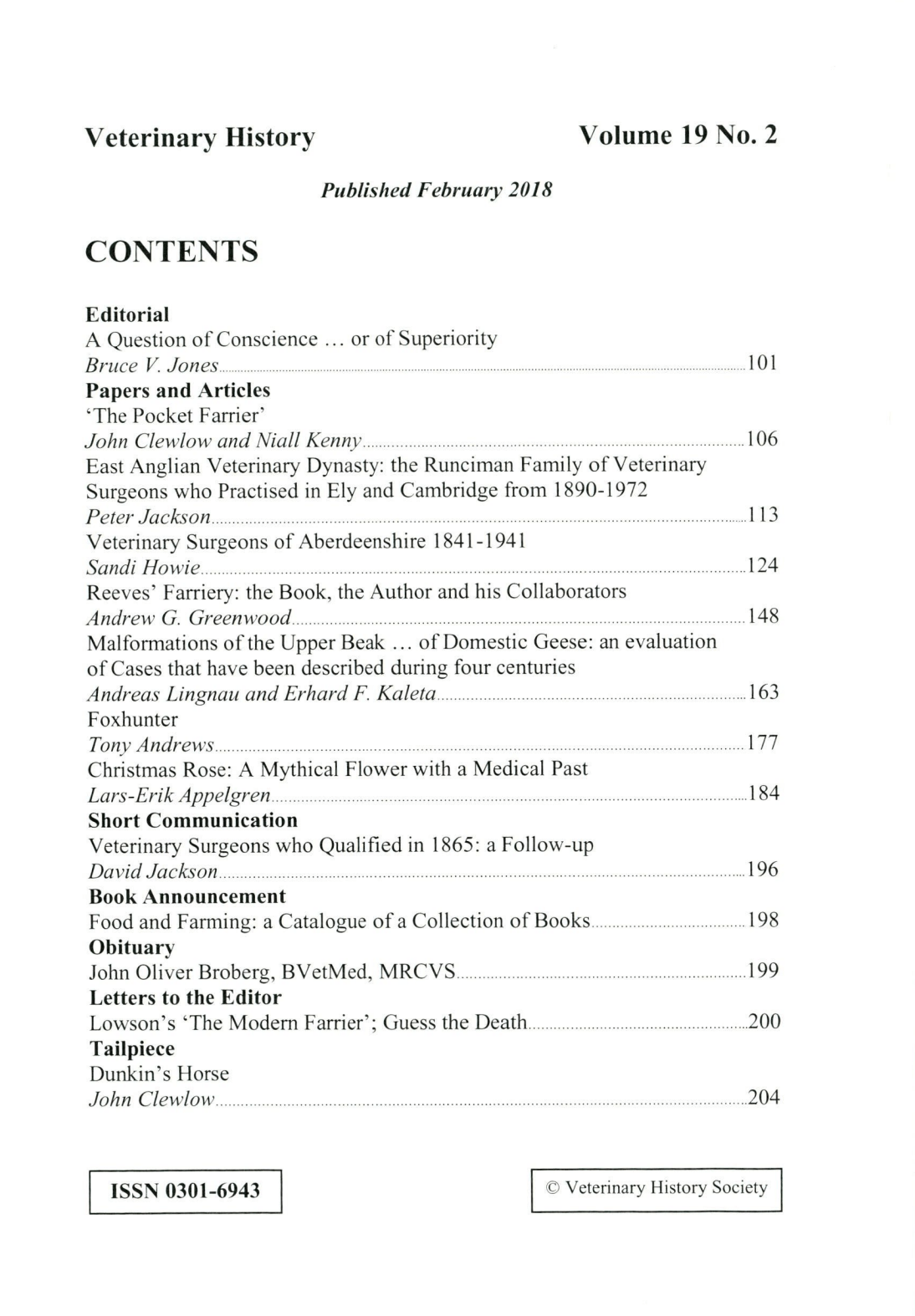
‘The Pocket Farrier’
Although the first publication entitled ‘Pocket Farrier’ was authored by William Burdon and published in 1730, ‘A Practical Farrier’ was published in 1844. Strangely there is no attributed author, and the publisher was Thomas Richardson. The authors describe this publication, its sources and the later editions published by Thomas Allman.
John Clewlow and Niall Kennedy
East Anglian Veterinary Dynasty: the Runciman Family of Veterinary Surgeons who Practised in Ely and Cambridge from 1890-1972
The paper describes the Runciman family dynasty and its connection with the veterinary profession. The first, Thomas Senior, purchased a practice in Ely, where he worked for over 40 years. An Dick) graduate, four of his six sons qualified as veterinary surgeons. Thomas (Junior) and Ben, graduated from New Veterinary College, Edinburgh and returned to work in Ely, with Ben later serving as a Civilian Veterinary Officer in the Second Boer War
James Graeme Runciman, studied in London, but moved to New Veterinary College, and finally qualified from Liverpool in 1904. He worked at, and subsequently purchased, George Banham’s practice at 15 Downing Street, Cambridge. His son, James Philip Graeme Runciman qualified in 1932 from London and ran the Cambridge practice until 1967.
The fourth son of Thomas (Senior) was William, qualifying in 1924. He was employed by the Indian Turf club, Bombay before returning to work for his father in Ely.
Peter Jackson
Veterinary Surgeons of Aberdeenshire 1841-1941
The paper details and reviews veterinary practice and surgeons in Aberdeenshire. Most veterinary surgeons had studied in Scotland, and for some, their only training was through an apprenticeship. The author describes changes in the background, qualifications and work of these professionals and how it changed over the period. The first woman from Aberdeenshire qualified in the 1930s. Many veterinary surgeons had other jobs and some were described as ‘disreputable rogues’ for their lack of professionalism.
Sandie Howie
Reeves’ Farriery: the Book, the Author and his Collaborators
The Art of Farriery in Theory and Practice by John Reeves was first published in 1758, with four editions until 1778, and was the most popular book written by a farrier between 1720 and 1800, being well received by a range of audiences.
Reeves (circa 1700-1778), a horse doctor, lived in Ringwood Hampshire and was a married man with seven children. Many of his collaborators were surgeons, including Dale Ingram (1710-1793).
The paper describes the developments in the text over the different editions, and describes the treatment of many systemic conditions. The plates are a mixture of original drawings along with some copies. The few remaining copies of the book are described as ‘well-worn’ indicating that they have been heavily used.
Andrew G Greenwood
Malformations of the Upper Beak…of Domestic Geese: an Evaluation of Cases that have been described during four centuries
The paper describes, with illustrations, skeletal malformations in geese over four centuries, the first case being recorded in 1603.
Andreas Lingnau and Erhard F Katea
Foxhunter
The paper describes the life story of Foxhunter (1940-1959) detailing some of his veterinary ailments. Detailed analysis of the history of Foxhunter’s burial site on Blorenge Mountain demonstrates that it only contained the horse’s hide, and that his skeleton is carefully preserved in the Anatomy Museum at the Royal Veterinary College.
Tony Andrews
Christmas Rose: A Mythical Flower with a Medical Past
The root of the black Hellebore has been used in both human and veterinary medicine since the 18th Century. Despite its dreadful taste, it has been used as a purgative, enema, and for treating strangles, epilepsy and ascites.
Lars-Erik Appelgren
Veterinary Surgeons Who Qualified in 1865: a Follow-up
This is a sequel to Veterinary History 19 (1) 87-90) and details the cohort of London veterinary graduates of 1885. 23 men qualified, most were aged between 20 and 27 at graduation. The majority came from southern England, although one came from America (and subsequently returned there). There was greater mobility of men compared with 1865. None of the graduates recorded taking either a municipal or government role, and only two followed an occupation outside the profession. In 1885 far fewer graduates had fathers who were either veterinary surgeons or farriers compared with 1865.
David Jackson
Please note
Buy now