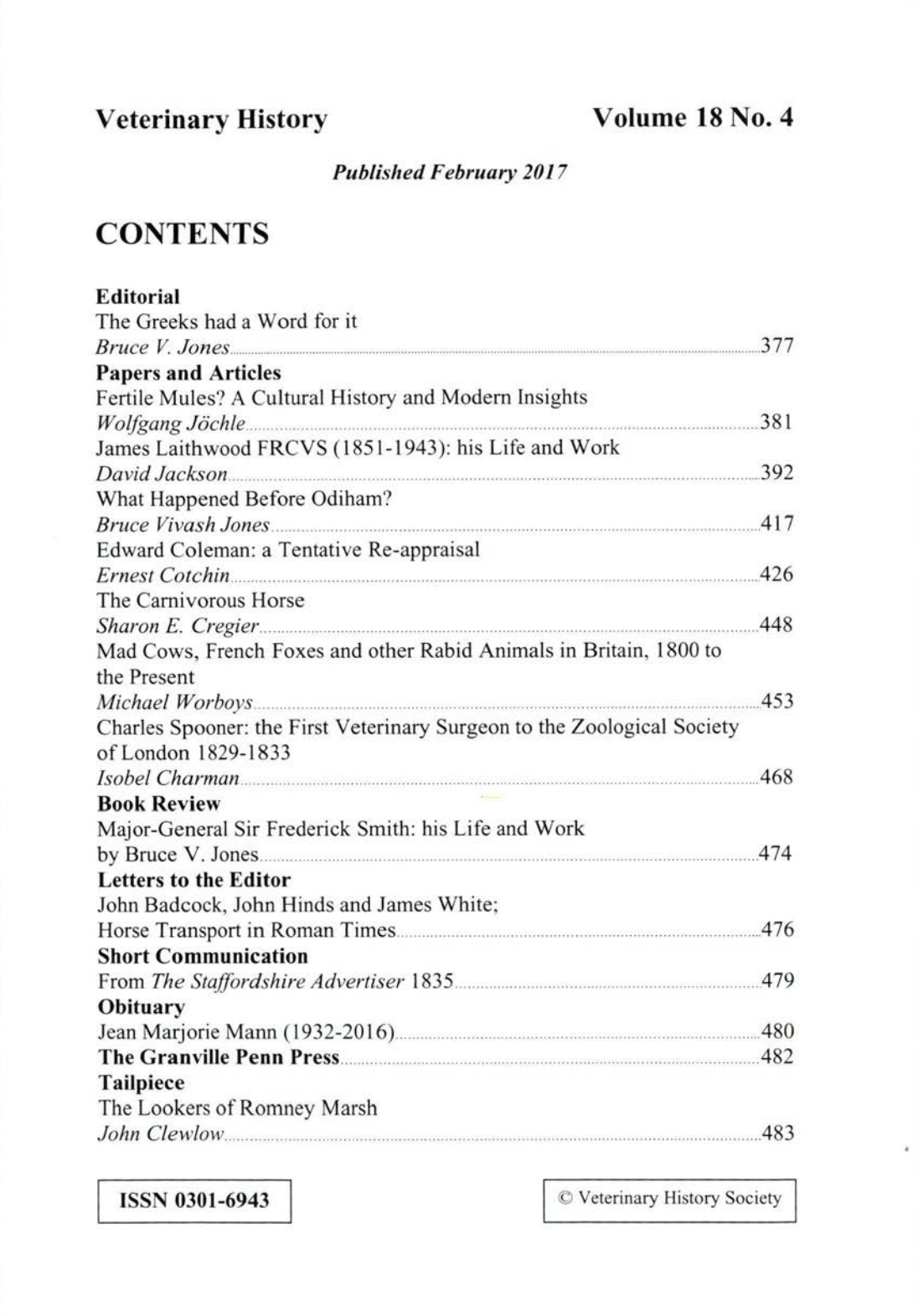
“Fertile Mules? A Cultural History and Modern Insights”
This presents a cultural history of, attitudes towards, mules and their infertility from ~1500 BC. In the Roman empire mules were held in high esteem whereas in the Spanish empire they were connected to witchcraft. Occasional pregnancies were considered signs of pending disaster driven by demonic forces. In the middle-ages women wore amulets containing parts of or ate parts of a female mule as a means of contraception. An insight into reasons for the infertility of these hybrids is included. There are 47 references, 6 Figures and one Table.
Wolfgang Jöchle
James Laithwood FRCVS (1851-1943): his Life and Work
This paper starts with a portrait photograph of James Laithwood (1851-1943). The paper is sub-divided into the following sections: Introduction; Family Background; Agricultural Background; Education; Veterinary Practice; Borough and County appointments; T.B. Research; Other Veterinary interests; Agricultural Activities; Other Activities; Relationships with employees; Relationships with other Veterinary Surgeons and Conclusions. James Laithwood was a veterinary surgeon in Congleton and a tenant farmer at Alcumlow. His father was a farmer who had previously been a butler. James qualified at Glasgow in 1883 with the McCall’s Gold Medal in Cattle Pathology and in 1891 was awarded a Fellowship of the Royal College of Veterinary Surgeons by examination. His practice was taken over by Alfred Holburn in 1907, in 1919 by John Bowden Garside, and in 1934 by A J Wright at which time the practice became a branch of Wright’s Macclesfield practice. The practice was still in operation in 2015 as Wright and Morten. James Laithwood’s veterinary activities extended beyond practice. He held the positions of Chief Veterinary Officer for Cheshire, District Veterinary Officer for Congleton/Astbury, and Borough Veterinary Inspector for Congleton. He was active in attempts to eradicate tuberculosis from cow’s milk, lectured on and also researched this disease. He was an active member of the local farming community, with particular interests in dairy farming and horses. His obit in the local newspaper recognised him as “that fine old farming gentleman”.
David Jackson
What Happened Before Odiham?
This paper provides insights into how various 17th and 18th century people including Sir Thomas Browne; Dr. Samuel Johnson; Andrew Snape; James Clark; Thomas Bates; John Hunter and others influenced members of the Odiham Society, in particular, the Rev. Thomas Burgess and Granville Penn to be responsible for establishment of the London Veterinary College in 1791. Aspect of the lives and contributions made by several of these people are included. It emphasizes differences between establishment of veterinary education in France and in Britain. The author also reminds us of the origins and use of the word veterinarian.
Bruce Vivash Jones
Edward Coleman: a Tentative Re-appraisal
This re-appraisal includes biographical details of Coleman. Although ‘tentative’, it systematically analyses and counters criticisms used by among others, Frederick Smith, to denigrate Coleman. Smith had little time for a Principal Veterinary Surgeon who had not served in the army and his criticisms were based on other’s opinions, not on personal knowledge of Coleman. The author restricts himself to Coleman’s role as a professor/teacher and systematically addresses three main criticisms: that he admitted unsuitable pupils; that he shortened the vet course; and that he allowed undue medical interference in the development of the profession particularly with examiners. The author concludes, as did Coleman’s contemporary Mayer in 1841 that: “ I hope we shall no longer hear Mr. Coleman reflected upon for not accomplishing impossibilities. I shall ever esteem the man and revere his memory; and although I feel myself incapable to do full justice to his merits, yet posterity will”. This paper goes some way to doing this justice.
Earnest Cotchin
The Carnivorous Horse
This paper is not about a specific carnivorous horse. It is a series of anecdotes in which horses are reported to have eaten meat, fish or small prey animals. The author wonders about the normality of such behaviour and suggests further reading.
Sharon E. Cregier
Mad Cows, French Foxes, and other Rabid Animals in Britain, 1800 to the present
In this article I discuss non-dog rabies in Britain from the 1830s to the present day. I begin with a discussion of the well-known story of rabies in urban dogs up to its eradication in 1902. I then widen the lens and take a cross-species perspective to look at how rabies was seen in cats, livestock, horses and deer. With these species, public and scientific interest was less in the disease, as, apart from cats, humans were unlikely to be attacked; rather it was in how the infection changed the animal, exposing the veneer of domestication, even turning herbivores into carnivores. For the twentieth century, I discuss responses to the threat of fox rabies, which spread from eastern to Western Europe in the post-Second World War years, arriving near Channel ports in the 1970s. Finally, I consider responses to the first death from indigenous rabies for 100 years in 2002, after an infected bat bit a conservationist. Subsequent investigations have shown a very low incidence in bat rabies in Britain and a near negligible public health threat; however, this has not inhibited the press from continuing to exhibit, what the New York Times called ‘Britain’s Rabid Obsession’.
Michael Warboys
Charles Spooner: the First Veterinary Surgeon to the Zoological Society of London 1829-1833
In 1829 Spooner was appointed at 22 years of age, straight from the London Veterinary College, after being recommended by Professor Sewell. He was put in charge of more than 600 animals but with little experience and no established body of knowledge many animals were dying. He instituted experiments in which he varied feeding regimes and carried out post mortem examinations and he reported to the Veterinary Medical Society results of treatments that he had tried on sick animals. He saw himself as a scientist using the opportunities he found at the Zoological Society to advance the profession. However, he was dismissed in 1833 and was replaced by William Youatt a leader in the profession. However, Spooner was the real pioneer taking on this almost impossible task first. Though his success was limited, his scientific approach set a precedent and paved the way for his successors. He went on to become Professor and Principal of the London Veterinary College 1838-1871, and died in office.
Isobel Charman
Please note
Buy now