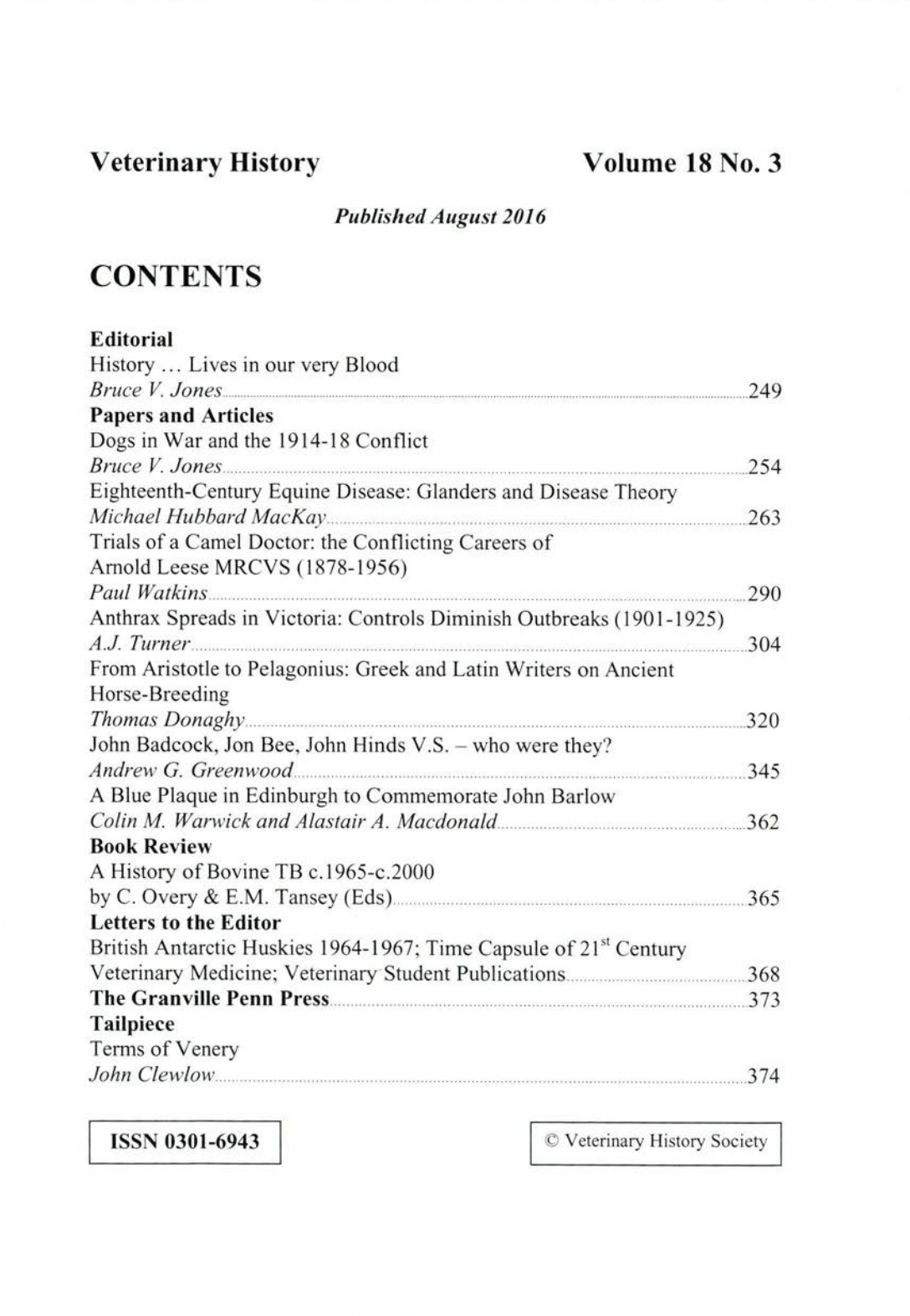
Dogs in War and the 1914 – 1918 Conflict
This records some of the history of the use of dogs in war particularly in the 1914-18 war. The roles and functions of dogs, both official and unofficial, are discussed. The author puzzles over the lack of official recognition by the British War Office of their use of dogs and their treatment of an outstanding dog trainer (Edwin Richardson). The contributions of two animal welfare organizations the RSPCA and the Blue Cross are discussed. The author concludes with the question, “Were we right to use animals in war”?
Bruce V Jones
Eighteenth-Century Equine Disease: Glanders and Disease Theory
This historian has reviewed 17th and 18thC veterinary literature including works by: Snape; Solleysel; Gibson; Bracken; La Fosse ; Sainbel; and Clark to contribute to understanding of the development of different ‘concepts’ of disease. It is an attempt to extract how and why the meaning of the ‘symptoms’ in horses, of the disease called Glanders/Farcy, changed in the 18thC. In so doing, he provides an alternative view of origins of the ‘germ theory’ of disease.
Michael Hubbard MacKay
Trials of a Camel Doctor: The Conflicting Careers of Arnold Leese MRCVS (1878-1956)
Arnold Leese (1878-1956) was a controversial member of the veterinary profession, whose name is best remembered for the rise of fascism in Britain. However, he made significant contributions to veterinary medicine in the early 20th Century before embarking on a career which would lead to imprisonment on a number of occasions. This paper describes the life of an enigmatic veterinary surgeon, perhaps the only one to have come under scrutiny by the Secret Intelligence Services.
Paul Watkins
Anthrax Spreads in Victoria: Controls Diminish outbreaks (1901-1925)
This paper is the third in the series. It provides evidence from newspapers to extend the records of Anthrax in Victoria from 1901-1925, a Table records cases of Anthrax. Disagreements over the diagnosis of Anthrax made in 1876 and 1895 are again emphasized because they were erroneously used in accounts of the diseases of animals in Australia into 1960’s. It is concluded that Anthrax was rare in Victoria until about 1900 when imported bone meal started to be used as a food supplement to improve productivity particularly in settlement dairy farms. In 1901 bone products were shown to contain B. anthracis and after treatment, of these imported products, by heating, was introduced there was a rapid decline in cases of Anthrax.
A.J. Turner
From Aristotle to Pelagonius : Greek and Latin Writers on Ancient Horse-Breeding
This paper gives an account of the breeding cycle of the horse with quotes and anecdotes from classical authors including: Aristotle (4thC BC); Varro (2nd -1st C BC); Columella (1st C AD) and Pelagonius (4th C AD). It includes descriptions of; Teeth and aging; Breeding ages; Lifespan; Breeding methods; Breeding season; Covering; Pregnancy and Birth. Current views are based mainly upon those of Rossdale. It is concluded that ancient horsemen had knowledge and understanding of horse-breeding which was not very different to that of the present.
Thomas Donaghy
John Badcock, Jon Bee, John Hinds V.S. – who were they?
This is an analysis of the lives and literary contributions of John Badcock and John Hinds. John Badcock a repeatedly bankrupt journalist /publisher with an interest in veterinary matters and John Hinds, son of a farrier practicing as a farrier/veterinary surgeon, came together between 1827 and 1832 to write successful books on veterinary medicine and horsemanship. Badcock like many journalists of the day wrote numerous articles and letters under several pseudonyms including that of Jon Bee, this led to the assumption that John Hinds was another such alias. However, close examination of Badcock’s background and the works of John Hinds suggest otherwise.
Andrew G. Greenwood
A Blue Plaque in Edinburgh to Commemorate John Barlow
The plaque commemorates Professor John Barlow’s residence at 1 Pilrig Street, Edinburgh. It was organized by Antony R. Barlow a great grandson of John Barlow. The plaque reads: PROFESSOR, JOHN BARLOW, 1815-1856, Eminent Quaker scientist, Professor of Anatomy and Physiology at the Royal Veterinary College, Edinburgh and highly respected member of the Edinburgh scientific community. Much loved member of the religious Society of Friends, Husband of Eliza Nicholson (1813-1894) and father of Alfred (1851-1857), Mary Barlow (1853-1899), leading Quaker pacifist and first Manager of the Bonneville Village Trust, John Henry Barlow (1855-1924). Lived here 1851 – 1856. Another plaque with similar inscription was erected at John Barlow’s gravestone in the Quaker’s cemetery, The Pleasance, Edinburgh.
Colin M. Warwick and Alastair A. Macdonald
Please note
Buy now