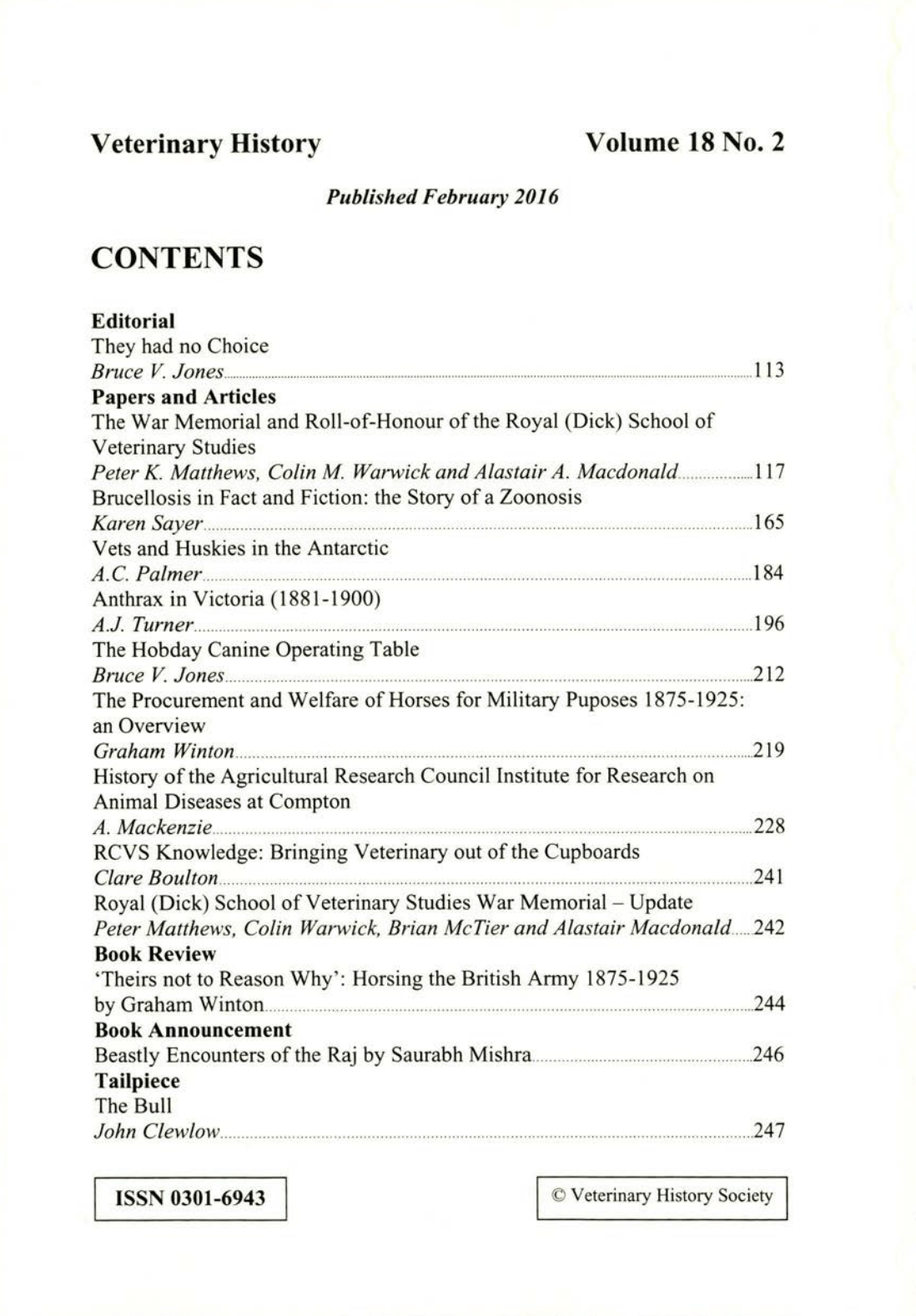
The War Memorial and Roll-of-Honour of the Royal (Dick) School of Veterinary Studies
This is about the men of the R(D)SVS who gave their lives in wars of the 20th C. War memorials and the memorial library at Summerhall, Edinburgh are described with a new list of ‘All those men who had tangible connection with the R(D)SVS and where death is perceived to have been related to their war services’. Sources are recorded and portrait photographs are included where available.
The roll includes men from:
- South African War (1899 – 1902), 8 men, names from D. C. Barningham – G. Sykes, no photographs available.
- Great War (1914 – 1918), 29 men, names from T. E. Bartleman – T. Wright, 20 men in photograph.
- World War II (1939 – 1945), 25 men, names from D. D. P. Bowie – L. Warren-Smith, 13 men in photograph.
For each named person the potential information available is: Rank; Army Department; Attachment; Place born; Place from; Qualified; Entered army; Career in army; Campaigns; Left army; Died – aged; Buried where?
Peter K. Matthews, Colin M. Warwick, and Alastair A. Macdonald.
Brucellosis in Fact and Fiction: the Story of a Zoonosis
This is an exploration of the ways in which the narratives about, and names for Brucellosis circulated in Britain from the 19th C to the mid 20th C. It includes accounts of historical failures to appreciate that Brucella affects humans as well as animals and that the handlers of diseased animals are exposed to it as an occupational risk. The history of the human disease from medieval times is mentioned though evidence is not detailed. Variable official interest in the disease and confusion over its name means that it is still considered a 21st C enigma. It is suggested that the history of research into this disease can be mapped onto wider socio-political issues. The health of vets, farmers and other animal handlers was generally unconsidered as was the general population of Malta by the Mediterranean Fever Commission which was convened in that country in 1904. Interest in the disease was so bounded by attitudes of empire and the impact of the disease on the army and navy, there was little reason for experts to look at remittent fever in children or abortion storms in cattle.
This paper may be of limited help to those seeking a historical review of Brucellosis as a zoonosis but it does give some history of it being ignored as an occupational hazard for vets, farmers etc.
Karen Sayer.
Vets and Huskies in the Antarctic
This provides a history of professional veterinary involvement in the Antarctic. Initial enquiries about the medical problems of huskies by the author when interviewed by Sir Raymond Priestley (a member of Scott’s 1910-1913 expedition) led to the suggestion that a veterinary surgeon should be employed to investigate the problems including a possible neurological condition of Huskies. The author was contacted soon after by the Falklands Islands Dependencies Survey about veterinary supplies for British Antarctic Survey bases and for a manual, to help non-professional people to care for the Huskies. Due to bad weather these particular supplies did not arrive. Various diseases of Huskies are described including; osteoarthritis; haemophilia; entropion; signy-x; and lurky. The contributions of the three Cambridge graduates who went to Antarctica: Mike Godsal (1963-64); Andrew Bellars (1967-68) and Robert Bostelmann (1973-74) provide useful information on diseases; management; diet; breeding; work loads etc. Use of Huskies has now been phased out and the dogs have been replaced by skidoos except for three teams of Huskies at Haley Bay. This was the end of an era and also of veterinary presence.
A.C. Palmer
Anthrax in Victoria (1881-1900)
This continues the chronological record of potential outbreaks of Anthrax in Victoria and tabulates 15 outbreaks occurring between 1881 and 1900. Records are generally made from newspaper reports and include; dates, locations, number of deaths, species and the veterinarian(s) involved. The author speculates on reasons for the lack of official documents, because not a single report of human infection with anthrax was officially recorded between 1867 and 1893. The first recorded outbreak after 1880 was in cattle brought in from Queensland at Lilydale near Melbourne in 1888. There are references to the 1876 epizootic in sheep, attributed to Black disease in the previous paper, including some consequences of the disputes which occurred at that time. Reasons for a sharp increase in outbreaks in the early 20th C will be discussed in a subsequent paper.
A.J. Turner
The Hobday Canine Operating Table
This describes with figures and photograph a historical veterinary artefact. This operating table provided a secure base for development of small animal surgery at the Royal Veterinary College from the end of the 19thC through to the 1940s. The photo shows an example, this is now in the collection of Royal Veterinary College.
Bruce V Jones
The Procurement and Welfare of Horses for Military Purposes 1875 – 1925: An Overview
This gives an overview of the history of the veterinary sub-divisions of the British Army responsible for procuring and caring for their horses and mules between 1875 and 1925. It deals with the Boer War and the Great War. Lessons learned in the Boer War helped to produce a requisition process which proved very successful. Changes in organization and practices for horse mobilization followed four initiatives: Amend the Army Act; Census of horses; Statement from War Office; Mobilization Scheme both partial and full. Huge numbers (895,770) of horses and mules were acquired from a range of countries including the USA, Canada, and Australia. More than 70% of sick and injured animals were returned from veterinary hospitals for active service and contributed to the victorious outcome. The Army Veterinary Corps was responsible for demobilization of horses/mules at the end of the war and thus helped to pay for itself.
Graham Winton.
History of the Agricultural Research Council Institute for Research on Animal Diseases at Compton
This history of the Agricultural Research Council Institute at Compton from 1931 -1974 was written by Dr. A. Mackenzie, it has been revised and re-edited by Jean Mann for this journal. It includes details of the development of the institute, farms, laboratories and staff. The main research interests are included as are developments of the farms, livestock and buildings to serve these interests. An appendix shows office holders of the Agricultural Research Council and the Institute for Research on Animal Diseases. Compton was closed in 2013 and research work was moved to Pirbright.
A. Mackenzie.
RCVS Knowledge: Bringing Veterinary out of the Cupboards
This an announcement that the RCVS archive is being updated thanks to the Alborada Trust. The new catalogue will be fully searchable on line. Key items will be digitized and available via a dedicated web-site. The Sir Frederick Smith collection will be the first to be catalogued and The Veterinarian from 1828 – 1902. Lorna Cahill (Project archivist) will start in October 2015.
Clare Boulton.
The RDSVS War Memorial: Update
This gives details of a new memorial plaque commemorating, staff, students and graduates of the RDVC who died during or following active service. It was created by ‘Dovetailors’ in European Oak. It was placed in a quiet study room next to the Lady Smith of Kelvin Library on 7th November 2014. A photograph is included.
Peter K. Matthews, Colin M. Warwick, Brian M. McTier and Alastair Macdonald.
Please note
Buy now