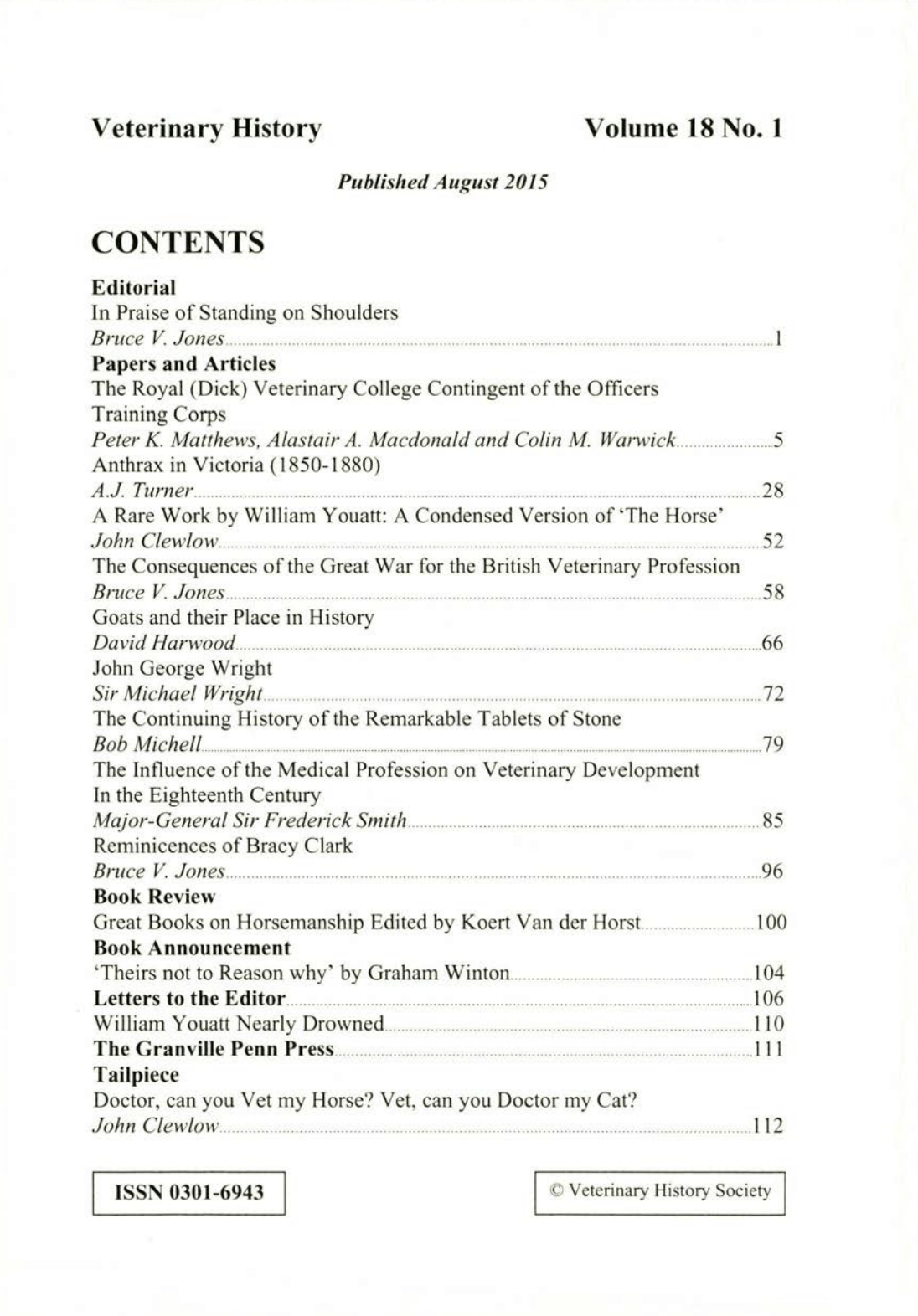
The Royal (Dick) Veterinary College Contingent of the Officers Training Corps
The Royal (Dick) Veterinary College Contingent of the Officers Training Corps was set up by Professor Ainsworth Wilson in 1912, and it was a cavalry unit. In 1914 many members went to war and three were killed. It was resurrected in 1919 by Captain William McGregor Mitchell. Training included, lectures, parading, shooting and riding. Spring and Summer camps were highlights of the year. Culmination of the Summer camp was the annual inspection by a senior officer of the RAVC. In 1929 Captain Mitchell was replaced by Lieutenant John Neish Ritchie, a product of the RDVC OTC. In 1936-37 it became a mechanised unit, with tanks. 1938 the last Summer camp was held at Aldershot, where they were lectured on the growing disquiet in Europe. The 1939 Spring camp at Dreghorn involved rigorous training but dissolution of the RDVC OTC followed. Five former members died in WWII. The 9th Battalion of the Home Guard was created in association with the University of Edinburgh and was commanded by Professor Tom Grahame. After WWII, students joined the Universities of Edinburgh and Heriot-Watt OTC in which Professor Gordon Ferguson served from 1963 -1975. Many alumni had distinguished careers in the veterinary profession and elsewhere, a list of officers from the London Gazette is included.
P. K. Matthews, A.A. Macdonald., C.M. Warwick
Anthrax in Australia: 1850-1880
This is the story of an epizootic disease in SW Victoria in 1876 which provoked by a book by Mitchell (1877). His evidence was taken from A. Park’s account (1876) and from local newspapers. Although claims by Mitchell that the epizootic was Anthrax were quoted by Sneddon in his review (1953). They were queried at the time by the Chief Inspector of Stock and others. Accusations, in the press of incompetence, were not heeded. The rapid decline in cases by 1877 and a different interpretation of evidence in NSW did not permit an agreed conclusion to be reached. The author gives his interpretation of the causes underlying this dispute, and with the benefits of scientific hindsight, emphasizes that the weather, at the time, was conducive for development of Liver fluke in Sheep. Braxy was not described as a separate syndrome until 1895. Post mortem signs of Anthrax in sheep were not well established. Systematic recordings of clinical signs and of post mortem examinations were absent in the newspaper reports. It is concluded that this new disease in SW Victoria was not Anthrax as claimed by Mitchell but Braxy. A pathogen for Braxy was not determined until much later by A.W. Turner.
A. J. Turner
A rare work by William Youatt: A Condensed Version of ‘The Horse’
After giving an overview of Youatt’s published work this paper reveals; how, and by whom this very rare 63-page pocket book was published. It includes the title page and two pictures of horses taken from another of Knight’s publications.
John Clewlow
The Consequences of the Great War for the British Veterinary Profession
This gives further insight into the author’s archive of knowledge of British Veterinary History. The period, pre-WWI up to post-WWII. Pre – WW1, the profession was equine based, poorly paid, and of relatively low social standing. During WW1 about half of the profession was in the army, mainly in France, where it was overstretched, short of supplies but returned three quarters of injured horses to active service. After WW1 the profession was in decline as the horse population declined and depression hit the economy. Government was aware that changes were necessary and changes occurred to the funding of veterinary research and ‘all women’ were rewarded with the Sex Disqualification (Removal) Act of 1920. This forced the RCVS to accept women into the profession. Guided by Fred Bullock, (registrar RCVS, 1907 -1946), an amendment to The Veterinary Surgeons Act 1881, was passed and imposition of an annual registration fee for members allowed a regular income for the RCVS. A national veterinary association was set up by O. Charnock Bradley in 1919 and became the BVA in 1952. Clinical practice was held back until after WWII when the boost for livestock production and increased small animal work were aided by the women of the profession and with new therapies, anaesthetics and vaccines from the pharmaceutical industry.
Bruce Vivash Jones
Goats and their place in history
A talk to the Veterinary History Society by the Honorary Veterinary Surgeon to the British Goat Society, giving an overview of their history, domestication, folklore, stereotypic views of, place in UK culture, numbers in the world today and some recent media events concerning goats in the UK.
David Harwood
John George Wright DSc, Dr. Med. Vet. (Hannover), MVSc, DVA, FRCVS.
This address was given to the 2nd AGM of the Alumni Association in April 1993, transcribed by Keith Ward BVSc MRCVS. Michael Wright gives a personal view of his father, an account of his life, how he became a Veterinary Surgeon, his progress through the profession and contributions he made. His father’s insistence on the need, of teaching, for a field station of which Leahurst was the first, and of creating the first university Faculty of Veterinary Medicine. He was not always aware that his father was a very special man, a giant of veterinary teaching, and one of the greatest clinicians of his generation. John George (JG) was a formidable raconteur with great command of the language, an astonishing memory, a socialist and an autocrat but few people seemed to resent being ridden over rough shod by him. His great friend, Professor Seaborne Davies said of him, “Death will remain but half a conqueror so long as his friends and the generations of his students whom he inspired remain alive”. Those taught by JG regarded, with pity, the unfortunates who never had this experience and his son thanked those who had invited him to speak to so many of JG’s fortunates.
Sir Michael Wright
The Continuing History of the Remarkable Tablets of Stone
This is an entertaining overview of the story of aspirin. After creating some confusion over three Stones, Bob Michell reminds us of the Rev. Edward Stone’s paper to the Royal Society in 1763 on his discovery of the value of Willow bark. Fifty years later Johann Pagenstecker found a pain killing extract from Meadowsweet. In 1835 a German chemist extracted the active component (salicylic acid). Charles Gerhart modified this unpalatable and irritant substance but gave up on the threshold of success. In 1875, Felix Hoffman re-visited this idea to help treat his father’s arthritis without side-effects. Felix Hoffman worked for Bayer and aspirin was patented. Britain and Australia looked to avoid this patent and George Nicholas, produced Aspro. In 1938 Reckitt and Coleman found a soluble version, Disprin. The anti-pyretic effects of aspirin are a good selling point but it has taken years for clinicians to realize that controlling fever may not be a benefit. The anti-thrombotic effect of aspirin may be its most important effect today, its mechanisms were unraveled by John Vane in the 1970s. Aspirin may also have anti-cancer properties, and be of benefit to willow trees. The aspirin of Stone’s tablets remains unique for its safety, polypotency, and cost effectiveness.
Bob Michell
The Influence of the Medical Profession on Veterinary Development in the Eighteenth Century
This paper was read before the, History of Medicine Section of the Royal Society of Medicine in 1923. It was later prepared for publication by J.W. Barber-Lomax MRCVS in The Veterinarian 1964 Vol 2 pp 219-226. Frederick Smith, condemns some and praises others for their contributions. It is a bird’s eye and chronological review of the interest 18th Century medical men showed in veterinary questions. It includes comments on work by: Thomas Bates FRS (1714) ; William Gibson (1680-1750); Henry Bracken (1687-1764); “Iater” a member of the Central Board of Health; an anonymous physician who, after the 1865 epizootic, blamed magistrates, the clergy, and advocated destruction of affected animals; J. Bartlett (1753); Dr F Nicholls FRS (1755); William Osmer (1756); Francis Home MD (1719-1813); Thomas Wallis (1759); Daniel Peter Layard (1757); James Blunt (1773); Thomas Percivall MD FRS (1747); William Taplin (1740-1807); Thomas Prosser (1790); John Hunter (1728-1793); Alexander Monro II (1733-1817); Erasmus Darwin (1731-1802); William Moorcroft (1767-1825); Edward Coleman (1765-1839); Delabere Blaine (1770-1845); Bracy Clark (1771-1860) and Edward Jenner (1749-1823). Smith apologises for his hurried and imperfect treatment of these characters but insists that these are facts which should not be forgotten. The contributions are in Volumes 2 and 3 of Smith’s Early History of Veterinary Literature (1923-24).
Major-General Sir Frederick Smith
Reminicences of Bracy Clark
This paper is based on a letter, in the RCVS archive, addressed to Major-General Sir Frederick Smith from Sister (Mother) Edith O.M.S.E. It includes details from a letter her mother wrote to her concerning the possible fate of some of Bracy Clark’s possessions. These, included plaster casts, her mother had offered to the Linnean Society and the Royal Veterinary College in March-Sept 1903. Her mother’s letter included; a photograph of Bracy Clark at 90 years of age (later used by Smith in Vol 3 of his ’Early History of Veterinary Literature’, anecdotes of the public recognition of Bracy Clark at ninety and other stories of his life. There are comments on Edward Jenner and what he possibly owed to a local Dr. Fuster, here, identified by Bruce V Jones as a Dr. Fewster who read a paper in 1765 to the Medical Society on ‘Cow pox and its ability to prevent Small pox’. Bracy Clark was a man of extraordinarily varied interests, interest in horses was only a little bit of his life and his work has yet to be analysed. To explain Bracy Clark’s difficult and intemperate behaviour, Bruce V Jones suggests that he may have suffered from Bi-Polar disorder. (201 words).
Bruce V Jones
Please note
Buy now