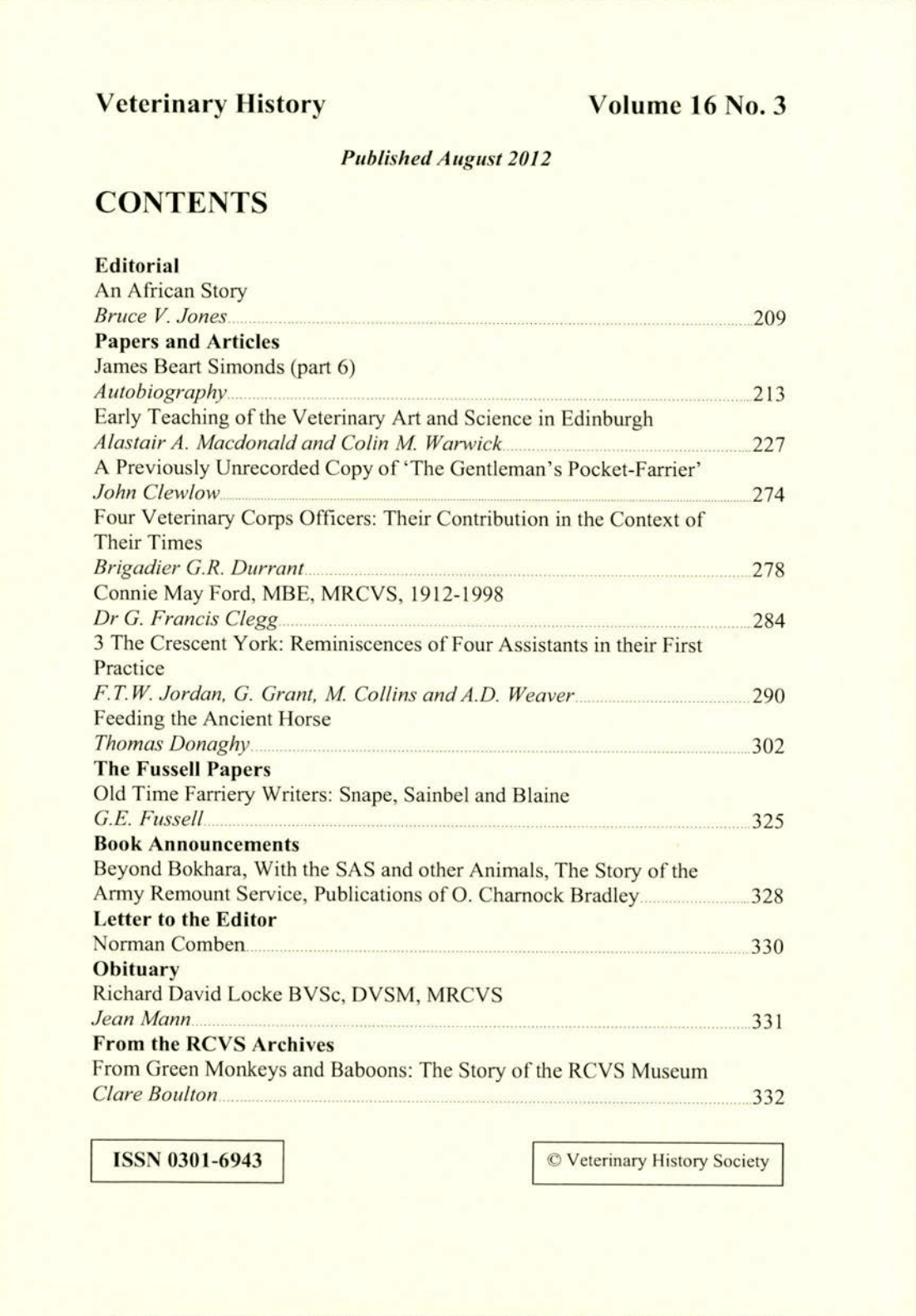
James Beart Simonds. Autobiography – Part 6
The sixth part of the autobiography of James Beart Simonds, originally published in 1894. This section covers his thoughts on Swine Fever or Hog Cholera outbreak in the USA. It also describes a European journey to find out about Cattle Plague (Rinderpest) in 1857, which was spreading across Europe at that time. Simonds also outlines the various legal approaches to the control of Rinderpest, once it had reached Britain.
Early Teaching of the ‘Veterinary Art and Science’ in Edinburgh
James Clark was unsuccessful in his attempt to start a veterinary college in Edinburgh in the 1790s. James Burt was the first veto work in Edinburgh after qualifying from the London College in 1797. Alexander Clark obtained his qualification in 1812, before returning to Edinburgh. William Dick qualified in 1818, returning with the aim of starting veterinary training in Edinburgh, supported by John Barclay and others. This was finally achieved in 1823, although William Dick had been giving occasional lecture courses from 1818. The veterinary school was based at the Clyde Street home of the Dick Family, where William Dick’s father, John, worked as a farrier. An appendix is given with a list of the sixteen veterinary surgeons appointed to the Army in 1797. A transcript of a lecture by William Dick on conformation of the horse is appended.
Alastair A Macdonald and Colin M Warwick
A Previously Unrecorded Copy of ‘The Gentleman’s Pocket Farrier’ by A Veterinary Surgeon (1838)
A description of a copy of this book acquired by the author, a plagiarised copy of ‘A Gentleman’s Pocket Farrier’ by William Burdon, originally published in 1730.
Four Veterinary Corps Officers: Their Contribution in the Context of their Times
A brief outline of the military careers of four distinguished Army Veterinary Corps officers.
Griffith Evans was born in 1835 in Wales and after qualifying from the RVC, he spent a few years in practice before being commissioned into the Royal Horse Artillery as a veterinary officer. He spent some time in Canada, where he acquired a medical degree, MD. Whiile serving in India, he identified the cause of Surra, which was causing larger numbers of horses. Evans identified the Trypanosome responsible. This was later identified as the cause of ‘sleeping sickness’ in people. This revolutionised tropical medicine. He lived to be a hundred year’s old.
John James Atkins was born in 1878 and qualified from the Glasgow College. He went to South Africa as a civilian officer with the British Army, during the Boer War. He then went to India and joined the Younghusband expedition in 1903-4 to Tibet, travelling with 20,000 transport and riding animals. After another period in south Africa, he came back to UK to service in Europe during the Great War. He was attached to the American Expeditionary Force, setting up their veterinary service. He returned to India in 1920. During the Second World War, he commanded a unit of the Home Guard.
George Barnett was born in 1895, As a veterinary student he enlisted in 1914, but in 1917 hew was sent back to RVC to complete his training and qualified in 1918. He then went to archangel with the BRITISH Archangel Expeditionary Force, setting up a veterinary hospital. He spent the rest of his career in India, apart from short periods in Iraq and Shanghai. He commanded the Indian Army Veterinary Corps college at Ambala. After retirement he was an early pioneer of the Animal Health Trust.
John Clabby was commissioned in 1933 and saw service in India. He joined the 1ST Cavalry Division and accompanied them to Palestine, Eritrea and then Greece, where he was captured and spent 4 years as a POW. In retirement He became chief executive of Animal Health Trust and Colonel Commandant of RAVC.
G R Durrant
3 The Crescent, York: Reminiscences of Four Assistants in their First Practice
The personal memories of four vets who worked at a veterinary practice in York between 1942 and 1985. This practice became the Minster Veterinary Group. The practice was founded in 1890 by Walter Weston. Frank Jordan joined the practice in 1942 after graduating from RVC and describes his experience as a new graduate in a mixed practice. David Weaver joined in 1955, who mainly did cattle medicine. He describes glass syringes and re-usable needles, which had to be boiled. He mentions the introduction of cattle crushes. He averaged 8-10 calls a day, finishing at 7pm. Gregor Grant worked at the practice between 1959 and 1993. He describes his living arrangements and night calls. The internal layout was altered to make a better working environment. He describes the limited range of drugs available in the 1960s. Mark Collins started in 1980. He describes the anaesthesia techniques, using Immobilon and Saffan. No gaseous anaesthetics were used. He mentions the rebranding of proprietary medicines with the practice’s own labels. he oversaw the move to new bigger premises in 1985.
F T W Jordan, G Grant, M Collins and AD Weaver
Feeding the Ancient Horse
The article shows that the horsemen of ancient times were well versed in the science of feeding horses. The ingredients were very varied, including barley, oats, vetches, fenugreek, marsh parsley, and clovers. The ancient horse-breeders understood the benefits of pasture grazing. There was an understanding of the need to vary the diet based on the horses’ condition or amount of work. Th4e importance of the balance between forage and concentrates was well understood. It was recognised how important it was to set up large feed depots to supply war horses.
Thomas Donaghy
Old Time Farriery Writers: Snape, Sainbel and Blaine
A review of the farriery writings of three late-eighteenth century writers – Edward Snape, Charles Vial de Sainbel (or St Bel) and Delbere Pritchett Blaine.
G E Fussell
From Green Monkeys and Baboons: The Story of the RCVS Museum
A museum was started at the Royal College of Veterinary Surgeons after the college moved to Red Lion Square in 1853/4. The main item on display was the skeleton of Eclipse, the famous racehorse. There were many donations over the years up to 1914. Most of the items were equine related, but more exotic species became to be represented in the collection. The skeleton of Eclipse is now at the Royal Veterinary College.
Clare Boulton
Please note
Buy now