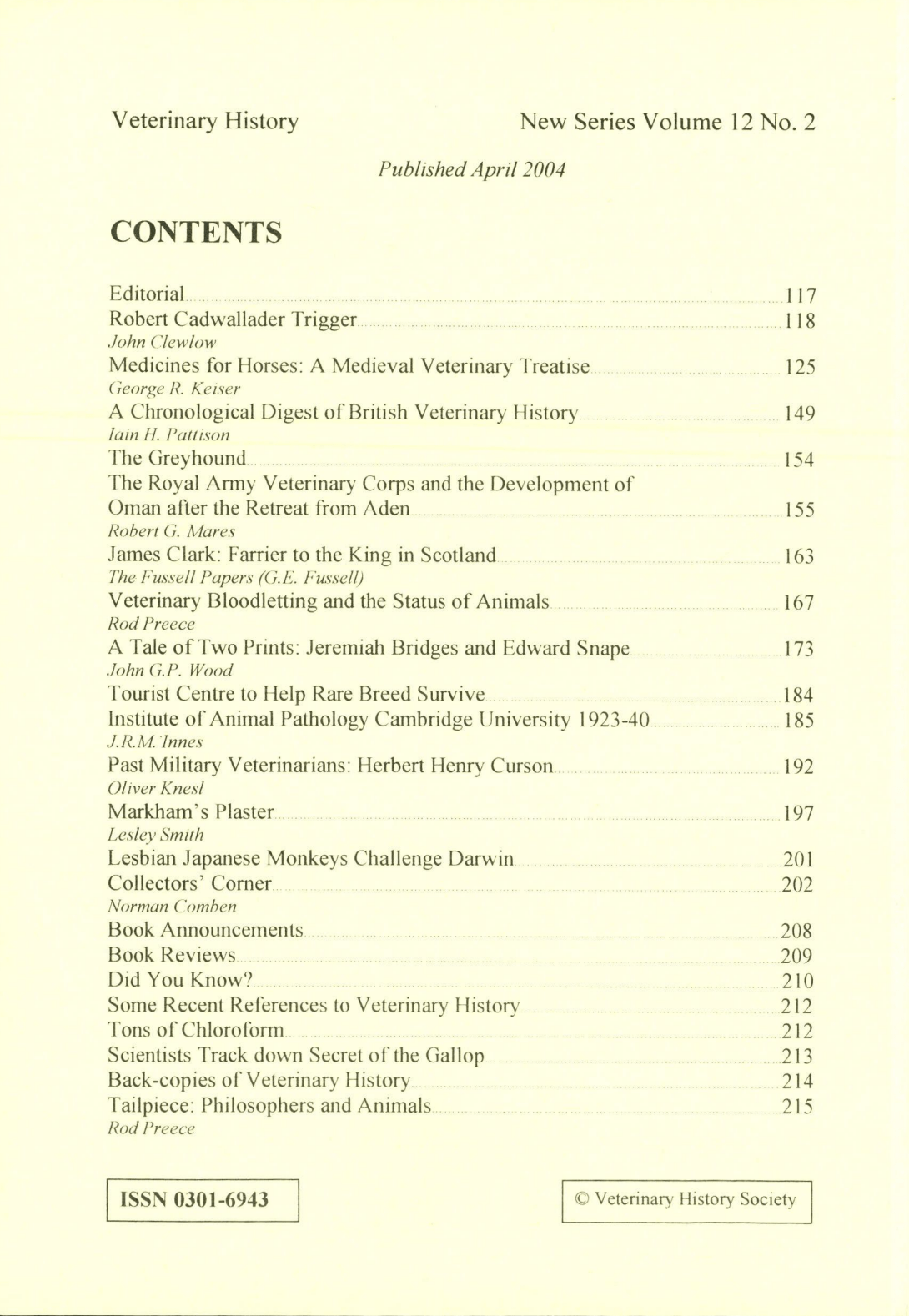
Robert Cadwallader Trigger JP FRCVS
Robert Cadwallader Trigger was born in 1848 and graduated from the RVC in 1870. He took over the practice in Newcastle-under-Lyme, which had been founded by Thomas Mayer. He was active in veterinary politics and became president of RCVS in 1896/7. He was also Mayor of Newcastle in 1910/11. He died in 1926. His nephew, William Trigger, qualified as a veterinary surgeon worked with him.
John Clewlow
Medicines for Horses. A Medieval Veterinary Treatise
A review of medieval veterinary literature, and an account of the relationship between William Caxton and Wynkyn de Worde. Gervase Markham’s writings often included other writers work and he is often accused of plagiarism. There are descriptions of John Fitzherbert’s Boke of Husbondrye and the Boke of Marchalsi. Proprytees and Medicynes of Hors was very popular and was printed by Wynkyn. Numerous excerpts from Markham’s Maisterpeece are given.
George R Keiser
A Chronological Digest of British Veterinary History, Part 4: 1849-1864
A chronological account of British veterinary history, including founding of New Edinburgh School by John Gamgee, the foundation of the Glasgow School by James McCall. Continuing disagreement between RCVS and William Dicks’ Edinburgh School. The devastating arrival of Cattle Plague in the UK occurred at this time.
Iain H Pattison
The Royal Army Veterinary Corps and the Development of Oman after the Retreat from Aden
An account of the part played by the British Army in the development of Oman was determined by the political events that led to Great Britain’s withdrawal from Aden in 1967. The provision of veterinary services is described, with veterinary staff available on call from Cyprus and Kenya. A permanent veterinary base was established in Dhofar, in Oman.
Robert G Mares
James Clark: Farrier to the King of Scotland
James Clark (c1734-1806) was the farrier to George III in Scotland, working in Edinburgh. He was an early advocate of proper veterinary education and was involved in an unsuccessful attempt to set up a school in Edinburgh in 1793-4. He was the author of a popular work, The Anatomy of the Horse, first published in 1776 and still in print in 1938.
G E Fussell
Veterinary Bloodletting and the Status of Animals
In ancient Greece, there was a concept, later called therophily, which gave animals a higher status than humans. However, a widespread view was espoused by Aristotle, who stated animals possessed material and mortal souls and Descartes who proclaimed animals to be machines, having no souls, material or immaterial. René de Cériziers acknowledged animal rationality but of an inferior kind. Democritus and Plutarch held the view that humans derived many skills and arts from animals Bloodletting is supposed to have been observed by sea-horses. An outline of the history of bloodletting is given.
Rod Preece
A Tale of Two Prints: Jeremiah Bridges and Edward Snape
An analysis of two prints showing a very similar image of the anatomy of a standing horse from the 1770s. Edwrad Snapes’s drawing appears to be a re-drawn copy of Jeremiah Bridges’s work. The original drawing appeared in a book by Carlo Ruini, from c 1598. There are variations in the quality of the drawings and in the accuracy of the anatomical captions. A comparison with the work of George Stubbs is considered.
John G P Wood
Institute of Animal Pathology Cambridge University 1923-40
The initial proposal for a centre for comparative pathology came from Professor Sir Clifford Albutt in the late nineteenth century. In 1909 land in Cambridge was acquired for a field laboratory for the investigation of farm animal diseases. This unit was later overseen by the Professor of Animal Pathology, J B Buxton, who was appointed in 1923. There was considerable expansion in the numbers of staff and the facilities over the next ten years. Initially, the staff shared facilities with the medical faculty. The major research projects included Tuberculosis – testing and vaccination, anaerobic diseases of sheep, cattle nutrition, variola, fowl paralysis and abortion in cattle.
J R M Innes
Herbert Henry Curson FRCVS DrMedVet (Hanover) 1892-1968
Herbert Henry Curson was born in 1892 in South Africa and qualified from the RVC in 1914.He returned to South Africa, where he worked for the state veterinary service. He was involved with research into Trypanosomiasis and Rinderpest. He obtained a doctorate from Hannover Tierarztliche Hochschule and was awarded a FRCVS in 1926. He joined the department of Native affairs in 1936, where he remained until retirement in 1952. He was a captain in the South African Veterinary Corps during WW2.
Oliver Knesl
Markham’s Plaster
Gervase Markham was born about 1568 was an adventurous and enthusiastic man fascinated by everything around him. He wrote many books on lots of subjects, including veterinary matters, although there was extensive plagiarism. His book The English Housewife was published in 1615. It contains a broad spectrum of useful knowledge for housewives. The author describes an experiment to recreate his plaster cast, which would be applied to a broken limb bone, following Markham’s recipe. The experiment was a success.
Lesley Smith
Please note
Buy now