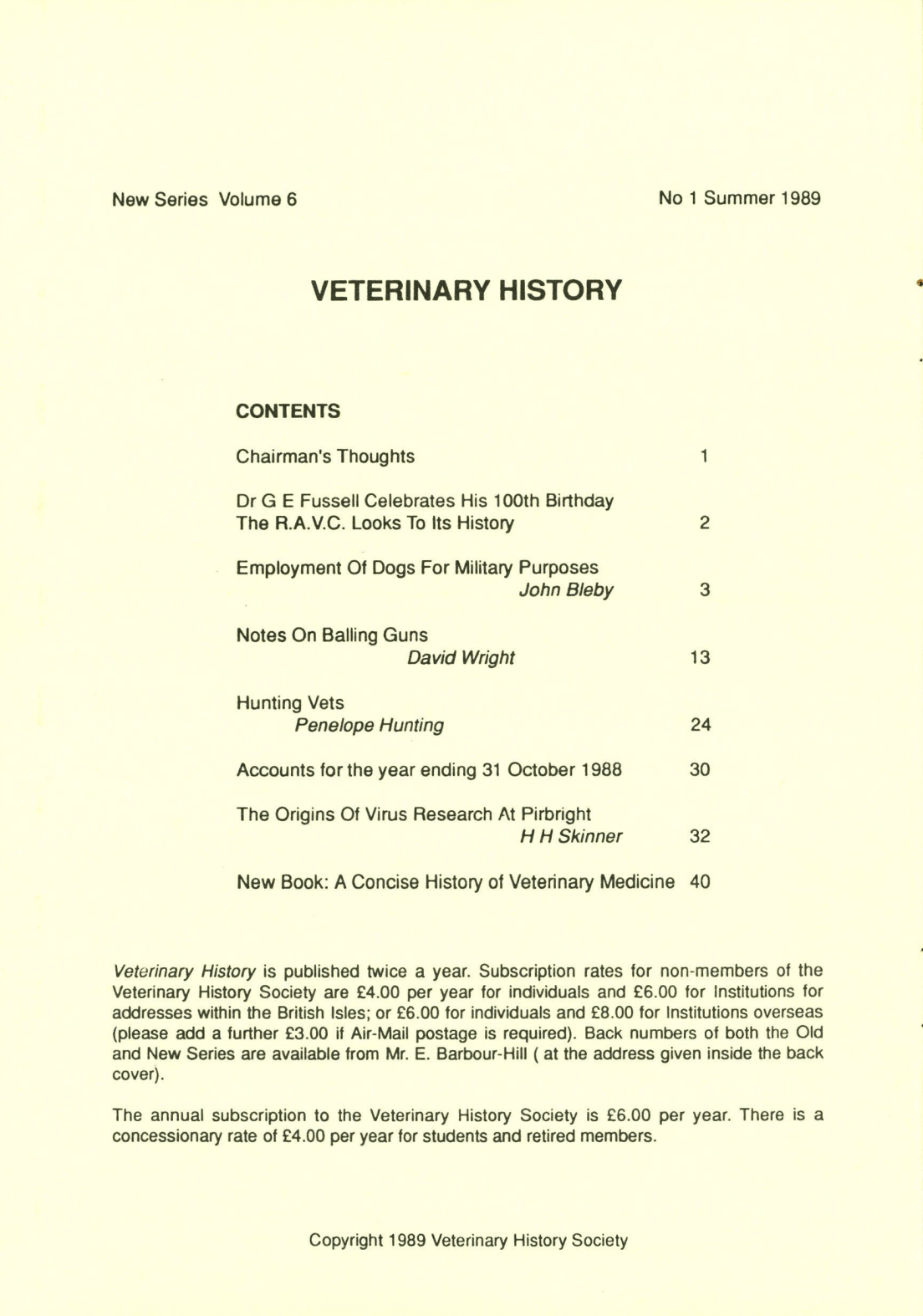
Employment of Dogs for Military Purposes
In 1889 E E Bennett presented a paper on the employment of dogs for military purposes. Bennett outlined five main uses of dogs by the army; as guard dogs, scout and reconnaissance dogs, despatch dogs carrying messages, ammunition carriers and as searchers looking for injured and killed soldiers. It was noted the German Army was much more advanced in their use of dogs than the British Army. In the years before the First World War, Edwin Richardson travelled widely observing the use of dogs by foreign forces. His advice led to the first use of dogs in WW1 was as messenger dogs trained at a base in Shoeburyness, later Lyndhurst and then Bulford. Another training school was set up at Aldershot in 1942 to train tracker dogs and guard dogs. The dog unit moved to its current home in Melton Mowbray in 1947. 1600 dogs were being used worldwide in 1989, 90 % employed to improve security.
John Bleby
Notes on Balling Guns
The balling gun is a device used to administer a solid medication. The first type to be identified is one designed by Joseph Goodwin in early 1800s. Two examples are in Wellcome Collection. John Weiss produced an ‘improved balling instrument’ in the 1820s. Weiss also patented a ‘veterinary syringe’, (which could be used as a stomach pump or enema) and a fleam. The first patented balling gun was registered by a farmer, Thomas Huckvale in 1852. Several other patented designs were created in 1870s, One of these designs, by James Arnold from 1872, was still being sold in 1954. Many of the balling guns are shown in illustrations.
David Wright
Hunting Vets
Charles Hunting gained his diploma from the London Veterinary School in 1850 after an early career as a groom. He took an appointment as a vet for a coal mining company in Durham. He was very successful investigating pleuropneumonia, devising new ways of feeding pit horse and ponies and contributing numerous articles to veterinary journals. He was later Vice-President of the RCVS and was involved in veterinary politics.
Charles’ second son was William Hunting qualified as a vet in 1865 and had a successful career in his father’s practice and later as Chief Veterinary Inspector for London. He founded the Veterinary Record in 1888. He the main force behind a plan to eradicate Glanders from the UK.
William’s brother, Charles Samuel Hunting founded the family’s shipping business, which became the Hunting Group of Companies.
Penelope Hunting
The Origins of Virus Research at Pirbright
The first premises was built at Pirbright in 1913 as a cattle testing station for TB. In 1925, it was taken over by the newly created group to research Foot-and-Mouth Disease, following an epizootic of 1922-24. Laboratory facilities had to be shared with Government Veterinary Laboratory at New Haw. The Pirbright Institute mainly dealt with FMD, but later investigating many other farm animal viral diseases.
H H Skinner
Please note
Buy now