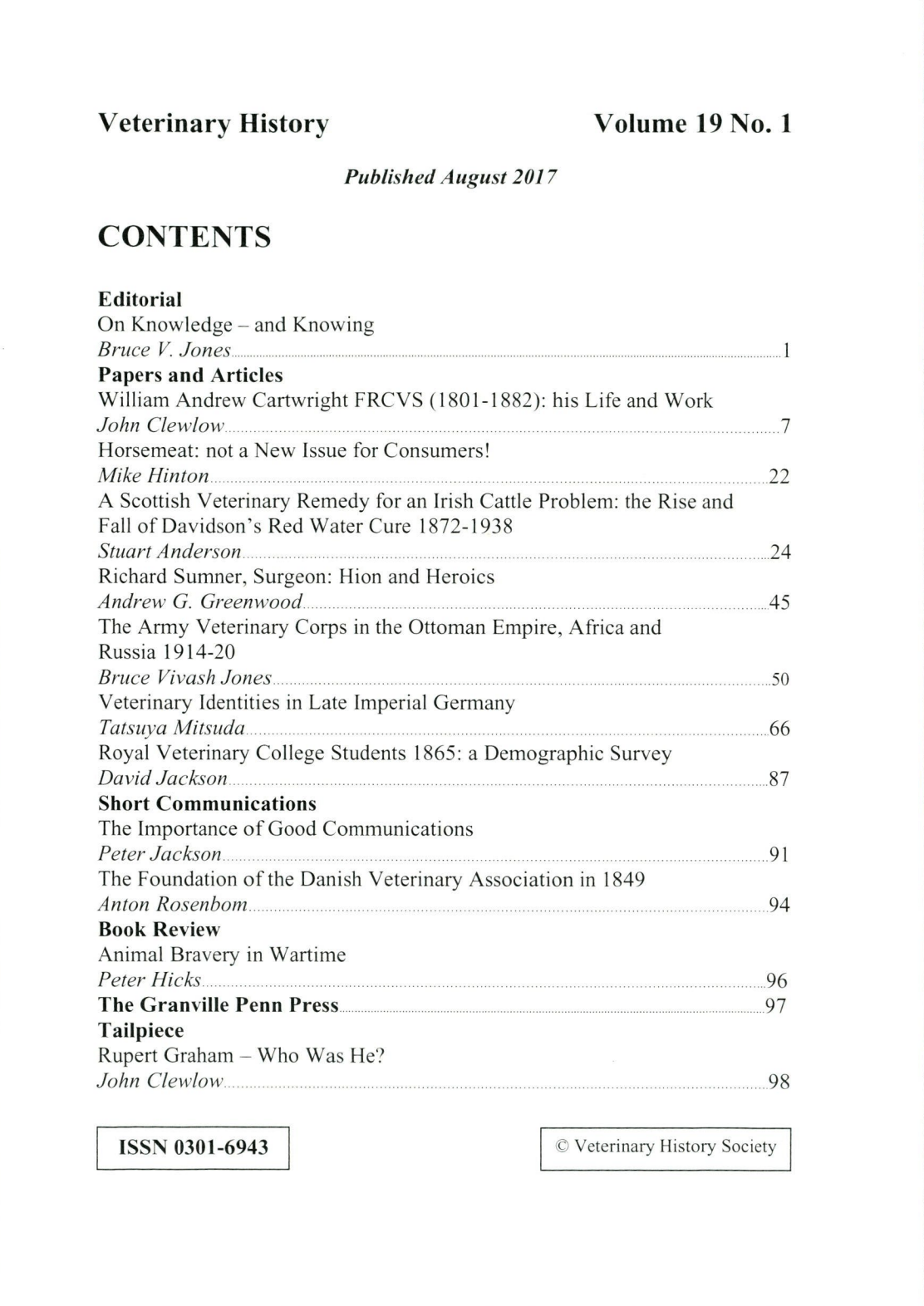
William Andrew Cartwright FRCVS (1801-1882): His life and Work
William Cartwright (1801-1882) was one of the earliest proponents of the concept of ‘One Health’. Raised in Shropshire, he was apprenticed to J M Hales, a veterinary surgeon with medical training. Qualifying from London Veterinary College in 1840, aged 39, he practised in Whitchurch where he described and recorded a wide range of conditions. He was a most prolific contributor to the Veterinarian over a period of 45 years, his contributions prevented its demise. A pioneer in veterinary obstetrics, he developed many original instruments for embryotomy. Cartwright also developed bespoke dental instruments for horses. A Vice President (1849) and Fellow (1877) of the Royal College of Veterinary Surgeons, he stressed the need for veterinary colleges to be strongly associated with farms as well as progressing the field of comparative anatomy.
John Clewlow
A Scottish Veterinary Remedy for an Irish Cattle Problem: The Rise and Fall of Davidson’s Red Water Cure 1872-1938
A consequence of the Irish Famine (1845) was a shift in Irish agriculture from crops to animals. As a sequel, the incidence of Redwater Fever (Babesiosis) increased significantly, driving a need for effective treatments.
Charles Davidson (, a pharmacist in Aberdeen was instrumental in developing and exporting his ‘Red Water Cure’. Containing linseed oil, turpentine, lavender oil, tar and red anchusa, it was first used in 1870 by Scottish farmers. In 1873 it was requested by a veterinary surgeon in Limerick. Advertised under trademark protection, and used widely in Ireland, it became a mainstay of veterinary treatment for the condition. This was reflected in sales, which remained buoyant until the 1920s. The demise of the cure over subsequent years was due to newer, more effective, treatments being developed, combined with political turmoil and economic crises. By the outbreak of World War 1 only small quantities of the cure were being produced.
Stuart Anderson
Richard Sumner, Surgeon: Hion and Heroics
Richard Sumner (1797-1884) pursued careers in both veterinary medicine, and medicine, serving as a surgeon in Formby, Lancashire. He pursued his interests in veterinary medicine and published a small treatise in 1833 ‘Every Farmer, His Own Farrier and Cattle Doctor’ which described a range of conditions in cattle and horses. Amongst these was ‘hion’ or clostridial myositis. Sumner is perhaps best remembered for his service with the Formby lifeboat, where, in 1833, he was awarded a Royal Humane Society Gold Medal for his actions in rescuing nine men from a pilot launch stranded in a storm.
Andrew G Greenwood
The Army Veterinary Corps in the Ottoman Empire, Africa and Russia 1914-20
During the Great War (1914-1919) the Army Veterinary Corps was deployed to 13 territories outside of the main seat of conflict in Northwest Europe. These included the Near and Middle East, Southern and Eastern Africa and Russia.
This article describes the deployment of veterinary staff and animals to these various sites of conflict, highlighting the challenges not only from the environments and from battlefield actions, but also the threats to man and animals from both infectious and non-infectious diseases.
Bruce Vivash Jones
Veterinary Identities in Late Imperial Germany
In Imperial Germany veterinary schools were established in 1778-90, but there was a reluctance by the medical profession to be involved with the early development of the veterinary profession. It was left to the miliary to provide support. The result was that many veterinarians were subsequently employed by the military. Later, there was greater employment in the state service, where poor rates of pay acted as an incentive for veterinarians to work in private practice. As the profession developed there was a greater input into public health and meat inspection, and subsequently veterinary involvement in animal breeding.
Tatsuya Mitsuda
Royal Veterinary College Students 1865: A Demographic Survey
In 1865, 33 men graduated from the Royal Veterinary College. Most had come from South-East England and East Anglia, with one each from Wales and Ireland, but none from Scotland. Most men qualified in their early twenties, with an age range of 18-26. After qualifying most only moved a short distance from their first address on qualifying; migration over long distances was an exception. Nearly half of the graduates had a family link with the veterinary profession. Many later undertook additional employment outside the profession, for example, chemist, hotel keeper, auctioneer, joiner, railway clerk and pawnbroker.
David Jackson
The Importance of Good Communications
In 1867 Professor Armatage, making use of rules developed by members of the medical profession, suggested a set of rules for clients. He proposed the rules should be hung in practices and stables and should have ‘conspicuous headings’. Clients should always send a written note requesting a veterinary surgeon, should state the address and name of the sender, and should always send early in the morning. Messages should convey information as the nature of the ailment, and clients should not allow the case to run into the night. Clients should avoid ‘doctoring the case’. Sunday calls were to be avoided, and when a veterinary surgeon arrives the object of the call should be explained in as few words as possible. Information relating to the cause of illness must never be withheld. If clients are not satisfied with the progress of the case they were instructed not to seek a second opinion.
PGG Jackson
The Foundation of the Danish Veterinary Association in 1849
The Danish Veterinary Association was the first national veterinary association. It was founded in 1849 in Copenhagen by David Ringhein, Chief of the Army Veterinary Corps. The first meeting was held that year, attended by 28 veterinarians. The association proposed the establishment of a ‘Veterinary Health Council’ to serve as the highest national authority in veterinary cases, and was inaugurated in 1850. There was a focus on the role of veterinarians in provision of public health. The association continued to develop and by 1908 it comprised 20 local unions.
Anton Rosenbom
Please note
Buy now