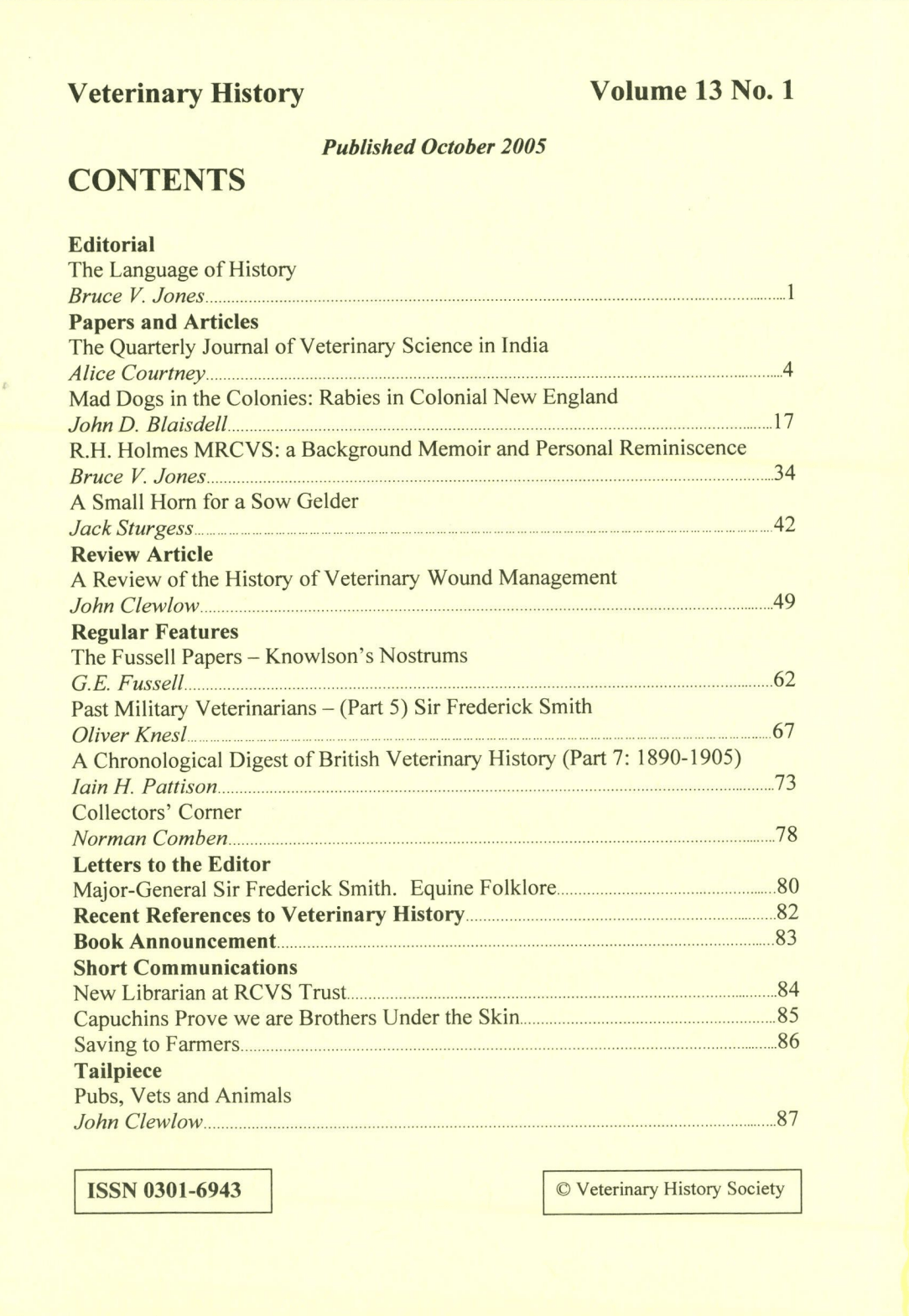
‘The Quarterly Journal of Veterinary Science in India’ and Army Medical Management
The first of five articles focussing on horse breeding in colonial India. ‘The Quarterly Journal of Veterinary Science in India’ was the first veterinary periodical published in India. There were eight volumes between 1883 and 1890, of four editions of about 400 pages. It was established by two British army vets, Frederick Smith and John Henry Steel, later joined by John’s father Charles Steel. Smith and Steel both graduated from the RVC and both had distinguished academic records. They qualified in 1876 and 1875 respectively. J H Steel published the first text on elephant veterinary medicine in a series of articles in this journal, later published as a book. The journal was very supportive of the two veterinary schools – Bombay Veterinary College and the Lahore Veterinary College.
Alice Courtney
Mad Dogs in the Colonies: Rabies in Colonial New England
The records for the history of Rabies in colonial North America are poor and inconsistent. An outbreak of a fatal condition affecting horses in 1767 in New England was thought to be Rabies, but was most likely to be equine influenza. An account is given of a real Rabies outbreak of 1769/70 and there are numerous newspapers reports of mad dogs. Control was mainly by slaughtering stray dogs. There was a misconception that any dog that bit was rabid and any person bitten would develop Rabies. This led to a lot of mis-diagnosis in people. A detailed account of an affliction suffered by a farmer known only as William, is given.
John D Blaisdell
R H Holmes MRCVS: A Background Memoir and Personal Reminiscence
A personal reminiscence of Raymond Hector Holmes by the author. Holmes was a vet in general practice in Totterridge, London.
Bruce V Jones
A Small Horn for a Sow Gelder
An investigation of the term ‘sow-gelder, which is recorded in several early nineteenth century sources. It describes a man who gelds (spays) sows. William Youatt in his 1847 book on the pig describes how the procedure is carried out – through a flank incision and an ovariectomy is carried out. The author gives two examples where a man tried to geld his wife or daughter.
Jack Sturgess
A Review of the History of Veterinary Wound Management
A history of veterinary wound treatments from classical times to the late nineteenth century. Classical writers such as Carto and Columella advocated removing diseased tissue and applying mixtures of wine, urine, and oils. This was the basic approach throughout history., Unlike internal medicine where symptoms of one condition merged with those of another, a wound was much more obvious, with a known cause and could be closely monitored during healing period. There was a general appreciation of the need for cleanliness with regular washing and using wine, vinegar and herbal concoctions to flush the wound. The wound was often covered with a grease or wax based compound to act as a barrier. Poultices were common from later seventeenth century. Suturing was popular by the nineteenth century; also, commonly were setons, where pulling a thread through the affected area to encourage drainage and healing.
John Clewlow
Knowlson’s Nostrums
John C Knowlson was a cattle doctor in Yorkshire in mid-eighteenth-early nineteenth centuries. At the age of 74, he published ‘the Yorkshire Cattle Doctor and Farrier’ The first edition sold 22,000 copies. It was full of treatments and advice about conditions affecting cattle and horses.
G E Fussell
Major-General Sir Frederick Smith KCMG CB FRCVS (1857-1929)
Frederick Smith was born in 1857 and graduated from the RVC Iin 1876.He joined the Royal Artillery and was posted to India in 1877. During his time in India, he published many papers and a pamphlet on saddles and sore backs. In 1886, he returned to the UK and was appointed to the Army Veterinary School at Aldershot, when he published books in hygiene and physiology. He returned to the regimental duties in 1892 and saw service in the Nile Expedition of 1898 and the Boer War. He was very critical of the very poor provision of veterinary care for the animals used in the Boer War. In 1906, he was appointed Director-General of the Army Veterinary Service. He retired in 1910, but was recalled in 1914 to the Army Veterinary Corps and was part of the very successful provision of veterinary services during the war. He retired again in 1919, after having been knighted in 1918. During retirement he devoted his attentions to veterinary history, first of the army and then his classic ‘Early History of Veterinary Literature’. He died in 1929.
Oliver Knesl
A Chronological Digest of British Veterinary History, Part 7 1890-1905
An account of the major developments in British veterinary history during this period, including the discovery of tuberculin and its use in control of TB, the discovery of the cause of Glanders Brucella mallei, expansion of veterinary training to four years and major developments at RVC. The first x-ray of an animal, the appointment of the first Chief Veterinary Officer, the foundation of the Dublin Veterinary School and the first International Tuberculosis Congress.
Iain H Pattison
Pubs, Vets and Animals
A brief account of pub names related to animals
John Clewlow
Please note
Buy now