A Memoir William Williams FRSE FRCVS JP
William Williams was born in North Wales in 1842. At 17, he became a pupil of a local veterinary surgeon. Three years later, he developed symptoms of consumption and decided to go to the gold diggings in Australia to improve his health. He returned in 1855 and enrolled at the Edinburgh Veterinary College, where he was an exceptional student winning a gold medal and qualifying in 1857. He set up a veterinary practice in Bradford and was very successful for the next ten years. He was then appointed principal of the Dick Vet School in Edinburgh, but he resigned in 1873 after disagreements with the trustees. He set up his own veterinary school in Edinburgh in Gayfield Square, the New Veterinary College, where he worked until his sudden death in 1900. His son, William Owen Williams, moved the New Veterinary College to Liverpool in 1904 and it became part of the University of Liverpool.
Jacqueline Williams
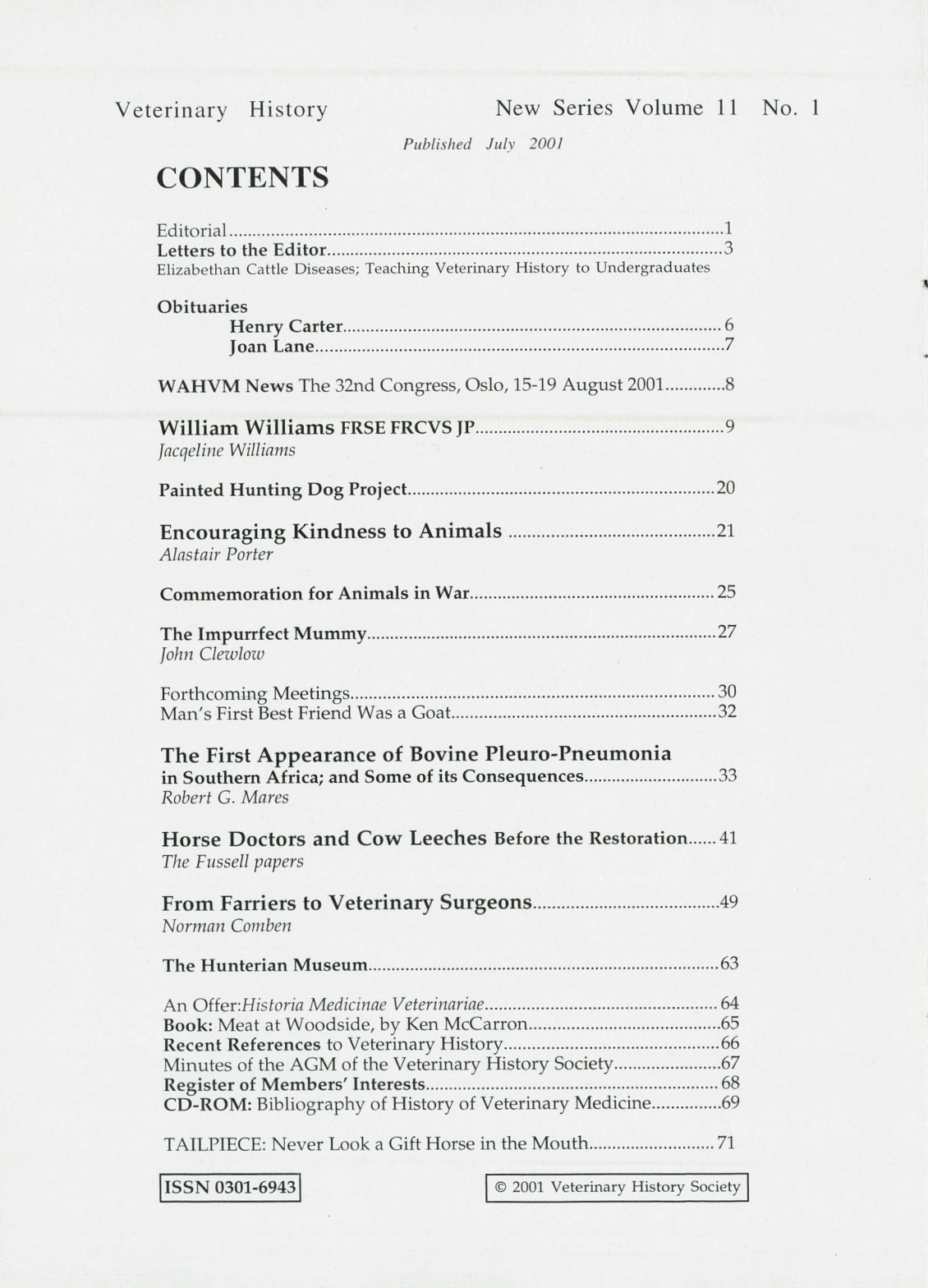
Encouraging Kindness to Animals
A history of the ‘Our Dumb Friends’ League’, which later became the Blue Cross. The league was founded in 1897 in London and opened its first animal hospital in 1906, providing treatments for animals of owners in need. During the Great War, they worked with French Army providing care for their horses.
Alastair Porter
The Impurrfect Mummy
An x ray was taken of an Egyptian mummified cat from the’ late period’ (747-332BC) and revealed a cat’s fore leg without a scapula and nothing else. This is a common finding in animal mummies.
John Clewlow
The First Appearance of Bovine Pleuropneumonia in Southern Africa and Some of its Consequences
Bovine Pleuropneumonia was first recognised in Hesse, Germany in 1693 and spread swiftly all over Europe. The disease arrived in south Africa in 1853 and by 1856 had spread to Transkei, where the Xhosa people started killing their cattle. There was a tale of a young girl claiming to have seen her ancestors and imagined they ordered the Xhosa to kill their cattle. This prophecy divided the Xhosa into believers and unbelievers. The chief, Sarhill, was a believer and ordered the slaughter of the cattle, with the consequences of suffering and privation. The reasons for the killing remain unresolved.
Robert Mares
Horse Doctors and Cow Leeches before the Restoration
An account of farriery writers in England before 1660. Their writings included treatments. Gervase Markham was the dominant figure with his numerous books, which were reprinted throughout the century. A description is given of his bloodletting techniques. Other writers of this time included Thomas Grymes, John Crawshey and Thomas de Gray.
G E Fussell
From Farriers to Veterinary Surgeons
An examination of the early history of veterinary publishing in the English language and some early bibliographic sources in this field. Writers include Thomas Blundeville, Leonard Mascall and Gervase Markham.
Norman Comben
Please note
Buy now