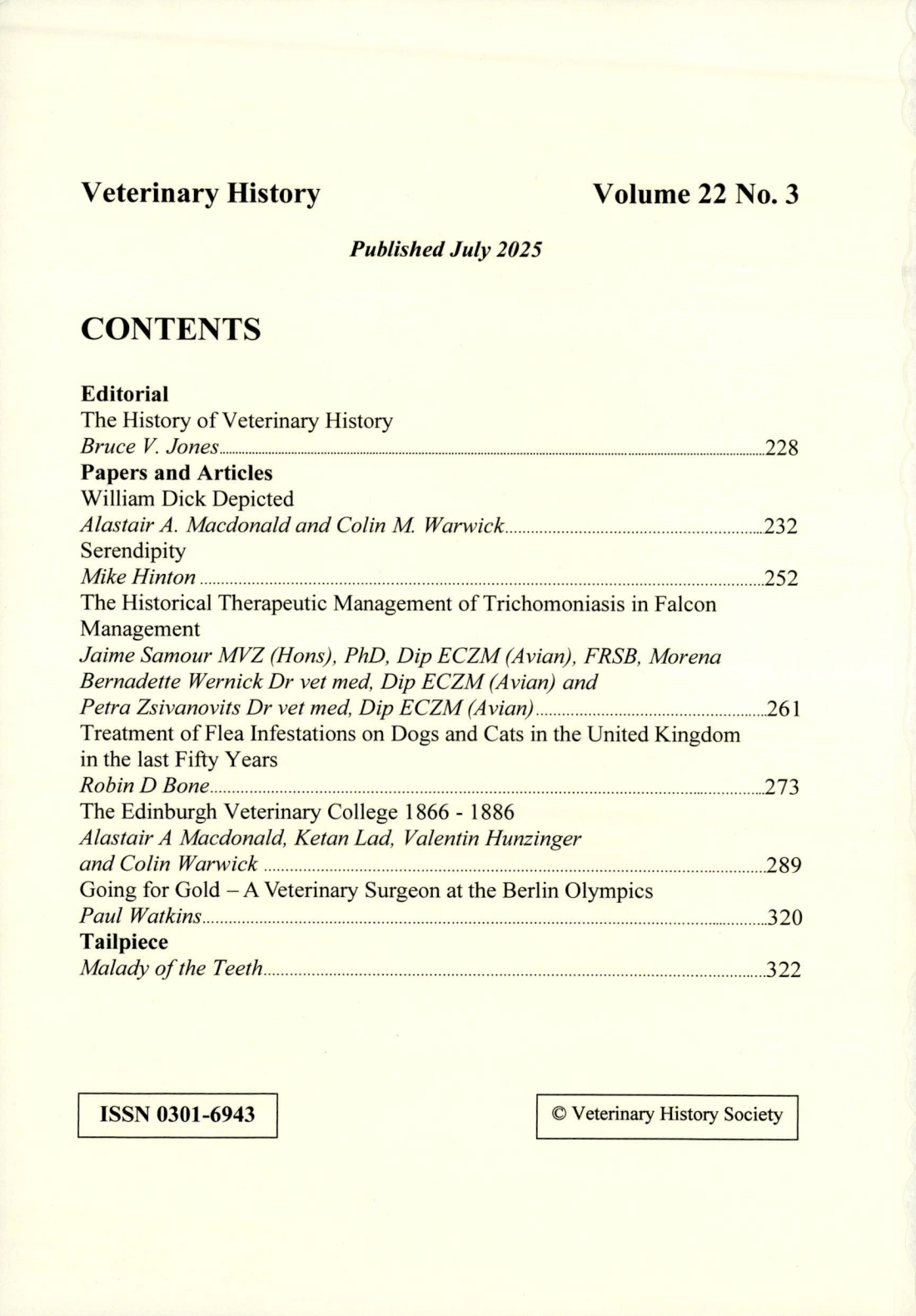
William Dick Depicted
A description, illustration and discussion of thirteen paintings, sculptures and a stained-glass image of William Dick. He was the founder of the Edinburgh Veterinary College, now known as the Royal (Dick) School of Veterinary Studies. The art works date from all stages of his life between the ages of 40 and c70 years old.
Alastair A Macdonald and Colin M Warwick
Serendipity
Francis Beckford Ward was born in 1820 and commissioned into the Royal Artillery in 1839 and promote to brevet major in 1855. He served in the Crimea between 1855 and 1856, from where, he wrote eighty letters to his parents. He married in 1859 and his wife’s sister was the mother of Aleen Cust, the first women to be admitted to membership of the Royal College of Veterinary Surgeons in 1922. The Crimean war records of other members of the Cust family are described. The letters mentioned above, also show a relationship to Rodolph de Salis, who was present at the Charge of the Light Brigade. The horse Drummerboy, ridden by de Salis, was presented with an engraved Crimean War Medal, due to his loyalty and bravery. Ward’s pistol from the Crimean War was found in an antique shop in Little Bookham and the parish church has two large memorials to Lord Raglan, who commanded the British army in Crimea.
Mike Hinton
The Historical Therapeutic Management of Trichomoniasis in Falcon Management
Trichomoniasis is a common condition affecting birds and in falcons appears to be associated with feeding these birds pigeons. The condition has been called Frownce, Frounce and Canker. The authors look at some early sources of descriptions of this condition and the various remedies suggested. Sydney Latham, whose two books on falconry were published in 1633 and 1662. Dame Juliana Berners was renowned for her toe books of 1486 ands 1559.Gervase Markham published revised editions of Berners’s works in 1595 as well as his own books in 1654 and 1683. Muhammad ibn Abdallah al-Bazyar was writing in the 9th century gives many suggested chemical and herbal remedies for this condition. Two other authors mentioned are Johann Salomon Schűlin, Dancus Rex and Demetrius.
Jaime Samour, Bernadette Wernick and Petra Zsivanovits
Treatment of Flea Infestations on Dogs and Cats in the United Kingdon in the Last Fifty Years
An account of the developments in the treatment of fleas in dogs and cats since the 1970s in the UK. Most of the earlier products contained organophosphates, which were later recognised as being toxic to the pets, owners and the environment. They were all eventually removed from the market, especially following European Union regulations. The earliest effective treatment was the spray Nuvan Top. Various shampoos and powders were available but very little persistence on the pet and so were ineffective. Spot on preparations started to appear in the early 1990s.The two market leaders Frontline and Advantage both appeared in 1997. In the mid-2000s, combined products started to appear combining two or more active ingredients to kill nematodes, lice and mites, in addition to fleas. Full list of products available, for flea treatment, in 1984 and 2016 are given.
Robin D Bone
The Edinburgh Veterinary College 1866-1886
Following the death of William Dick, the management of the Edinburgh Veterinary College passed to the Lord Provost, Magistrates and Councillors of Edinburgh. Who had no experience of running a veterinary school, but they produced a set of rules and regulations in 1873, reprinted here in full. There was a high turnover of principals and academic staff, of the college, over the next twenty years or so. William Williams resigned and took forty students to found the New Veterinary College. In 1867 there was petition from the staff and some students about the poor quality of the buildings of the college and various suggestions were made as to the improvements required. The trustees rejected the petition’s requests. Various alterations were made to the layout of the college buildings in the 1870s and 1880s, which are given here in some detail with plans. The commission and erection of a statue of William Dick is described.
Alastair A Macdonald, Ketan Lad, Valentin Hunzinger and Colin M Warwick
Going for Gold – A veterinary Surgeon at the Berlin Olympics
Kenneth Iriam Barlow was born in 1908 and commissioned into the RAVC in 1934. He was selected to be the official vet at the Berlin Olympics in 1936. He attended the opening ceremony, raising his hat instead of giving a Nazi salute. He looked after the three-day eventing and show-jumping teams.
Paul Watkins
Please note
Buy now