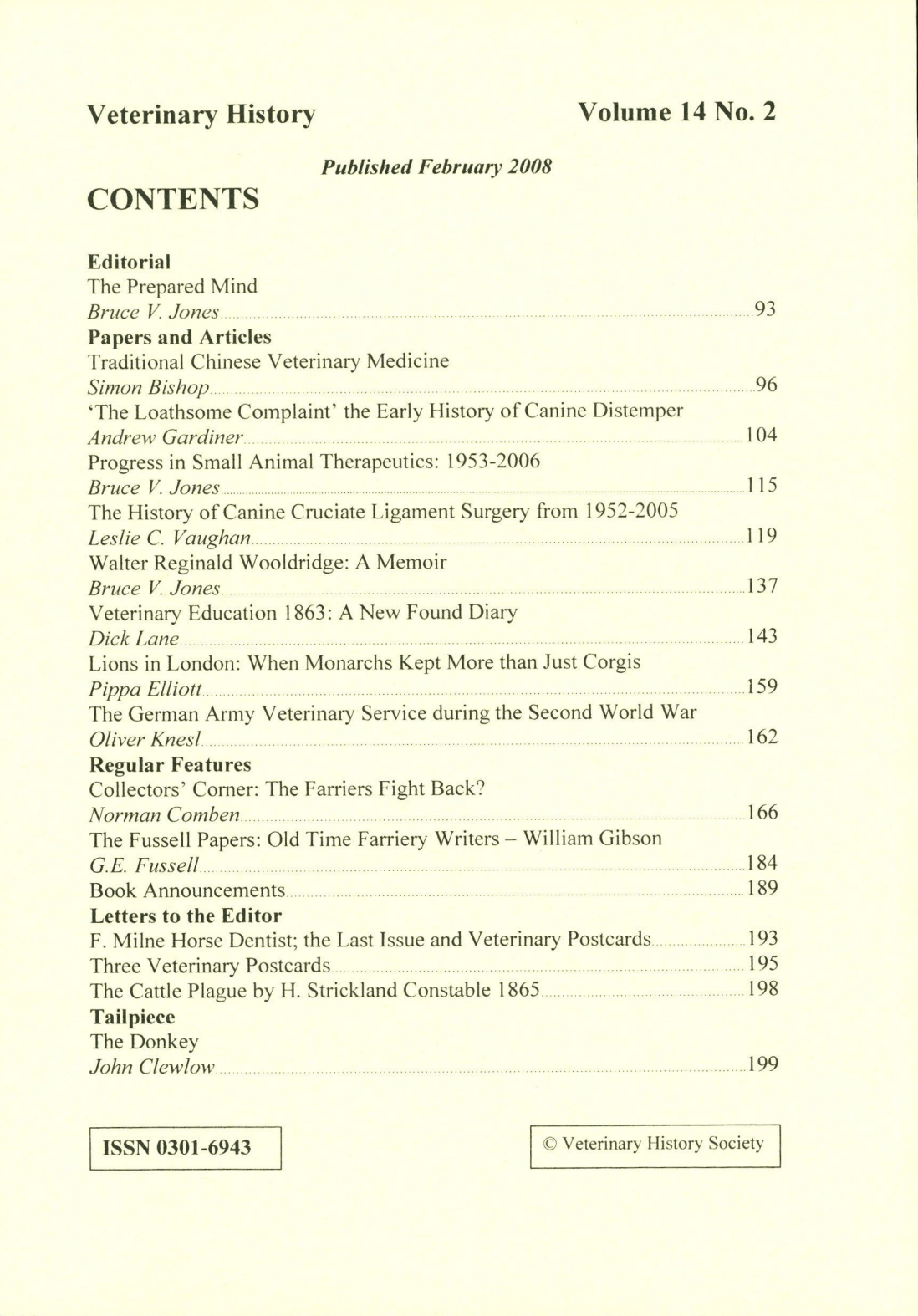
Traditional Chinese Veterinary Medicine
Traditional Chinese Medicine (TCM) is part of the Chinese philosophy of Ying and Yang, with functional disease related to Yang and organic disease related to Ying. The two main methods of treatment are acupuncture and Herbal medicine. A veterinary school was set up in the Tang dynasty (AD 618-907), which was probably the first in the World. Treatment was mainly for horses. Veterinary publications appeared from the Tang dynasty onwards. Western medicine started to displace TCM in the seventeenth century. From 1955 veterinary TCM re-emerged strongly and ancient classical veterinary texts were republished. In 1972 an attempt was made to combine TCM and western medicine in a textbook. In 1977, the first English language acupuncture text was published.
Simon Bishop
‘The Loathsome Complaint’: The Early History of Canine Distemper
A major dog epizootic, identified as Distemper, spread across Europe in 1760/1. Distemper was not recorded in Britain prior to 1760. It was possibly introduced to Europe with a group of dogs imported into Spain from Peru, where the disease had been seen since mid-1740s, just before the outbreak started. There had been similar disease described in the previous decade in various parts of Europe. In 1809, Edward Jenner made a study of the disease describing its symptoms and pathology, noting that it was not zoonotic. William Youatt and Delabere Blaine can be regarded as the founders of British small animal practice. They were both interested in Distemper and they noted the variations in the manifestation of the disease. Blaine appeared to recognise there was no cure for Distemper, but marketed his own remedy, which was popular.
Andrew Gardiner
Progress in Small Animal Therapeutics: 1953-2006
An account of the pharmaceutical listed in the British Veterinary Codex of 1953, the product of collaboration between the Pharmaceutical Society, RCVS and BVA. 431 products were included as monographs, although 1000 products were listed. Twelve immunological products are listed, 6 antisera and vaccines for Feline Panleucopenia, Distemper and canine Leptospirosis. Cocaine, Morphine, Arsenic and Strychnine are all listed with no precautions listed for handing and use. Five antibiotics are discussed – chlortetracycline, oxytetracycline, chloramphenicol, penicillin and Streptomycin. Anaesthetic agents included ether, barbiturates, chloroform and cyclopropane. Comparison with 2006, shows the massive expansion in parasiticides, especially flea control and also in the range of conditions for which vaccination is available. Two additional categories are treatments for cardiac and arthritic conditions.
Bruce V Jones
The History of Canine Cruciate Ligament Surgery from 1952-2005
A history of the management of cranial cruciate ligament rupture in dogs. Damage to the internal structures of the stifle was first described in horses in late nineteenth century. Stifle injuries in dogs were first described in 1906, although recognition of rupture of the cruciate ligament was not identified until 1926. The diagnostic ‘drawer’ symptom was described in 1941. Paatasma, in Finland, in the early 1950s attempted internal stifle surgery and developed the technique of a band of fascia and threaded through bone tunnels and fixed. Many studies were carried out on modifications of this technique, using different graft materials including nylon strands. The next technique to be developed was the lateral suture from fabellae to tibial crest – ‘imbrication’. The ‘over-the-top’ technique was developed in the 1980s. TPLO was a very different approach, much more surgically invasive, became established in the 1990s.
Leslie Vaughan
Walter Reginald Wooldridge. A Memoir
Walter Reginald Wooldridge (Reg) was born in 1900 and graduated from the RVC IN 1924. In 1926, he went to a research position at Cambridge University achieving a PhD in 1928. He went to work at the London School of Hygiene and Tropical Medicine as a lecturer in biochemistry. In 1942 he founded the Veterinary Education Trust, hoping to raise a million pounds. Initial fundraising allowed the sponsorship of research fellowships. In 1946 he became scientific director of the newly named Animal Health Trust. Four research stations were set up to study horses, dogs and cats, farm animals and poultry. He was on the Loveday Committee, which was examining veterinary education and led to the 1948 Veterinary Surgeon’s Act. Wooldridge died in 1966.
Bruce V Jones
Veterinary Education 1863: A New Found Diary (George Williamson)
This is an account of the discovery of a very rare veterinary student’s diary from 1863. It was written by George Williamson, who had entered the RVC in July 1862 after serving an apprenticeship. He describes the lectures and practical sessions, listing all ninety-five lectures of the second term. He is interested in small animal medicine and is disappointed at the lacking of teaching in this area. He leaves the college without sitting his final examinations and travels to China, possibility related to disappointment about his employment prospects. The diary also has an account of the long sea voyage.
Dick Lane
Lions in London: When Monarchs Kept More Than Corgis
Keeping exotic animals in London started in 1235, with a gift of two lions to Henry III from Frederick III, Holy Roman Emperor. Henry III also had a polar bear and an elephant.
Pippa Elliott
The German Army (Wehrmacht) Veterinary Service during the Second World War: Russian Front
A description of some papers relating to Corporal Friedrich Spilker, who served with the German Army during the Second World War. Veterinary graduates had to complete a year’s military training before being seeing active service. Spilker took part in Operation Barbarossa, the German invasion of Russia in 1941. He was killed in 1942. There is a short account of the work of veterinary officers in the German Army.
Oliver Knesl
The Farriers Fight Back? Opposition to the New Veterinary College
A brief account of the foundation of the London Veterinary College by Granville Pennand and Charles Benoit Vial de St Bel (Sainbel). The farriers were very disappointed about this veterinary college as they had been led to believe a national farriery school was going to be established, following the support form the Odiham Agricultural society. The farriers had been the main source of veterinary attention for horses and they were concerned the new veterinary graduates would be competing for this work. A set of prints were produced attempting to ridicule the new college and professor Sainbel and are illustrated in the article.
Norman Comben
Old Time Farriery Writers: William Gibson. Cavalry Surgeon in Queen Anne’s Reign
William Gibson, trained as a surgeon, saw service in the Cavalry of Queen Anne. He appears to be the first medical doctor to apply the science of medicine to cure of equine diseases and injuries. After the war he opened a veterinary practice in London and spent forty years working until his death in c1750. He published several books on farriery and equine diseases, which were popular and had several editions.
G E Fussell
Please note
Buy now