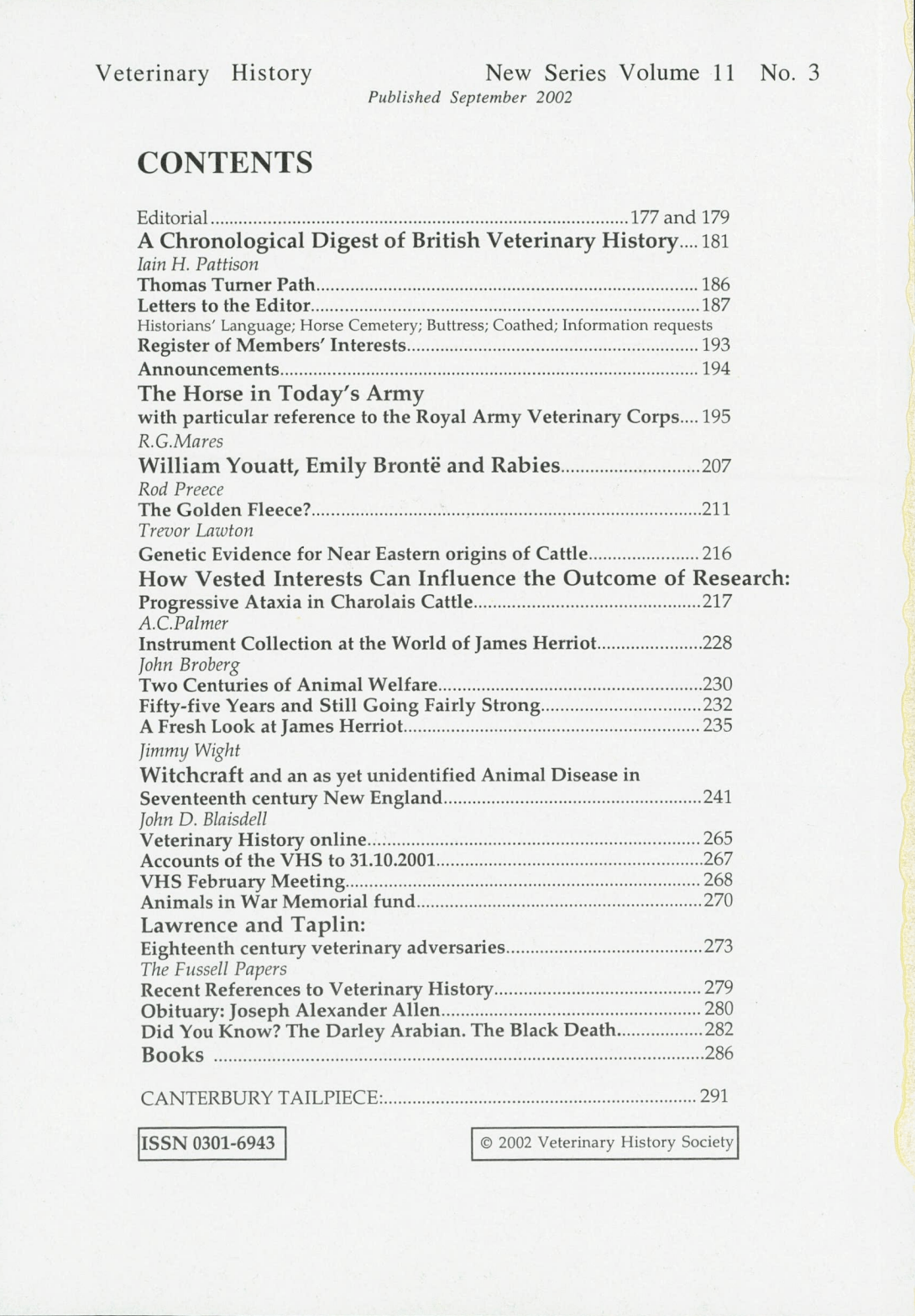
A Chronological Digest of British Veterinary History, Part 1: 1762-1839
A chronological list of the main developments in veterinary history from 1762 to 1838. This covers the foundation of the first veterinary college in Lyons in 1762, the foundation of the London School, the death of St Bel and the appointment of Edward Coleman, appointment of veterinary surgeons for the army, the foundation of William Dick’s school in Edinburgh, and development of the RVC.
Iain H Pattison
The Horse in Today’s Army, with particular reference to Royal Army Veterinary Corps
A history of the use of horses by the British Army from 1961 onwards. The uses for horses in the army are listed, including patrol work at Aldershot, travel in difficult terrain overseas (Malaya, Bosnia, East Timor), ceremonial duties with Blues and Royals, Royal Horse Artillery. The defence animal centre is based at Melton Mowbray, where training for army riding is carried out and also for farriery courses. An account is given of the IRA bombing in 1982 at Hyde Park, London.
Robert G Mares
Willia M Youatt (1776-1847), Emily Brontë (1818-1848) and Rabies
William Youatt was an advocate of the use of hot cautery being applied to the bite wound from a rabid dog as a means of preventing infection. This method was also described by Charlotte Bronte in her novel, Shirley, and attributed, by Elizabeth Gaskell in her ‘Life of Charlotte Bronte’, as having been used by Emily Bronte after a bite form her own dog, Tartar.
Rod Preece
The Golden Fleece?
A review of the current status of Herdwick Sheep in the Lake District after the Foot-and-Mouth epidemic of 2001. There was a project to save the unique blood line of Herwick sheep during the FMD outbreak with the storage of frozen embryos. A heritage Gene Bank is to be set up of all the 80 or so UK sheep breeds. There are 29 breeds at risk of dying out.
Trevor Lawson
How Vested Interests can Influence Outcome of Research: Progressive Ataxia of Charolais Cattle
Progressive ataxia was first recognised in the Uk in 1971 affecting an imported Charolais cattle. The pathological findings were published in 1972 and 1976. The first recorded case in France was from 1976 but no further cases were reported for another four years. The condition was identified in USA and Canada in imported French Charolais cattle at this time. There was a marked reluctance of French authorities to acknowledge the existence of this, potentially inherited, condition in Charolais cattle. In 1981 a heifer was returned to France suffering from Progressive Ataxia. This was greeted by indignation from French vets and breeders at the criticism of their national breed, despite the clinical and pathological evidence having been published. The last case was seen in the UK in 1995, which was the first for fourteen years. The inheritance of the condition was never proved and the incidence appears to have diminished as a result of selective breeding.
A C Palmer
A Fresh Look at James Herriot
A personal account of the life of Alf Wight (James Herriot) by his son Jimmy Wight. Memories of living above the surgery and veterinary work in the 1950s and 1960s are given. There is a description of some of the instruments on display at the museum created in the old veterinary surgery. Some anecdotes about Donald Sinclair (Siegfried Farnon) and his idiosyncrasies are recounted.
Jimmy Wight
Witchcraft and an, as yet unidentified, Animal Disease in Seventeenth-Century England
An examination of witchcraft cases in new England from 1648 to 1692 show that several of the cases involved accusations of causing disease outbreaks in fam animals. The affliction was similar in most cases with neurological signs and convulsions being the more dramatic symptoms. It mainly affected cattle and pigs but sheep and horses could also be affected. The author suggests Pseudorabies as being the most likely cause. Several court cases are described, including the many court appearances of John Godfrey of Massachusetts from 1659 to 1675.
John D Blaisdell
Lawrence and Taplin Eighteenth Century Veterinary Adversaries
John Lawrence and William Taplin were two veterinary writers from the late eighteenth century. They were inveterate enemies, and did not hesitate to express their mutual hatred and contempt. They mainly accused each other of plagiarism of other writers’ work.
G E Fussell
Please note
Buy now