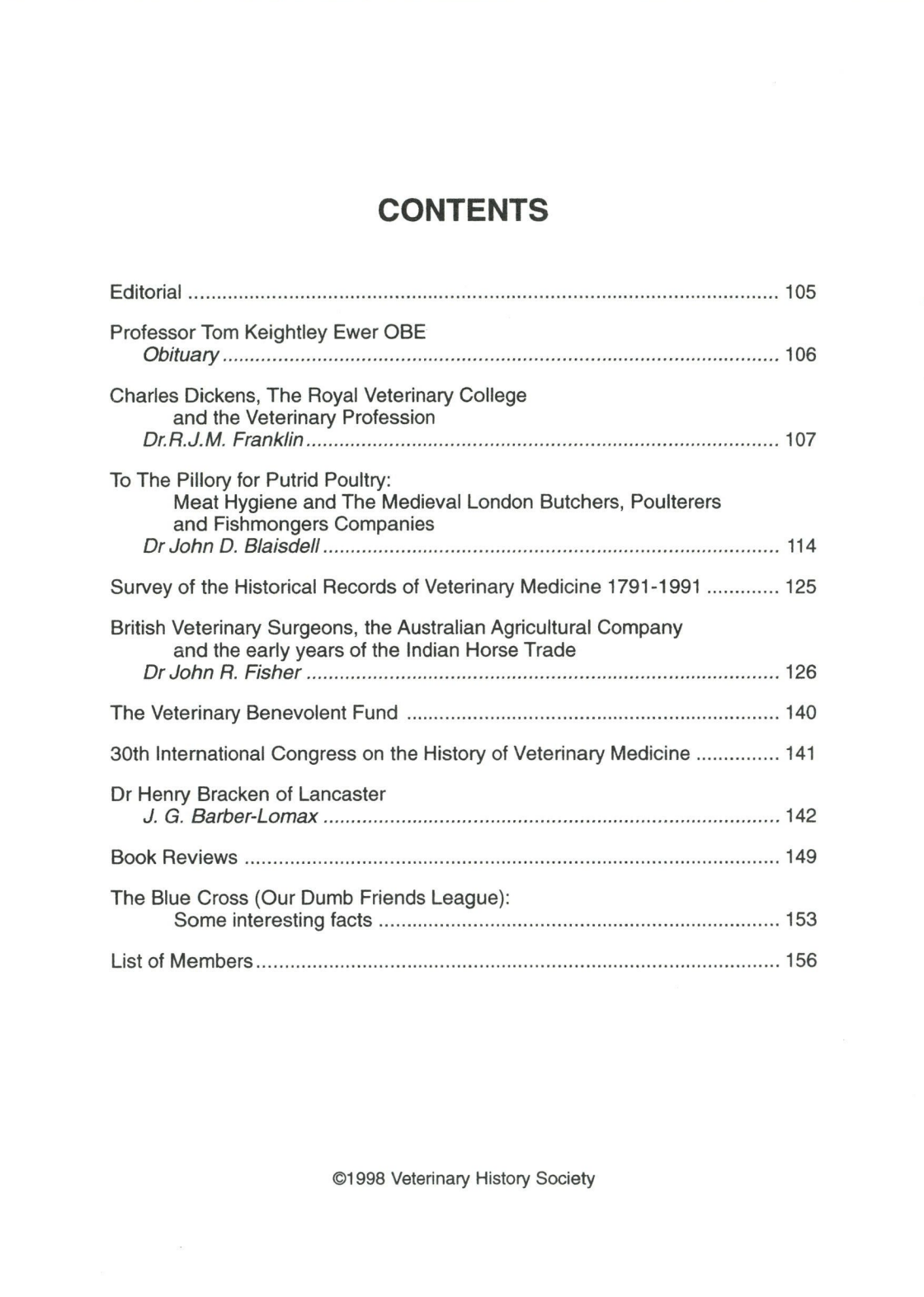
Charles Dickens, The Royal Veterinary College and the Veterinary Profession
Charels Dickens lived in Camden Town from the age of ten. He mentions the Veterinary College in two of his novels, including a reference to the cruelty of live vivisection being carried out by students. Dickens had an interest in animals and became a great supported of the RSPCA.
R J M Franklin
To the Pillory for Putrid Poultry; Meat Hygiene and the Medieval London Butchers, Poulterers and Fishmonger Companies
Regulations for the control of animal slaughter, handling and selling of meat and fish were first seen in the 1300s in London. The rules were controlled by various guilds including the London Butchers Guild. Slaughterhouses were banished from the city, but there remained a serious problem of dumping of entrails on the streets and in the River Thames. Various examples of accusations against butchers are given and also punishments for those found to be guilty. Poultry and Fish selling was regulated by their own Guilds. A jury of butchers was required to make a decision about the condition of the meat.
John D Blaisdell
British Veterinary Surgeons, The Australian Agricultural Company and the Early Years of the Indian Horse Trade
Thomas Hagger was born in 1804 and received his diploma from the London Veterinary College in 1828. He joined the East India Company’s Army. In the 1830s he was in Madras, where he was dealing with the problems in obtaining horse suitable for military use in India. Early supplies came from Central Asia and South Africa, but various problems led to investigating obtaining horses from New South Wales in the 1840s. Hagger moved to Stroud, the headquarters of the Australian Agricultural Company, which had a million acres of land – The Port Stephens Estate. Hagger was involved in the development of the horse trade with India. He had an unsuccessful venture to breed horse in West Australia for export to India. There were many management problems of the Port Stephens Estate and livestock production and horse breeding were not successful. The commissioner, between 1839 and 1849, Philip Parker King, was summarily dismissed and a damming report was written by James Charles White.
John D Fisher
Dr Henry Bracken of Lancaster
Henry Bracken was born in 1697 and studied medicine at St Thomas’s Hospital in London. He also received medical training in Paris and Leyden. He was in medical practice in Lancaster and became widely known as a surgeon and author. He was a race horse owner and developed a passion for horse racing, He was also fond of heavy betting and gambling. Bracken was one of a number of medically qualified men who developed an interest in diseases and conditions affecting horses. He was famous for his book ’Farriery Improved or a Complete Treatise upon the Art of Farriery’, published in 1737. He produced a pocket version. In 1751 he published a translation of Monsieur La Fosse’s ‘A Treatise on the True Seat of Glanders’. He also published medical texts on Midwifery and Lithiasis. Bracken died in 1764.
J G Barber-Lomax
The Blue Cross (Our Dumb Friends League): Some Interesting Facts
A brief history of the Blue Cross with illustrations.
Anon
Please note
Buy now