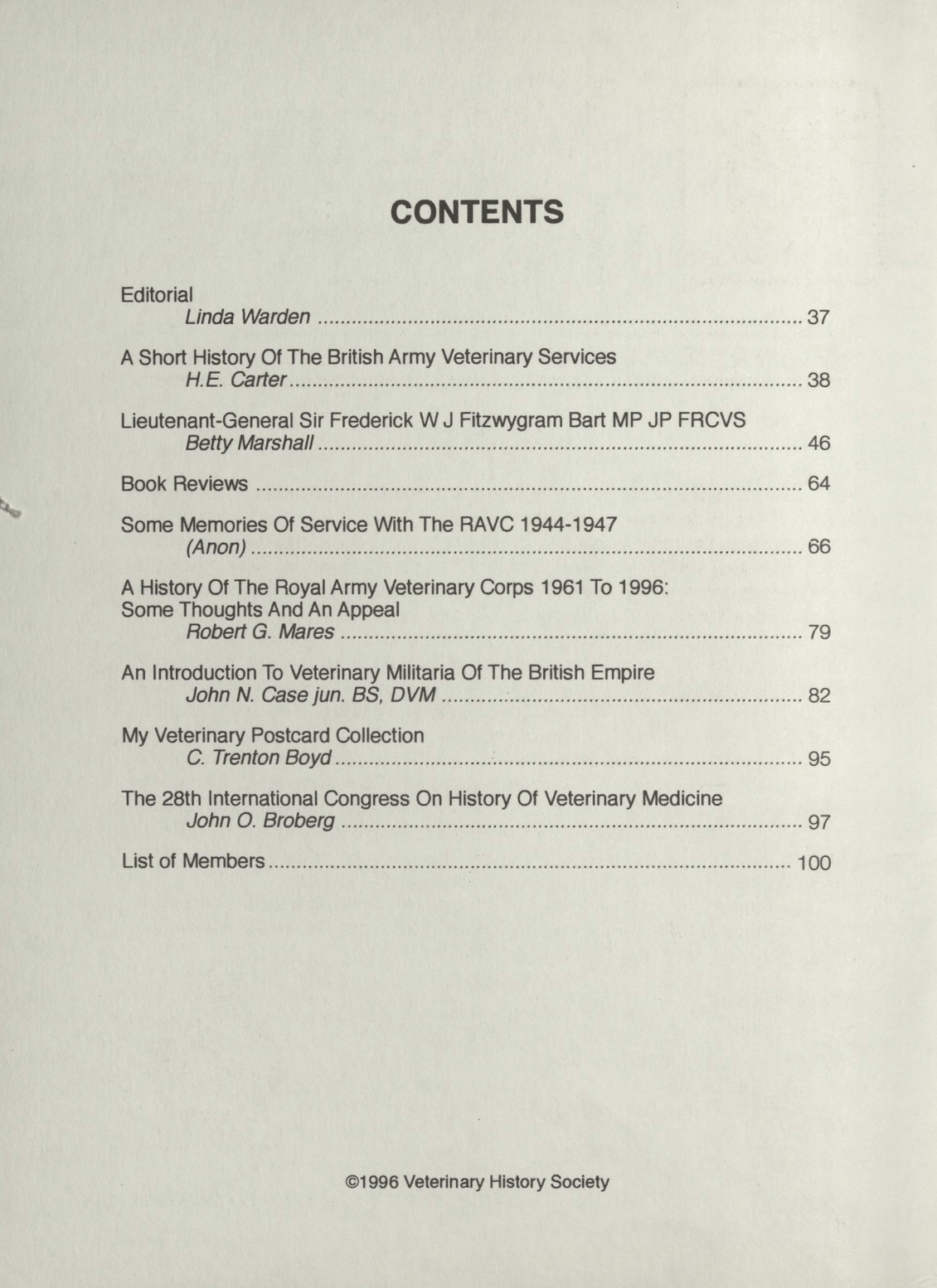
A Short History of the British Army Veterinary Services
William Gibson, following a military career, was in veterinary charge of military horses in London in the mid-eighteenth century. William Stockley, one of the first diplomates of the London Veterinary College, was the first qualified vet to join the army in a veterinary capacity and became senior veterinary surgeon to the Royal Artillery. After the disastrous Flanders Campaign of 1794-95, resulting in appalling losses of horses from disease, bad shoeing and neglect, it was decided each regiment should have its own veterinary surgeon, graduates of the London Veterinary College. The first vet appointed was John Shipp in 1796. Initially only diplomates of the London School could be appointed, but in 1838, graduates of the Edinburgh school were eligible for military appointments. An Indian Veterinary Service was established in 1834. By 1856 there were sixty-four veterinary officers in the army, of whom forty-three were in Crimea. An army veterinary service was formed in 1881. The army veterinary service had become reduced both in numbers and financial support and was in no fit state to cope with the Boer war in 1899. This led to a considerable improvement in the provision of veterinary services for the Army and effective and efficient service provided during the Great War.
H E Carter
Lieutenant-General Sir Frederick W J Fitzwygram Bart MP JP FRCVS
The life story of Frederick Fitzwygram, who was born in 1823. He was commissioned into the 6th Dragoons in 1843, which was followed by a swift rise through the ranks. He attended the Edinburgh School and qualified as a veterinary surgeon in 1854. Fitzwygram was present in Crimean Campaign and became determined to improve the lot of the men and horses under his command. He was appointed a Lieutenant-Colonel in 1858 and was sent to India. He returned to UK in 1860. He published two books in the 1860s. In 1869 he was sent to India, as Major-General with the 15th Hussars, where he took a particular interest in the care of horses. This was followed by his appointment as Commanding officer of the Cavalry Division. He took an active part in the creatin of the Veterinary school at Aldershot, which led to the formation of the RAVC. Fitzwygram was involved in veterinary politics and became president of the RCVS Iin 1875. He was active in the improvement in the standards of veterinary education. From 1872-1979 as vice-president and president of RCVS Fitzwygram’s achievements were extraordinary. He transformed the status and organisation of the profession, rescuing it from division and low standards, and produced a unified profession with a recognised qualification. He died in 1904.
Betty Marshall
Some Memories of Service with the RAVC 1944-47
A personal memoire of life as a junior veterinary officer in India from 1944. After landing in Bombay, he went to Indian Army Veterinary Service centre at Ambala. A description is given of living conditions and his duties. He was posted to Lahore, where his patients included camels and buffaloes, Hunting jackal was a popular past-time. Camel and buffalo care was challenging. Testing for Surra was a never-ending chore. Wrestling on mule-back was popular. A period of time was spent with Gurkha and Sikh battalions. In the aftermath of the war, there were Further postings to Thailand, Java, Malaysia and Burma.
Anon
An Introduction to Veterinary Militaria of the British Empire
A description of badges and insignia worn by veterinary officers in the army veterinary corps of Australia, Canada, United Kingdom, New Zealand and south Africa. Many illustrations are included.
John N Case
Please note
Buy now