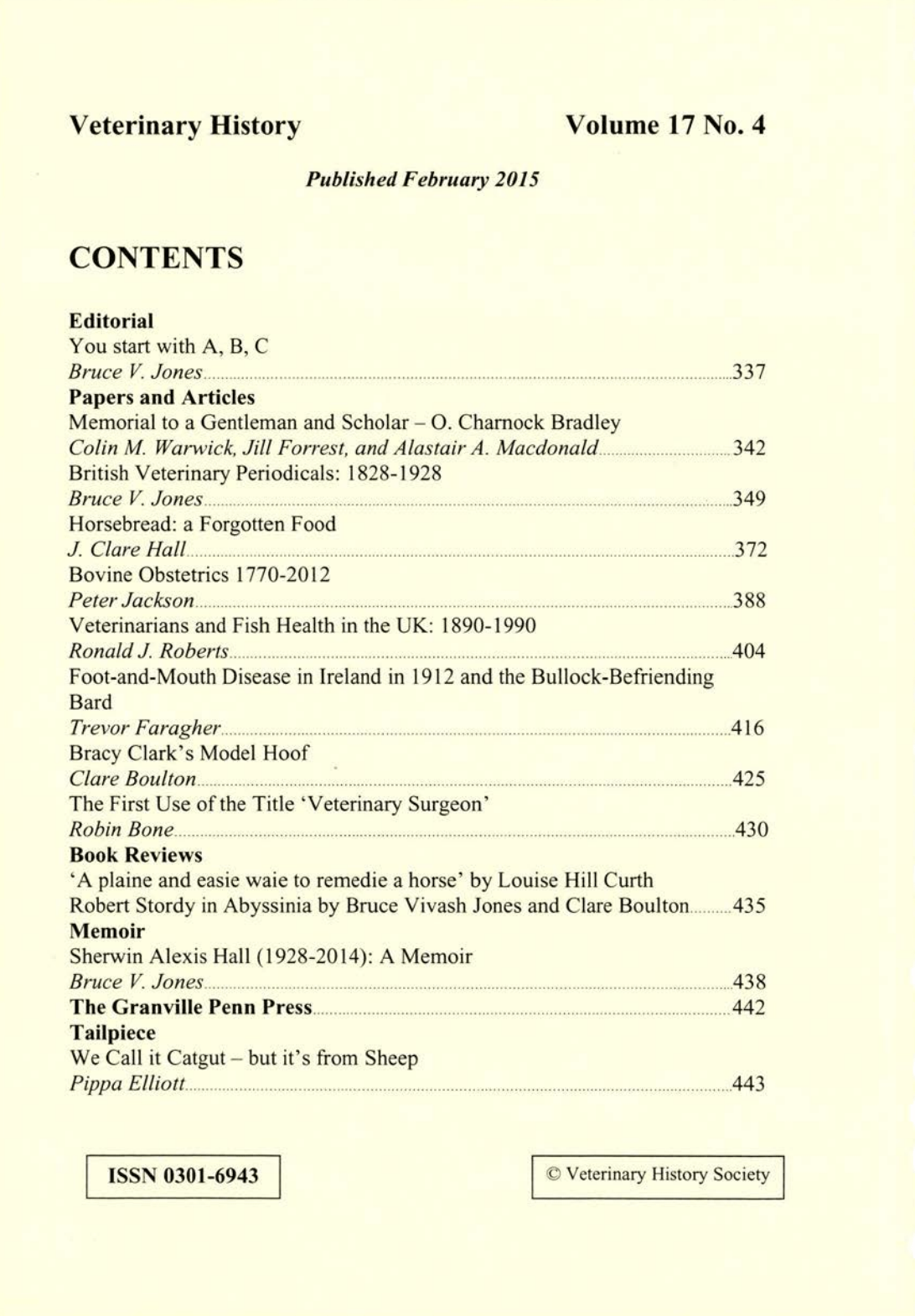
Memorial to a Gentleman and Scholar- O Charnock Bradley
O Charnock Bradley (1871-1937) was Principal of the Royal (Dick) Veterinary College for over 25 years. In 1947, the College Alumnus Association commissioned Scott Martin Ltd to create a memorial to him. The work was carried out by Sydney Gocke and the memorial contains three carved and painted wooden panels.
In 1950 the memorial was installed in the oak panelling of the entrance hall of the veterinary school at Summerhall. It was unveiled by Mr William Nairn, in the presence of the governors, led by Professor FAE Crew. Following vacation of the Summerhall site in 2011, the memorial was moved to Easter Bush, where it sits in Seminar Room 01, close to the 1936 painting of Bradley by Sir Stanley Cursiter.
Colin M Warwick, Jill Forrest and Alastair A Macdonald
British Veterinary Periodicals:1828-1928
For the earliest veterinary graduates, the need for immediate and regular information sources prompted the production of veterinary periodical literature. The first periodical was produced in Germany in 1788, but soon after British periodicals appeared.
William Percivall (1792-1854), an Army veterinary officer, was the founder of British veterinary periodicals and his early writings were critical of both the London Veterinary College and Edward Coleman, with the latter taking exception to Percivall’s efforts. Percivall was editor of The Veterinarian, first published in January 1828.
The article identifies 14 British veterinary periodicals launched in the period 1828 to 1928; of these only three were still in print in 1928. The author describes each of the 14 periodicals, providing a resume of their readership, the important contributors and articles and, where, appropriate, identifies the cause of their demise.
Bruce V Jones
Horsebread: A Forgotten Food
Horsebread, a coarse form of very dark bread, has been produced since the Medieval period, using either by-products of human food production and/or products deemed unsuitable for human consumption. Based on bran and beans, but without yeast, variants have included the addition of eggs, ale or wine. Although it has been eaten by, invariably, the poorest in society, horsebread has primarily provided a dense source of calories and proteins for horses. It is also recorded how it can act as a medicine.
The article provides a detailed overview of horsebread, its production, storage, distribution and consumption, and recognises its importance in earlier times in sustaining long distance trade and transport by horses. The latter is reflected in its previous regulation through three statutes and two Acts of Parliament.
J Clare Hall
Bovine Obstetrics 1770-2012
This paper reviews the broad area of bovine obstetrics over a period of more than two centuries. In doing so, it considers the numerous conditions encountered including developments in the management of dystocia, both through medical and surgical approaches, as well as detailing the development of pharmacological approaches to bovine obstetrics. The author highlights the important contributions to this field made by veterinarians, both in Britain and in Europe and America.
Peter Jackson
Veterinarians And Fish Health in the UK: 1890-1990
Earliest reports of fish diseases were made in 330BC, and prior to 1880 most reports involved parasites of fish. The first descriptions of bacterial disease- furunculosis- were made by Marianne Plehn in 1911, who detailed the identification, spread and effect of the first recorded global epizootic in fish. In the UK, the disease stimulated the establishment of the Furunculosis Committee by the House of Lords in 1929.
The next epizootic, in 1964, of ulcerative dermal necrosis, led directly to veterinary involvement in this field through the Department of Veterinary Pathology at Glasgow. Research led to publication of a number of papers on the condition. By the early 1970s the establishment of commercial aquaculture led to significant economic ventures in this field. The result was a greater veterinary involvement, combined with significant collaboration with medical professionals. One outcome was the establishment of the Aquatic Pathobiology Unit at Stirling which served as both a teaching and research unit.
Members of the unit contributed to the highly successful United Nations Mission to South-East Asia, researching the pathogenesis and epidemiology of Epizootic Ulcerative Syndrome.
Ronald J Roberts
Foot and Mouth Disease in Ireland in 1912 and the Bullock-Befriending Bard
In July 1912 foot and mouth disease was reported in County Dublin, Ireland after an absence of 28 years. The response by veterinary authorities was one of slaughter along with controls involving rigorous disinfection of adjoining properties and the prohibition of movement of livestock. A further 68 outbreaks occurred over the ensuing 4 months.
News of the outbreaks spread to Europe, to Trieste, where James Joyce was living in self-imposed exile. He returned to Dublin in 1912 and wrote an editorial on the problem entitled ‘Politics and Cattle Disease’ in which he supported many of the local control measures that had been introduced.
The writing of Joyce’s friend, Henry Blackwood Price, an Ulsterman, on foot and mouth disease to The Evening Telegraph formed the basis of parts of the novel Ulysses. Price had proposed two treatments for the disease, based on his observations in Austria. The first was use of ‘serum of inoculation from Berlin’, and the second topical administration of the antiseptic Pyoktanin or
Rosaniline. Pyoktanin was produced by E Merck in Darmstadt, Germany and had been demonstrated to diminish the clinical signs and lesions in cattle infected with foot and mouth disease.
Trevor Faragher
Bracy Clark’s Model Hoof
Bracy Clark (1771-1860) was born in Chipping Norton and qualified from the London Veterinary College in 1794. He established a practice in Giltspur Street, London and developed an interest in shoeing of horses. On his retirement in 1828 he pursued his interest in shoeing. In 1820 he published a two-page pamphlet ‘A new exposition of the horse’s hoof’. Accompanying this was a pasteboard model of the hoof which can be disassembled. The model, now in possession of the RCVS Library, may have been acquired when Clark became Vice-President of the College in 1857.
Clare Boulton
The First Use of the Title ‘Veterinary Surgeon’
It has been assumed that the first use of the title veterinary surgeon was by the British Army in 1796, although this appears not to be the case. In November 1794 Richard Thompson of Leeds described himself as a ‘Veterinarian Surgeon’ having studied for two and a half years at the (London) Veterinary College. Two years later, in 1796, he described himself as a ‘Veterinary Surgeon.’ In that same year both Thomas Draper of Castle Donnington, Leicester and George Baldwin of Kakenham, Norfolk also used the same title.
Robin Bone
Please note
Buy now