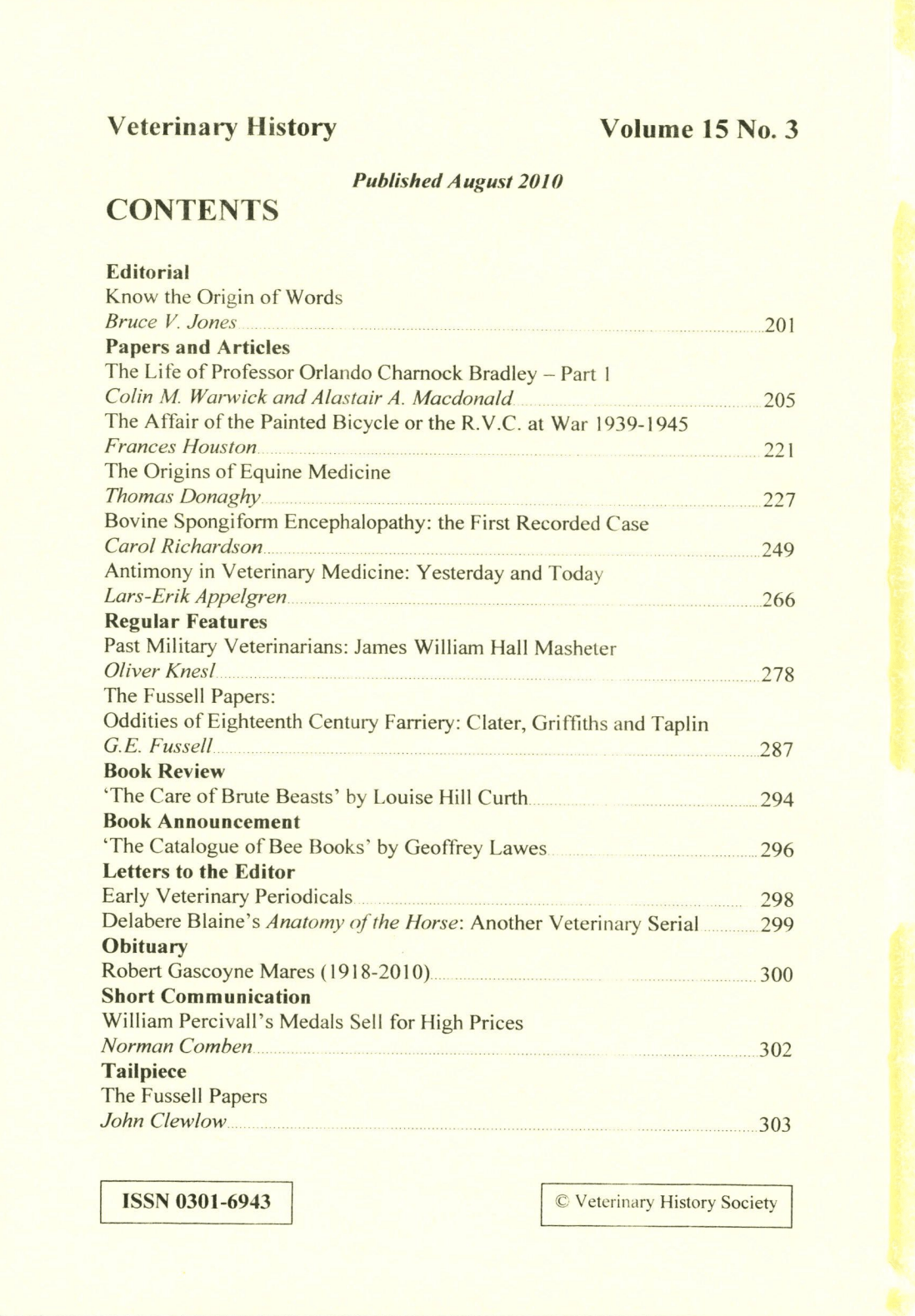
The Life of Professor Orlando Charnock Bradley, (1871-1937): Diary Entries 1895-1923, Part 1
The life of Orlando Charnock Bradley, as recorded in the forty-one years of his diaries. He was born in 1871. He attended the New Veterinary College in Edinburgh from 1889. He also was a medical student at Edinburgh University from 1895, graduating in 1900. He had a friendship with Aleen Cust and tutored her at the New Veterinary College. Aleen Cust was the first female veterinary student in the UK. and the first woman to receive the RCVS diploma in 1922. Bradley became professor of veterinary anatomy at the ‘Dick’ Vet School in Edinburgh, whilst at the same time involved in medical research at the University of Edinburgh. He was elected a fellow of the Royal Society of Edinburgh in 1903. Charnock Bradley was at the forefront of planning the unification of the various veterinary medical societies in Britain., which resulted in the formation of the BVA in 1952. In 1911, he became principal of the Royal (Dick) Veterinary College and president of the RCVS in 1920.
Colin M Warwick and Alastair A Macdonald
The Affair of the Painted Bicycle or The Royal Veterinary College at War 1939-194
An account of the transfer of the RVC to Streatley, in Berkshire, for the duration of the Second World War. The principal of the RVC had appealed to the vice-chancellor of University of Reading to give sanctuary to the RVC. The author describes the preparations and the removal to Streatley House. New students were admitted and 74 students were called up to fight. Land Army Girls helped out the College. Some bombs fell nearby.
Frances Houston
The Origins of Equine Medicine
The earliest sources for veterinary medicine are from Egypt and Mesopotamia in 18-19th centuries BC. Specific equine medicine is first mentioned in the Alalakh tablets from Syria. The famous Hittite text, written by the Mitannian horse-master, Kikkuli, was written in c1400BC. It shows great understanding of the feeding and care of horse undergoing intensive training. The first veterinary text to deal with horses is the Ugaritic Hippiatric Text from Ugarit in Syria. It describes various conditions, including ‘roaring’, infectious discharges, constipation, dysuria, pain and colic. Remedies for these conditions are given. Xenophon was the earliest known writer of ancient Greece from the 4th century BC. There is a short section on equine ailments as well as advice on training and riding skills. Aristotle, writing in the 4th century BC describes several equine ailments and their remedies including hoof disease, limb problems, tetanus, strangles, colic, ‘broken wind’ and stringhalt. Mago of Carthage, writing in 2-3rd century describes various ailment, including dyspnoea and dysuria. Varro, from 1st century BC, describes two divisions in treatment of animals by a physician or by the herdsman. Columella, writing in 1st century AD, describes many ailments affecting small animals, farm animals and horses. His descriptions and treatments for coughing, worms and skin diseases are given here.
Thomas Donaghy
Bovine Spongiform Encephalopathy: The First Recorded Case
The author was a veterinary pathologist working at the Central Veterinary Laboratory at Weybridge. She describes some early discoveries of new farm animal diseases including Bright Blindness and Scrapie in sheep. The first histopathological diagnosis of Bovine Spongiform Encephalopathy (BSE) was made in September 1985, although its significance was not realised at the time. The author describes the lesions found and their similarity to those found with Scrapie. Other veterinary pathologists were asked for their opinions and there was some disagreement about the findings and possible aetiologies. The author gave evidence to the Government enquiry into the BSE epidemic.
Carol Richardson
Antimony in Veterinary Medicine: Yesterday and Today
The medicinal use of antimony is known from early Egyptian time. In the 18th century the use of different antimony compounds is described in veterinary medicine. It was used to retore the balance between the body’s four liquids. In Denmark, the veterinarian Viborg made extensive practical experiments on the posology of antimony compounds and found that Tartar emetic was much more toxic if administered in water than as a powder. The use of antimony as a diarrhoeic and emetic slowly disappeared and today antimony compounds are the drugs of choice for treating Leishmaniasis.
Lars-Erik Appelgren
James William Hall Masheter MRCVS (1873-1943)
James William Hall Masheter was born in 1873 and qualified from the Edinburgh College in 1893. He practiced in Yorkshire until he went to South Africa in 1990 as a civilian veterinary surgeon attached to the 8th Hussars during the Boer War. During his time in South Africa, he wrote seventy-five letters to his father and these letters are quoted in this article. He was very critical of the way the horses were transported to South Africa and their care and management. He was contemptuous of the army veterinary service. He describes the terrible chaos and conditions at the veterinary hospital in Pretoria. After the war he returned to the UK and settled in Malton, Yorkshire, where he was in practice. He died in 1943.
Oliver Knesl
Oddities of Eighteenth-Century Farriery – Frances Clater, William Griffiths and William Taplin
An account of three farriery writers from the eighteenth century – Francis Slater, William Griffiths and William Taplin.
G E Fussell
Please note
Buy now