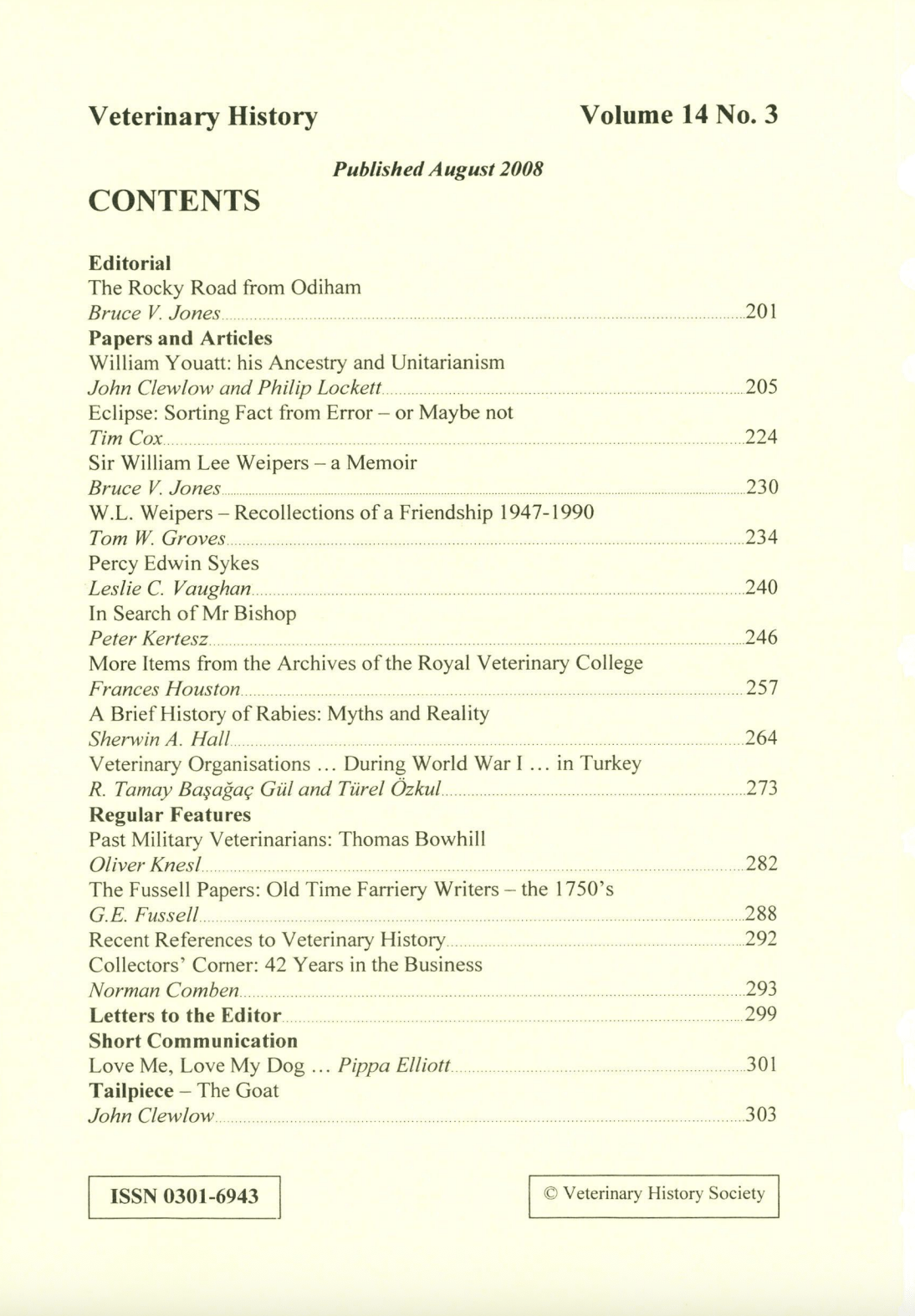
William Youatt: His Ancestry and Unitarianism
A history of the ancestry of the early life and Unitarian ministry of William Youatt. Youatt appears to have been born in the West Country. His father was probably a presbyterian minister, William Youatt of Dulverton, Somerset. The first confirmed references to William Youatt, the veterinary surgeon, is the survival of seven student essays from 1792-95 at the nonconformist Northampton Academy. In 1803, Youatt was appointed as a minister of a Baptist congregation in Chichester. He was a Unitarian and preached a sermon on this in 1805 and detailing his theological beliefs. An account is given of his life and activities in Chichester, including the intellectuals he associated with. His defence of William Blake at his court case for sedition is described. Youatt resigned his ministry in 1812 and joined Delabere Blaine as a partner in his veterinary practice in London. A history and theology of Unitarianism is part of this article.
John Clewlow
Eclipse: Sorting Fact from Error – or Maybe Not
95% of all thoroughbreds alive today can trace their ancestry to Eclipse. This is an account of the ancestry of Eclipse, with several different stories relating to his parentage. He was sold, un-named, in 1765, the price paid increasing, in later versions of the story, from 45 to 75 guineas. The pedigree given for this sale is missing a generation. A stud book gives Eclipse’s dam as Spilleta. The sire was given as Marske or Shakespeare, the former being the currently accepted sire. There was a lot of speculation about Eclipse’s ancestry at the time and false stories were circulating, possibly in an attempt to discredit a stallion.
Tim Cox
Sir William Lee Weipers: A Memoir
William Weipers was born in 1904 and graduated from the Glasgow college in 1925. After a short spell at the Edinburgh college, he set up in practice in Glasgow’s West End. The practice thrived and Weipers established a reputation as an outstanding clinician and surgeon. He masterminded the transformation of the Glasgow college, which occupied very poor premises and had a low standard of teaching. Weipers oversaw the building of a new veterinary college at Bearsden and its incorporation into the University of Glasgow, following the Loveday reports. He became dean of the faculty in 1969. Glassgow developed an international reputation for teaching and research. He retired in 1974. He campaigned, successfully, to save the Glasgow college form closure in 1986-90. He died in 1990.
Bruce V Jones
W L Weipers – Recollections of a Friendship 1947-1990
A personal recollection by the author of working with William Weipers in his veterinary practice in Glasgow in the late 1940s. He describes the working environment and the personality of Weipers. He describes Weipers’s enthusiasm for planting trees at his smallholding at Duntocher. The author saw the work that was going into the planning for the new veterinary school.
T W Groves
Percy Edwin Sykes AM MACVSc MRCVS
Percy Sykes was born in 1920 in Sudan. He graduated from the RVC in 1943, when he enlisted in the RAVC. He was posted to India, and later, to Burma. After the war, he took over the running of the Army Veterinary Hospital in Calcutta, retuning to the UK in 1946. He set up in equine practice in London. In 1951, Sykes moved to Sydney, Australia, where he set up an equine practice looking after race-horses. the practice was very successful and eventually a large new equine hospital was built in 1990.
Leslie Vaughan
In Search of Mr Bishop
Throughout the life of a horse specific changes occur to the appearance of the permanent incisors and this can be used to determine the age of a horse. These features were documented in c600BC in a Chinese text. The term ‘bishoping’ describes the fraudulent technique of altering the appearance of the incisors to make the horse look younger than it actually was. The term first appears in print in 1725 but origin of the term has never been established and there is no evidence of a ‘Mr Bishop’, who may have given his name to the technique. Early farriery writers often gave advice as to how to spot the alterations.
Peter Kertesz
More Items from the Archives of the Royal Veterinary College
Various examples or correspondence covering subjects such as: complaints on frequency and standard of teaching, building projects, staff appointments, numbers of female students and the library.
Frances Houston
A Brief History of Rabies: Myths and Reality
Rabies is a disease of great antiquity and it was recognised that it was caused by the bite from a rabid dog. A myth persisted for a very long time that removing the ‘worm’ form the underside of a dog’s tongue would stop a dog becoming rabid. Delabere Blaine was very scornful of this technique in his 1817 book on canine pathology. Another myth was the belief that Rabies could arise spontaneously, especially in hot weather. Bline was insistent that Rabies was only spread by the bite from an infected dog. In 1884, Louis Pasteur demonstrated the first successful use of an attenuated viral strain to protect dogs against Rabies. He also developed a method of protection following a bite. This methos was then applied to people and in 1885 Pasteur prevented the development of Rabies in two boys bitten by Rabid dogs. By 1905, 100,000 people had received the Pasteur treatment. Rabies was never endemic in UK and only sporadic outbreaks occurred. And by 1902, it had been eradicated from Britain, Unfortunately, it returned in 1918, with dogs being brought back to UK with soldiers, but was eradicated again by 1922.
Sherwin Hall
Veterinary Organisations and Services during World War 1 and the Independence War in Turkey
The first veterinary school in Turkey opened in 1842. At the outbreak of World War 1, there were insufficient veterinarians and animals available for the army. Infectious disease, especially Rinderpest, was prevalent and it is estimated 57.7% livestock died. After the was all the vets, farriers and employees of army animal hospitals were discharged and many retired, although vets were given responsibility of food inspection for the first time. During the Independence War, government vets joined the army and were responsible for the care of the horses used by the army.
R Tamay Başağaç Gűl Tűrel Őzkul
Thomas Bowhill MBE FRCVS FRPS (1859-1925)
Thomas Bowhill was born in 1859 and after a few years in the colonial forces in south Africa, he returned to Edinburgh and qualified as a vet in 1886. He then went to California, where he was a special investigator researching the devastating epidemic of Texas or Southern Fever in cattle. It was found to be a tick-borne disease. He was a lecturer in bacteriology at the University of California, until he returned to South Africa as a civil veterinary surgeon during the Boer War. In 1902, he was appointed to a government position in Cape Colony. He was investigating Lamziekte and he identified two different diseases, a bone disease caused by phosphate deficiency and an acute disease, later recognised as Botulism. He resigned in 1906 ands appears to have worked in veterinary practice in San Francisco and in Canada. At the outbreak of World War 1, he joined the Army Veterinary Corps, involved with the purchase of horses for the British Army. After the War he returned to Africa and worked in Uganda, retiring to Durban, where he died in 1925.
Oliver Knesl
Old Time Farriery Writers: The 1750s
A review of two farrier writer from the 1750s – Jeremiah Bridges and John Bartlet.
G E Fussell
Please note
Buy now