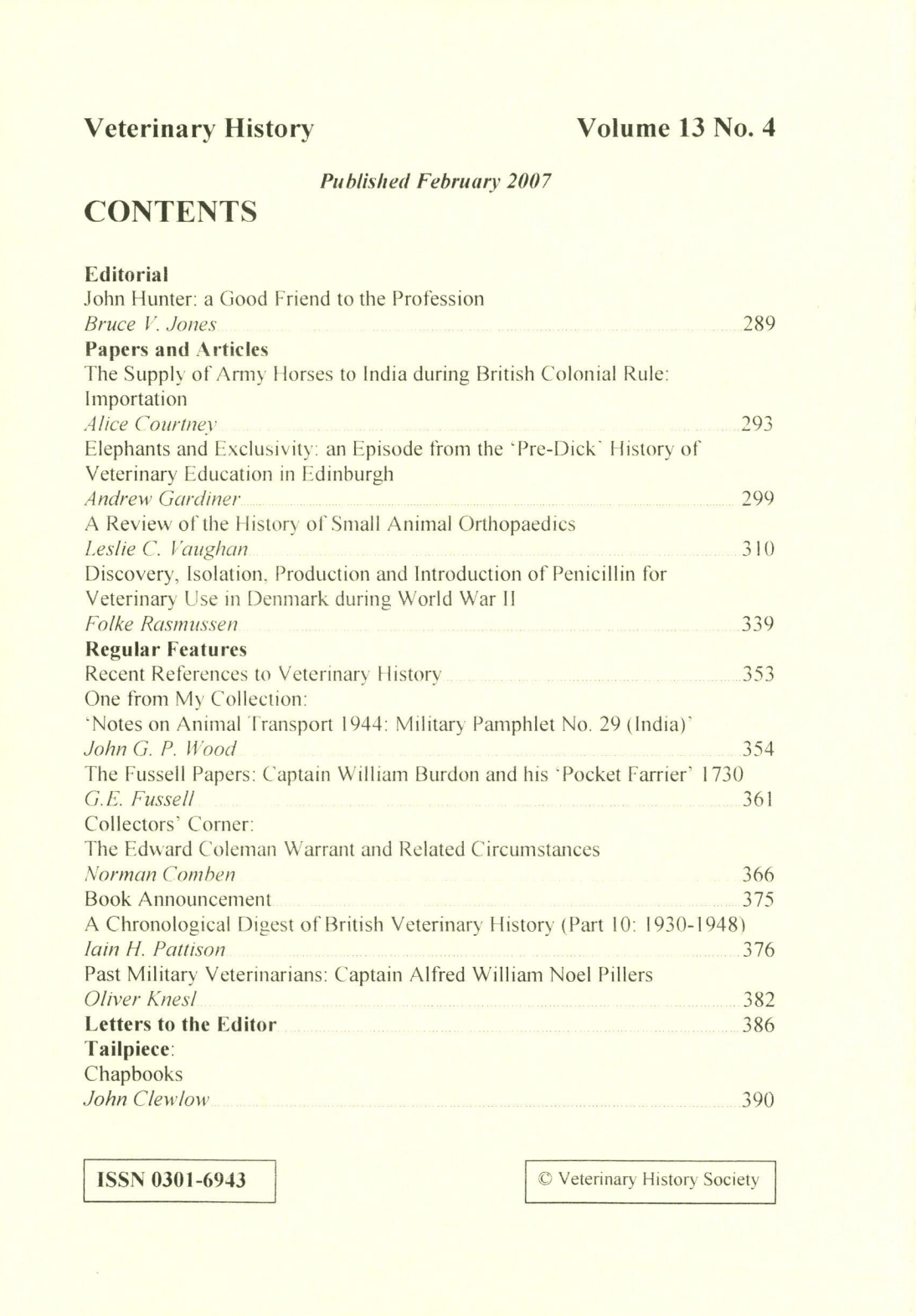
John Hunter: A Good friend to the Veterinary Profession
John Hunter (1728-1793) was a distinguished surgeon in London. He acquired a huge collection of pathological specimens, which forms the basis for the Hunterian Museum at the Royal College of Surgeons. He was very supportive of the fledgling Veterinary School in London through the perilous time after the death of Sainbel’s death.
Bruce V Jones
The Supply of Army Horses to India During British Colonial Rule: The Horse Breeding Operation
Towards the end of the nineteenth century, the horse supply of India was beginning to feel the strain of the Army’s high demands. The stud system had been successful for 80 years but a more efficient system, using country-breds, was needed. The Department of Horse Breeding was set up in 1876. It had five principles – to supply free the best stallions for approved mares, to award prizes at horse shows, restricted to horses from approved stock, to advise owners about animal health, treatment and management, also to encourage castration of unapproved stallions, to provide veterinary instruction to anyone one wanted it, and to provide a free copy of a standard textbook on care of brood mares and foals. The Remount Department was expected to attend all horse fairs and shows and buy all approved stock. The programme was a great success.
Alice Courtney
Elephants and exclusivity: An episode from the ‘Pre-Dick’ History of Veterinary Education in Edinburgh
Organised and continuous veterinary education in Edinburgh began in 1823, with the foundation of William Dick’s veterinary college. Edinburgh Town Council had made a proposal that a chair of Comparative anatomy and Veterinary Physic and Surgery should be established at Edinburgh university. They stressed the benefits to both medical and veterinary knowledge. The council advance various arguments about the financial benefits and even of benefits to the study of Divinity. The senate rejected the proposal as they claimed that the study of Veterinary Physic and surgery was ‘not consistent with the dignity of the University’. They suggested any veterinary training establishment should be attached to a forge or riding school. This last suggestion was what actually happened with the foundation of William Dick’s veterinary school.
Andrew Gardiner
A Review of Small Animal Orthopaedics 1950-2006
A history of the development of veterinary orthopaedics over second half of twentieth century. The author describes the various methods to repair fractures and their history including: intramedullary pins, plates, lag screws, rush pins, cerclage wires the AO system and external fixation. Methods of dealing with joint problems are described covering dislocations, hip dysplasia, osteochondritis dissecans, ligament and tendon ruptures.
Leslie C Vaughan
Discovery, Isolation, Production and Introduction of Penicillin for Veterinary Use in Denmark During World War II
In 1928 Alexander Flemking observed that a Penicillium mould contaminated one of his cultures and showed antibacterial activity and he named this substance penicillin. In the 1940s Penicillin was first used in Denmark to treat bovine mastitis as an intramammary infusion. Which proved to be very successful. It was realised that excretion in milk was affecting cheese and butter production. By the 1950s, withdrawal periods were in place to prevent contamination of milk and dairy products. Research was carried out into the use of new injectable penicillins.
Folke Rasmussen
Notes on Animal Transport 1944: Military Training Pamphlet No. 29 (India)
A detailed description of a rare pamphlet about the care and management of mules in India. There are sections on saddlery, loads and loading. Prevention of skin sores (galls) was a major priority. There is an account of the ideal construction of a pack saddle. The correct design of carts is considered. A veterinary section with advice on treatment of wounds, galls and colic.
John Wood
Captain William Burdon and his ‘Packet Farrier’ 1730
A description of this popular booklet written by William Burdon, in response to his concern about the poor training and expertise of farriers. Burdon gives advice on how to buy a horse. He offers a range of remedies, some quite drastic and criticises other remedies available at the time.
G E Fussell
Collectors; Corner – The Edward Colemen Warrant and John Shipp’s Book
An account of the appointment of Edward Coleman to be Principal Veterinary Surgeon to the Cavalry in 1796 and the illustration of the warrant document. John Shipp was the first veterinary surgeon to serve in the British Army.
Norman Comben
A Chronological Digest of British Veterinary History, Part 10 1930-1948
This period covered the 11th International Veterinary Congress in London, the first sulphonamides, the foundation of the Animal Health Division of the Ministry of Agriculture and Fisheries, The Loveday Commission on veterinary education, the 1948 Veterinary Surgeon’s Act.
Iain H Pattison
Captain Alfred William Noel Pillers FRCVS DVSM FRSE (1883-1936)
Alfred William Noel Pillers was born in 1883 and qualified from the RVC IN 1906, where he stayed as a demonstrator in surgery for a year. he was then appointed to be horse superintendent to the Great Central Railway. He obtained his FRCVS IN 1911 and was appointed Assistant Veterinary Officer to the City of Liverpool. He served in the RVC during the First World War. He resumed his career in Liverpool after the war, becoming Chief Veterinary Officer in 1932. He was recognised for his work in the eradication of bovine TB, to help ensure a clean milk supply. He published numerous publications on parasitology. He died in 1936.
Oliver Knesl
Please note
Buy now