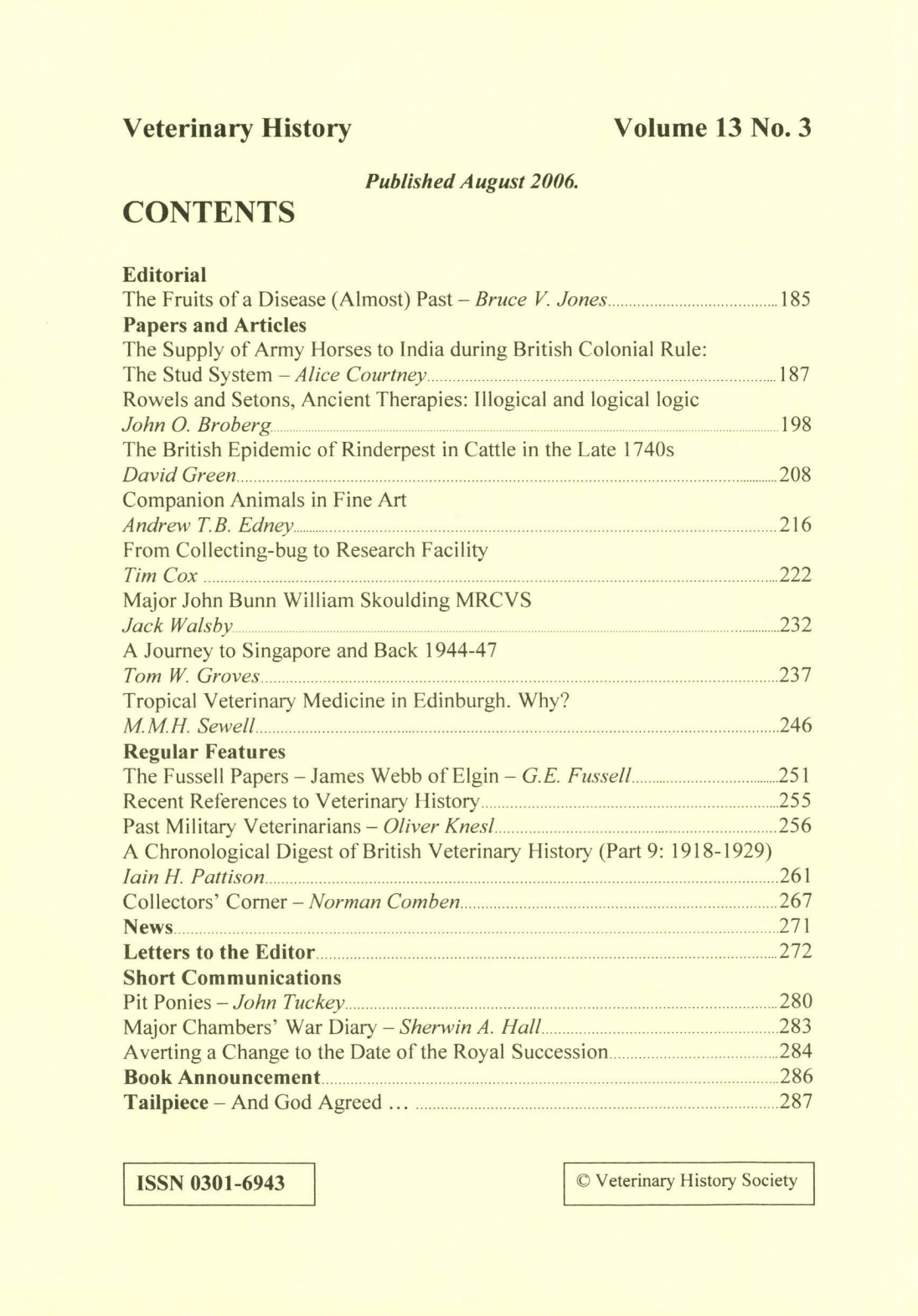
The Supply of Army Horses to India during British Colonial Rule: The Stud System
At the start of their occupation of India, the British Army found the supply of local horses inadequate for their needs. The East India Company set up stud farms, importing stallions from England, particularly Arabs. Local Indian owners of mares would bring them to the stud for service. There was experimentation with the use of local breeds of stallions and mares crossed with imported horses to achieve the ideal horses for use in India. Shortage of decent grazing grass was a problem in some areas. Later on, there was a change with the stallions being owned by local Indians and being paid by the government to service mares. This reduced the cost of importing and maintaining the stud farms. After the Mutiny of 1857, there was a major disruption to the stud system and there was a move to importing large numbers of horses form New South Wales.
Alice Courtney
Rowels and Setons, Ancient Therapies: Illogical and Logical Logic
A review of the use of rowels and setons. A rowel is a piece of cloth or leather placed between the skin and underlying muscle or bone. Their purpose was to promote drainage. Setons were strings or tapes threaded through the skin and tissue and also through wounds. The tape was moved up and down. Herbs and medications were mixed with grease and applied to the seton, which was and pulled under the skin. They were used to promote drainage and granulation tissue. They were also used for vaccination. Many early authors, including Leonard Mascall, Conrad Heresbach, Gervaise Markham, Henry Bracken and E R Gent all describe the techniques and uses of setons and rowels. Paul Adami from Vienna in the eighteenth century advocated the use of setons to vaccinate cattle against Rinderpest, using infected saliva. In 1934, Professor Wooldridge, was advocating the use of setons for fistulas, abscesses and bursas.
John O Broberg
The British Epidemic of Rinderpest in Cattle in the late 1740s
The first documented Rinderpest outbreak in Europe occurred in Bohemia in 1710. It arrived in Middlesex in 1715, but was quickly and effectively contained by a law ordering the slaughter of all affected cattle and their deep burial. In 1745 Rinderpest arrived again in the UK, following the importation of infected calves from Netherlands. It spread rapidly through England despite slaughter and burial orders, which were not believed or enforced properly. The Stuart Rebellion of 1745 was a distraction for the government. The epidemic was not over until 1759, when a National Day of Thanksgiving was held, two months after the last case. By this time, it is estimated 500,000 cattle had died or been killed. This European epidemic led to the foundation of the first veterinary school in Lyon.
David Green
Companion Animals in Fine Art
A review and history of the appearance of dogs and cats in works of fine art, alongside people and scenes. Dogs and cats can appear as companions to the people in the painting. They also are shown at work, at play, in the background of scenes. Animals are often shown with children and there are many paintings showing the human-companion animal bond. Examples are discussed of these various categories.
Andrew T R Edne
From Collecting-Bug to Research Facility: The Development of a Library Devoted to the Thoroughbred Horse
An account of the development of a library dedicated to the thoroughbred horse and horseracing. The library is in a three-storey extension to Tim Cox’s house, designed to house 16,000 books. This library is available to researchers, but is not a lending library. The author describes the importance of three important books with veterinary connections by Thomas Blundeville, George Stubbs and Charles Dibdin.
Tim Cox
Major John Bunn William Skoulding MRCVS
John Bunn William Skoulding qualified from the RVC IN 1852, aged twenty. He joined the Royal Horse Artillery in 1855 and saw action in the Crimean War. After returning in 1856, the was then posted to India and saw service during the Indian Mutiny of 1860. he was involved in looking after large numbers of horses and dealing with outbreaks of Glanders. He then went to China and was there during the Opium Wars. In 1865, he returned to India and was put in charge of the stud department. In 1879 he was involved in looking after horse, mules, and camels during the Afghan War. He retired from the army in 1885 a bitter man, having been passed over for promotion on many occasions, despite being mentioned in dispatches, personal recommendations of commanding officers and government officials.
Jack B Walsby
A journey to Singapore and Back 1944-47
A personal account of the authors experiences, as a veterinary officer, in the Far East between 1944 and 1947. The author arrived in Ambala, the Indian Army Veterinary Corps training centre. He describes the care of mules, in the support of the Burmese jungle warfare campaign. After the fall of Rangoon, Groves travelled back to Bangalore in India, where he oversaw the dispersal of the mules, no longer required by the Army. He was then transferred to Batavia (now Djakarta) and describes the chaotic lawless environment. Transfer to Kuala Lumpur and Pahang involved helping with the re-establishment of livestock production, disease control and training local staff. Groves nearly died of Scrub Typhus, a Rickettsial disease. He returned to the UK in 1947.
T W Groves
Tropical Veterinary Medicine in Edinburgh. Why?
William Dick had a broader interest in animals other than the horse at his Edinburgh college, including some exotic species. In 1930 there was the establishment of Colonial Veterinary Scholarships and this led to the Diploma in Tropical Veterinary Medicine offered by the Edinburgh Vet College and Edinburgh University. The courses had funding support from the Ministry of Overseas Development, but this was gradually withdrawn and by 1981 stopped altogether. The MSc course continued, but it had to be funded by sufficient numbers of students. The last students graduated in 2002.
M M H Sewell
James Webb of Elgin: Veterinary Surgeon to the Morayshire Farmers’ Club
James Webb wrote a popular book ‘The Farmer’s Guide, or a Treatise on the management of Breeding Mares and Cows’ in about 1831 with a second edition in 1834. His cures produced excellent results. He gives detailed instructions about preparing mares prior to service. He has advice about caring for cows both before mating and during pregnancy.
G E Fussell
Otto Henning Dr Med Vet (1865-1933)
Otto Henning was born in Germany in 1865 and qualified as a veterinary surgeon from Stuttgart in 1887. He worked in a laboratory and as a Government Veterinary Surgeon in Creilsheim. In 1892 re went to South Africa working as a government vet in Cape Town. In 1896, there was an outbreak of Rinderpest in the Bulawayo District. Despite attempts to stop it spreading by wholesale slaughter and quarantine, it spread into South Africa. Hennin was involved in this Rinderpest eradication campaign and was appointed as the first official veterinary surgeon for Orange Free State. Henning engaged with the forces of the Orange Free State at the outbreak of the Boer War and was part of the besieging of Ladysmith. As a non-combatant, he later worked at the British Military Veterinary Hospital at Bloemfontein. After the war he supervised the mass immunisation programme against Rinderpest, which had flared up again. He was appointed aa government position in German South west Africa. Following occupation of SW Africa, he worked as a prisoner of war. He died in 1933.
Oliver Knesl
A Chronological Digest of British Veterinary History, Part 9 1918-1929
This period covers; the granting of the Royal title to the Army Veterinary Corps, the foundation of the National Veterinary Medical Association, Controversy about plan to introduce a registration fee to be paid to RCVS, Aleen Cust first woman veterinary surgeon registered in 1922 and the serious financial problems for the RVC.
Iain H Pattison
Pit Ponies
A brief history of the use of pit ponies in British coal mines and their veterinary care.
John Tuckey