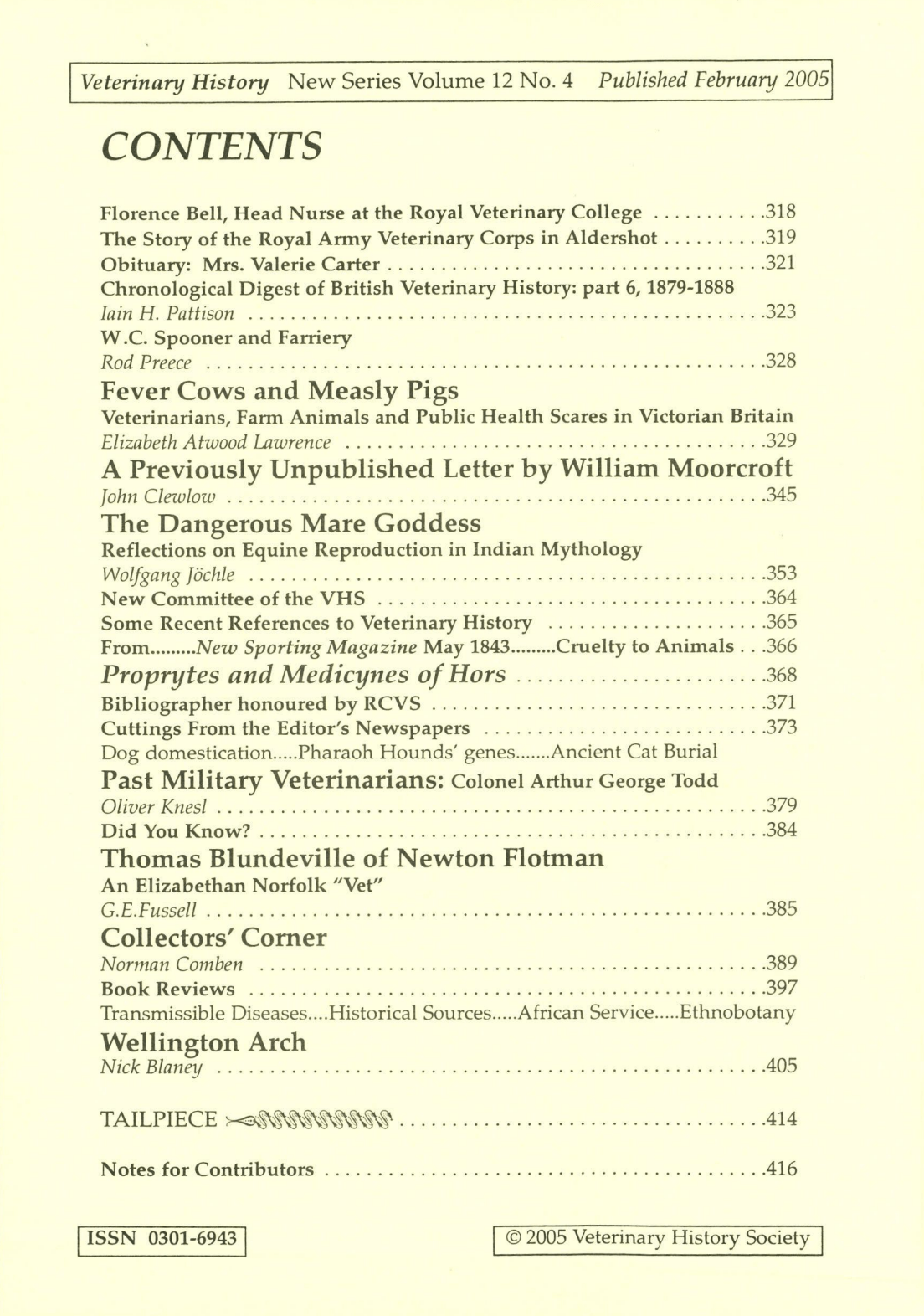
A Chronological Digest of British Veterinary History: Part 6 1879-1888
This covers the period of the successful campaign by Frederick Fitzwygram and George Fleming to get an act of parliament to protect the use of the title of ‘veterinary surgeon’ to qualified men in 1881. The National Veterinary Association was founded in 1882. The ‘Veterinary Record’ was first published in 1888.
Iain H Pattison
Fever Cows and Measly Pigs, Veterinarians, Farm Animals and Public Health Scares in Victorian Britain
In the 1850s there was a rising concern amongst the public about diseased meat being sold. There was a break-down of trust in the urban meat supply. Unhygienic urban private abattoirs were a cause of concern and there was a campaign to shut them down and build public abattoirs beyond the city centre. A ‘meat scare’ of 1856-7 occurred as a result of large numbers of cattle in London were dying of a lung disease and being sent to butchers for human consumption. The campaign for a public veterinary inspection service was led by the Sampson Gamgee, an eminent surgeon and his brother John Gamgee, who was head of the Edinburgh New Veterinary College. There was support in both medical and veterinary professions for reform in meat inspection practices, but ultimately very little was achieved and meat inspection continued to be mainly carried out by unqualified men. There were only 1018 qualified vets in the whole country 1862, which made veterinary inspection difficult to support.
Sarah Wilmot
A previously Unpublished Letter by William Moorcroft
A transcript of a letter written, in 1819 from Calcutta, by William Moorcroft to Erik Viborg, Principal of the Danish Veterinary School. Moorcroft describes his plans for travelling through central Asia and what he hopes to see and achieve.
John Clewlow
The Dangerous Mare Goddess, Reflections on Equine Reproduction in Indian Mythology
During the last 3000 years BC, the role of the male in procreation became recognised instead of the idea of female self-reproduction. When the Aryans invaded India from 1300BC onwards, they brought with them the mare goddess, Saranyu (or Samjtra) who was a dominant figure in their pantheon. She gradually lost her status and became a dangerous, demonic character, who had beauty, low infertility and dangerous seductiveness to men. This was similar to characteristics given to several prominent women in both the old and new testaments. Divine intervention was required for these women to conceive. It is suggested that the horse is the only species, where fertility has declined as a result of intensified breeding programmes. This is unlike the situation with cattle, where the cow is regarded as sacred in India and retains a mother goddess image. This is proposed as the reason for the denigration of the mare goddess.
Wolfgang Jőchle
Colonel Arthur George Todd CBE DSO MRCVS (1871-1954)
Arthur George Todd was born in Darlington in 1871 and qualified from the NEW Veterinary College in Edinburgh in 1892. He joined the army and was posted to South Africa, where he saw distinguished service during the Boer war, when he was awarded seven clasps to the Queen’s South Africa Medal, a unique achievement. After the war, he was promoted to Captain and transferred to the Gambia to study diseases of horses and mules. Attempts to controlling cattle diseases were largely unsuccessful. He returned to UK and was appointed to the Royal Army Veterinary School at Aldershot. During the First World War, he worked in the War Office in Whitehall.
Oliver Knesl
Thomas Blundeville of Newton Flotman
Thomas Blundeville was a Norfolk squire, who published a book The Fower Chiefyst Offices belonging to Horsemanshippe’ in 1566. It remained in use for a century and is regarded as the first book in the English language about veterinary matters to have a scientific and rational basis. There are five sections on breeds, riding and training, feeding, disease and treatments and shoeing.
G E Fussell
Wellington Arch
The Wellington Arch was originally erected by 1828 in a different position to its current location. This was opposite the entrance to Hyde Park and was intended as an entrance gateway for Buckingham Palace. In 1846 a huge bronze statue of the Duke of Wellington on horseback was erected on top of the arch. This proved very unpopular and was considered too large and out of proportion. The duke was upset at the suggestion of its removal and it was left in situ. In 1883 the arch was dismantled and re-erected in its current position as part of a traffic scheme. The statue of Wellington was moved to Aldershot. Adrian Jones an army veterinary surgeon and sculptor was commissioned to produce the quadriga, which was put into position in 1912.
Nick Blaney
Please note
Buy now