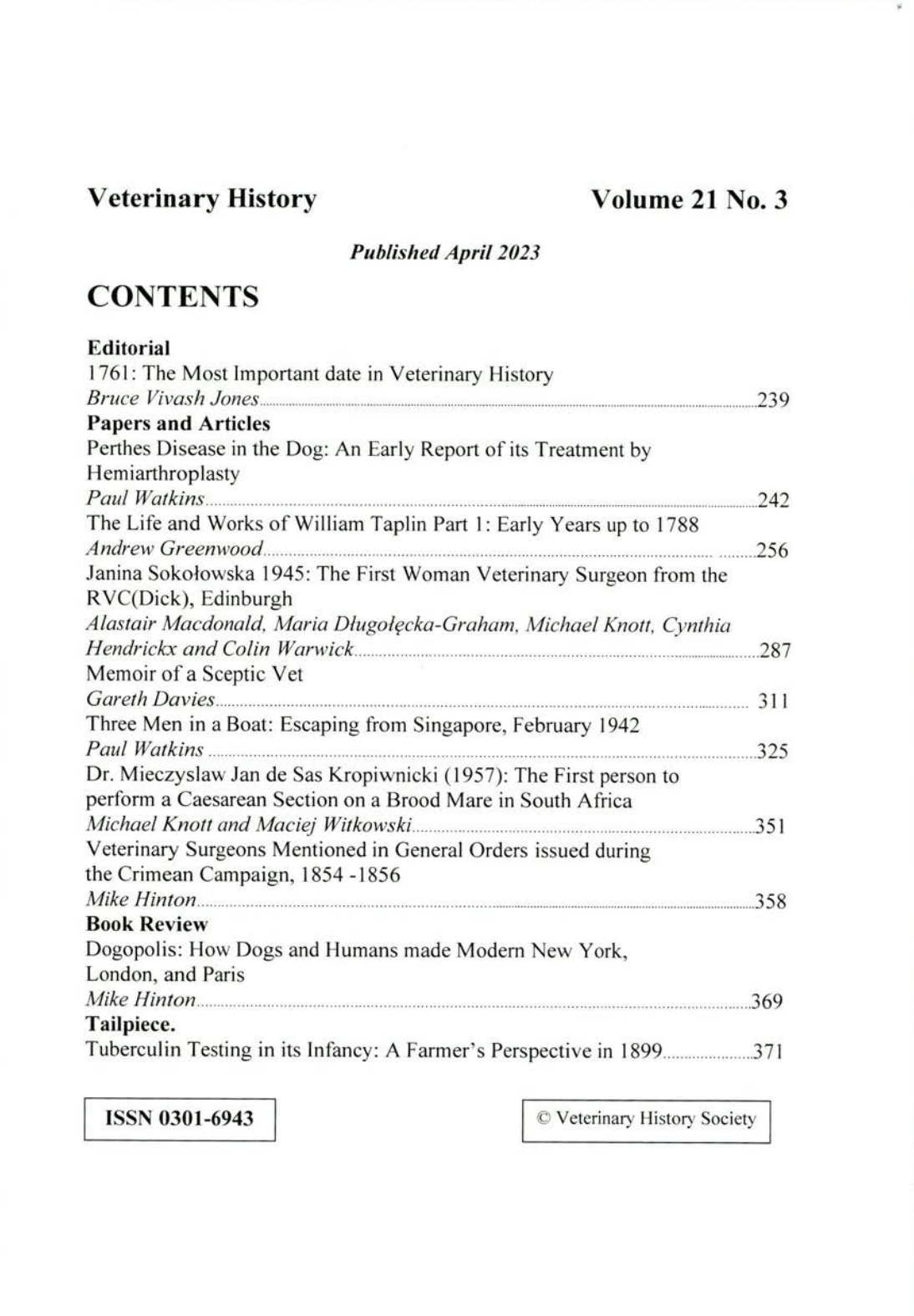
Perthes Disease in the Dog: An Early Report of Its Treatment by Hemiarthroplasty
Zbigniew Wincenty Doroszynski was born in 1916 in Lwow in Poland. He qualified as a veterinary surgeon in 1939. After joining the Polish Army, he was captured by the Russians and sent to Siberia, where he suffered terrible conditions. He was released in 1942 and the Polish Army was transferred to the Middle East, by the British Army, where they saw action. In 1944 he was at Monte Cassino, where he was injured. He was evacuated to Glasgow to be cared for there and discharged in 1945. The author describes the complicated process of giving permission for Polish vets to work in Britain. Doroszynski was awarded MRCVS in 1947. He worked in Edinburgh and Southport, before setting up his own practice in Wallesley., where he stayed for six years. He changed his name to Zbigniew Doroszynski Vincent in 1950, by deed poll. In 1956 he published a paper describing the treatment of Perthe’s Disease using a replacement stainless steel prosthesis. He and his family moved to South Africa in 1956 and settl4ed in Rondebosch. In 1988 they moved to Alderney, where he died in 1996.
Paul Watkins
The Life and Works of William Taplin (1750-1807). Part 1: Early Years up to 1788
William Taplin was probably the most successful veterinary author in his lifetime and a financially astute veterinary surgeon. Taplin was born 1740/50. He had an apprenticeship with an apothecary on the Strand in London. After he completed this, he pursued a career on the stage as an actor, marrying an actress, Harriet Dyer. The couple worked in various theatres in England and in Dublin. Harriett eloped with a fellow Irish actor, leaving Taplin with her large debts to settle. Taplin was always a keen hunter and he may have had financial support from his family to enable him to do this. He appears to have socialised with gentry and aristocracy and he later had many of them as equine veterinary clients. He produced a pamphlet on the state of game in England. He awas advocating various changes to the laws surrounding gamekeepers, poachers, trespass in order to improve the overall quality of game available to hunt. Taplin supported the career of the artist, Benjamin Marshall who equine paintings Taplin hung in his veterinary premises. Taplin appears to have set up a veterinary practice in Wokingham in c1781, but his veterinary work may have started a few years earlier as he published the book The Gentleman’s Stable Directory or Modern System of Farriery in 1788, with volume two in 1791. These books were very popular and ran to many editions. Taplin divides diseases into different groups, some based on anatomy and some based on symptoms. There are twelve classes, covering: limbs, skin, wounds, external swellings, respiratory disease, Fevers, worms, jaundice, strangles, glanders, staggers, convulsions, gastrointestinal complaints, urinary tract and eyes. The author deals with these sections in some detail.
Andrew G Greenwood
Janina Maria Sokolowska 1945 The First Woman Veterinary Surgeon from The Royal (Dick) Veterinary College, Edinburgh, Scotland
Janina Maria Sokolowska was born in 1914 in Lwow in Poland, she had nearly finished her veterinary training in 1939 when war broke out. The invading Russian Army captured many civilians, including Janina and her family, and they were sent to Siberia. The Polish captives were released in 1941 and Janina joined the Polish Army as a veterinarian. With British assistance, the Polish refugees were evacuated to Persia and then to Palestine. Janina was then given the responsibility of transferring 350 women to Britain, arriving in Scotland. She applied to the ‘Dick’ Vet School to complete her final year of training. About sixty Polish veterinary students completed their training in Edinburgh. The authors give a detailed account of the application process and the structure of the course for the Polish students. Janina received her diploma in 1945 and in the same year married a fellow Polish veterinary students Kazimierz Soltowski. They emigrated to the USA, where they settled in Chicago and then in Minnesota, where they spent the rest of their lives.
Allastair A Macdonald, Maria Dlugolęcka-Graham, Michael Knott, Cynthia Hendricks and Colin M Warwick
Memoir. The Diary of a Veterinary Sceptic
An autobiographical account of the author’s veterinary career. Davies graduated in 1960 and after tow years in practice, joined the Veterinary Investigation Service. He worked at Weybridge and was later sent to Kenya to be involved with the control of Contagious Pleuropneumonia., including a vaccine programme. He returned to Weybridge but transferred to the Central Veterinary Laboratory to be involved in the eradication of Brucellosis programme, proving central testing facilities. He was appointed to manage the Epidemiology Unit in 1975, providing advice about infectious farm diseases across the UK and Europe. He worked in Brussels developing policy on Foot -and -Mouth Disease. Davies worked in Bolivia, Turkey and the Balkan States to advise on control in infectious disease and the risks to spread of disease in to the European Union. Davies was involved in the Foot -and -Mouth Epidemic of 2001 and the discussion around the use of vaccination as an alternative to a slaughter policy.
Gareth Davies
Three Men in a Boat: Escaping from Singapore, February 1942
Thai is an account of the escape from Singapore by three veterinary surgeons in February 1942 after the Japanese invasion of the island. The three vets, George Rocker, William Orr and Ronald wright had all been employed as Government vets. The author outlines the colonial veterinary service in Malaya before the war and lists the vets employed there. The lives and careers of the three men are described. The threat of capture and being sent to a Japanese prisoner of war camp convinced the men the risks of escape were worthwhile. They set off in a small sailing launch; barely twelve feet in length and with no cabin. After 4 weeks of hazardous journeys in boats, buses, cars and on foot, with regular risk of attacks by Japanese planes and unfriendly locals, they eventually reached Freemantle in Australia, they encountered many other people fleeing Singapore. Their subsequent lives and return to Europe are outlined.
Paul Watkins
Dr Mieczyslaw Jan de Sas Kropiwnicki (1957): The First Person to Perform a Caesarean section on a Brood Mare in Africa
The first caesarean section carried out in a mare, and reported in the veterinary literature, was in 1908 in Hungary. This short paper described the first caesarean section in a mare in Africa, which was carried out in 1957 in South Africa.
Michael Knott, Maciej Witkowski
Veterinary Surgeons Mentioned in General Orders Issued During the Crimean War Campaign, 1854-1856
This is a list of the seventy-two mentions of a veterinary surgeon in the general orders issued during the Crimean Campaign, 1854-56. They mainly cover appointments and leaves of absence.
Mike Hinton