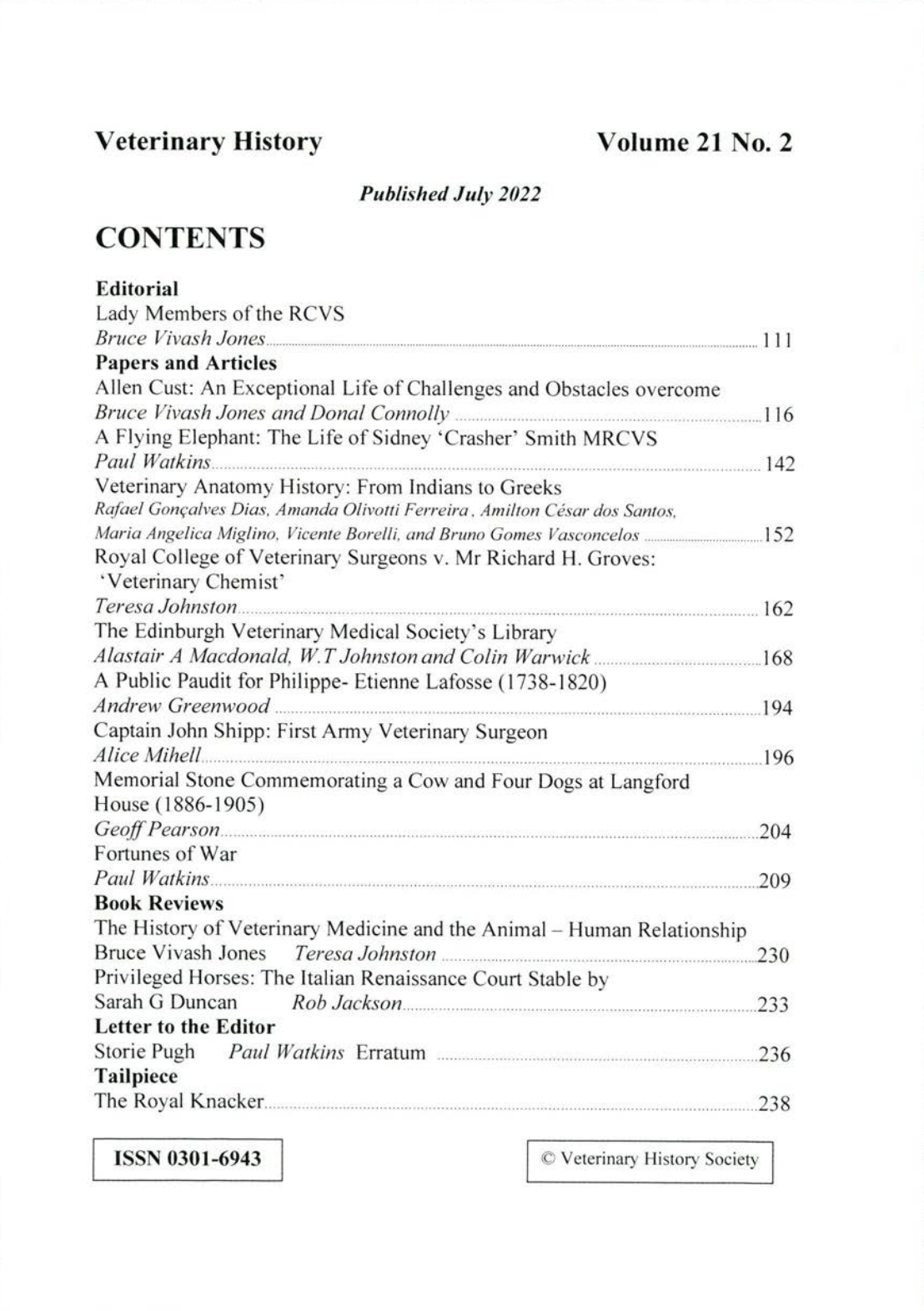
Lady Members of the RCVS
Brief biographies of four eminent female veterinary surgeons from the post-war generation: Joan Joshua, Olga Uvarov, Mary Branker and Madelaine Sheppard.
Bruce Vivash Jones
Aleen Cust: An Exceptional Life of Challenges and Obstacles Overcome
A biography of Aleen Cust, the first woman to be awarded a diploma by the Royal College of Veterinary Surgeons and allowed to call herself a veterinary surgeon. This occurred in 1922, which was over twenty years after she had qualified from the New Veterinary College in Edinburgh. Aleen Cust was born in 1868 into a wealthy family. In Co Tipperary, Ireland. Her father died when she was ten and the family moved to England. In 1894, having considered a career in nursing, enrolled at the New Veterinary College in Edinburgh, supported by her guardian Major Widdrington, but not by her mother. She completed the course in 1900, having had a successful academic career. She applied to The RCVS sit her professional examinations, but was refused as the examination committee did not believe they had the power to admit a woman. The Council of the RCVS were divided on the issue. Advise from a barrister was sought who advised the RCVS to refuse admission and to invite Aleen Cust to pursue the issue in a higher court. Aleen declined to this, probably due to costs and she did not want to embarrass her mother, who had been appointed Lady of the Bedchamber to Quenn Victoria. She went to work for William Byrne in Athleague, Co Roscommon, where she established a successful career, earning the respect of the local community. It has been suggested that she had to children with Byrne, who were adopted. Byrne died in 1910 and Aleen set up her own premises in Athleague and continued to prosper, one of her specialities being castration of colts. In 1914, she closed her practice and drove to France, where she worked with Frederick Hobday treating horses at the Western Front. When she returned to Ireland after the war, the political situation made it impossible for her to resume her old life. She moved to the New Forest in Hampshire. Her health deteriorated and she spent winters in warmer climates, including France and West Indies. She died in Jamaica in 1937 and was buried there.
Bruce Vivash Jones and Donal Connolly
A Flying Elephant: The Life of Sidney ‘Crasher’ Smith MRCVS
Sidney Smith was born in Lowestoft in 1886 and his father was a local veterinary surgeon. He qualified from RVC in 1907 and he returned to work with his father. In 1914 he was in the Army Veterinary Corps and promoted to Major. He volunteered to join the Royal Flying Corps. He acquired his nickname ‘Crasher’ after admitted to his commanding officer that her had damaged the undercarriage of three planes. He eventually was appointed to command the 27th Squadron. He became a wing commander and later Group Captain in the newly formed RAF. He never returned to the veterinary world and he died in 1957.
Paul Watkins
Veterinary Anatomy History: From Indians to Greeks
An account of the vary earliest writers on comparative anatomy. The earliest recorded animal anatomies, that of the horse and the elephant, were carried out by in India in 2350BC. Later writers on anatomy and physiology included Muni Palkapya and Asva Vaikyaka. In the Greek period in Europe there was a significant development in comparative anatomy by writers including: Alcmaeon, Empedocles and Democritus. Aristotle made major contributions to anatomical knowledge and made detailed and accurate observations on mammalian anatomy and function. Galen followed Aristotle with a significant advance in osteology, arthrology and myology. He also did major work on the nervous system, showing nerves emanated from the brain not, the heart, as had been previously believed.
Rafael Gonçalves Dias, Amanda Olivotti Ferreira, Amilton César dos Santos, Maria Angelica
The Royal College of Veterinary Surgeons v Mr Richard Henry Groves
In 1893, the RCVS prosecuted Richard Henry Groves, a pharmaceutical chemist for describing himself as a veterinary chemist. This was an important test case as to whether the adjective ‘veterinary’ could only be used my members of the RCVS. The RCVS lost the case, blaming a poor performance by their counsel in court. Various transcripts from the Veterinary Record and The Chemist and Druggist are given.
Teresa Johnston
The Edinburgh Veterinary Medical Society’s Library
The Edinburgh Veterinary Medical Association (later Society), EVMA/EVMS, was founded in 1834 by students at William Dick’s Veterinary College in Edinburgh. Dick encouraged the development of a library and also encouraged all students to have their own set of eleven recommended texts. A list of books owned by the society in 1842/3 and in 1857 are given. William Dick bequeathed his own library to the Society. The association met weekly between 7 and 9pm. THE Society had a closed relationship with the Highland and Agricultural Society of Scotland, who allowed their seal to be attached to certificates and diplomas issued by the EVMS. In 1873 the principal of the Dick’s Edinburgh college announced his intention to resign and set up a new veterinary college in Edinburgh. Most of the students left with him and there was a court case over the ownership of the library. It was transferred to the New Veterinary College in 1874. Unfortunately, a fire in 1884 destroyed the whole library.
Alastair A Macdonald, W T Johnston and Colin Warwick
A Public Plaudit for Phillipe-Etienne Lafosse (1738-1820)
A letter, published in 1789, in the Journal de Paris contained a very complimentary account of the successful treatment of a horse by Phillipe-Etienne Lafosse, who was a military veterinary surgeon and staunch revolutionary. He authored a number of important book son farriery.
Andrew Greenwood
Captain John Shipp. First Army Veterinary Surgeon
Following the debacle of the Flanders Campaign of 1794/5, when there was a very high mortality rate of the horses, it was decided that the army should employ veterinary surgeons to provide care for the horses. Edward Coleman, principal of the London Colleges since 1793 had reduced the course from three years to six months, to encourage the production of more qualified veterinary surgeons for the army, John Shipp qualified after one year at the college in 1796 and joined the 1th Light Dragoons, later transferring to the 23rd Light Dragoons. He saw active service in Europe, including at the Battle of Waterloo. Very little is known of his life after retiring from the army in 1818. He died in 1834 and was buried at West Hackney church. Following WW2 bombing damage, his gravestone was re-discovered and moved to the Aldershot army museum and then, in 2006, Melton Mowbray.
Alice Mihell
Memorial Stone Commemorating a Cow and Four Dogs at Langford House
Langford House became part of the University of Bristol Veterinary School in 1951. A small memorial garden was established for owners’ pets. There was already a large memorial on this site dating from the late nineteenth century. It commemorates a cow and four dogs. It was probably erected by Simon Sidney Hill, who bought the house in 1877. A transcript of inscription and pictures are given.
Geoff Pearson
Fortunes of War
The careers and history of nine Polish veterinary surgeons, who had come to Britain in 1940, following the Fall of France. They were allowed to settle in Britain kin 1945/6 following an examination process. Many of them had distinguished careers in research and government service both in Britain and overseas. Some returned to Poland. They included Hieronim Jozef Cembrowicz, Karol Stanislaw Chodnik, Alfred Ginsberg, Olgierd Rymaszewski and Wladyslaw Uruski.
Paul Watkins
A tablet to Edward Coleman in the parish church of Burwash
A brief account of the gravestone of Edward Coleman, principal of the London Veterinary College, in Burwash, Sussex.