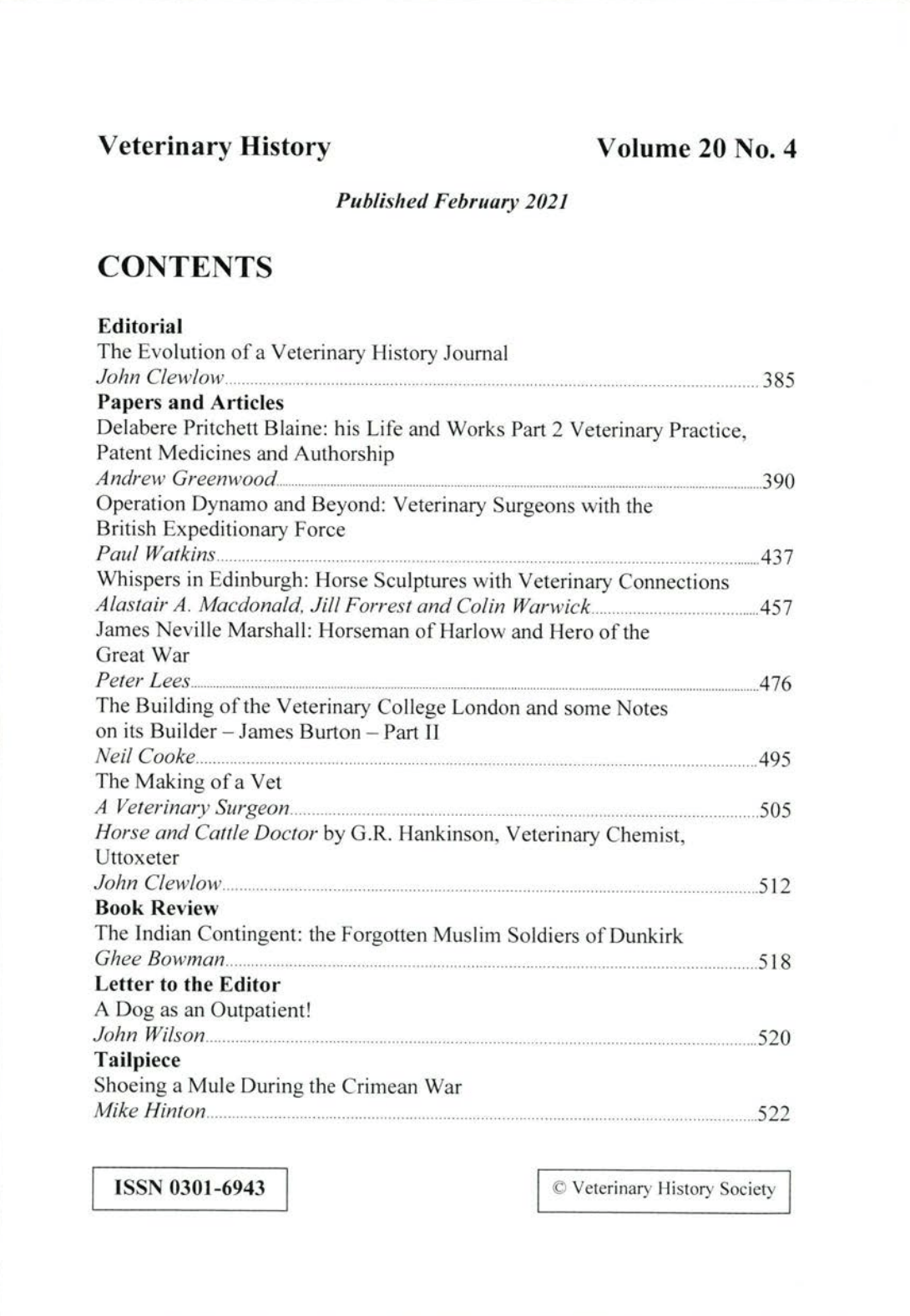
Delabere Pritchett Blaine: His Life and Works. Part 2 Veterinary Practice, Patent Medicines and Authorship
The second part of the life of Delabere Pritchett Blaine. It would appear Blaine had an illegitimate son, born in 1807, Delabere Roberton Blaine, who became a successful lawyer in London. The books written by Blaine in this stage of his life are listed and reviewed, including A Concise Description of Distemper in Dogs, published in 1800, which had four expanded editions up to 1806. The description of the epidemiology of the disease evolved with Blaine’s increased understanding. He sold powders to treat Distemper. In 1803, he published A Domestic Treatise on the Diseases of Horses and Dogs, which covered anatomy, lists of conditions and their remedies. He showed his fondness for dogs. Outlines of the Veterinary Art, appeared in 1802. this was a very successful publication, running to five editions in Blaine’s lifetime, as well as translated editions published in Europe. Blaine intended this volume to help the education of farriers, medical men and horse owners in the country, as most of the vets qualifying form the London College joined the Army. This book included a section on the history of veterinary medicine and the London college. The author provides a long and detailed account the sections in this book, covering anatomy, physiology structure and function, lists of diseases and their treatments. Blaine was in practice in London from 1804 until retirement in about 1817. He was initially based in Wells Street, where he was joined by Willaim Youatt. He later moved to Suffolk Street (renamed Nassau Street). In 1817, Blaine published Canine Pathology, which confirmed his status as the ‘father’ of canine veterinary medicine. In retirement he lived in Kings Langley and Newport on the Isle of Wight, where he married Mary Wavell in 1827. He died in 1845.
Andrew Greenwood
Operation Dynamo and Beyond: Veterinary Surgeons with the British Expeditionary Force
The British Army in 1939 was fully mechanised with horses being used only for ceremonial purposes. Despite this it was the condition of the roads in northern France was very poor, especially in winter and it was decided that there was a need for mule transport, which had been very effective t-in the First World War. The mules were obtained from India and there is an account of their acquisition and transport to France, where they arrived in December 1939. The responsibility for the care of the mules fell to Major JJ Plunkett. He had graduated from the Edinburgh College in 1914 and saw service with the RAVC in France. He was appointed Senior veterinary Officer with the British Expeditionary Force (BEF). Major F J Eardley was appointed to assist Plunkett. The defence of the Maginot Line and fighting in the Saar are described. The situation in France leading up to Operation Dynamo and the Dunkirk evacuation was confusing with the whereabouts of the Animal Transport Corps (ATC) being unclear but some men did escape from France. Plunkett returned to France to look for the other ATCs which were still missing in France, but some had been captured by the Germans and were now prisoners of war. Plunkett returned to UK after being rescued at sea after the sinking of the SS Lancastria. Major Eardley was the first British veterinary officer to be Captured by the Germans.
Paul Watkins
Whispers in Edinburgh: Horse Sculptures with Veterinary Connections
There are many equine statues in Edinburgh; a number of them have veterinary connections. These include the statue of Charles II outside the cathedral, which was repaired under the guidance of William Dick, principal of the Edinburgh Veterinary College. The authors also consider the equine statue seen on an early map in Nottingham Place. William Dick commissioned a statue to be erected at his veterinary college in Clyde Street. The history of an equine statue at the Lothian Road premises of Isaac Scott is described. The horse, cow and dog statue erected outside the New Veterinary College of William Williams is outlined.
Alastair A Macdonald, Jill Forrest and Colin Warwick
James Neville Marshall: Horseman of Harlow and Hero of the Great War
James Neville Marshall was born in 1887 in Manchester. He was educated in Birmingham and claimed to be a veterinary surgeon on the census of 1911, without having any formal qualifications. He also changed his name to Jasper, altered his birth date and location of birth to Grand Canary. He also added an extra name of Wellesley, when he married in1911. He practised animal medicine, especially for horses, in Harlow, Essex. He was prosecuted in 1913 for calling himself a veterinary surgeon, without any formal qualification. The case was dismissed as he claimed to call himself a ‘quack’ and that only other people referred to him as a veterinary surgeon. He also claimed to be successful at treating horses. In 1914, he joined the Belgian Army, having been rejected by the RVC. He joined the British Army in 1915 as a lieutenant. He was killed in the last battle of the War in 1918 at Sambre. He was awarded a posthumous Victoria Cross, having already received a Military Cross with bar.
Peter Lees
The Building of the Veterinary College London and Some Notes on its Builder James Burton – Part II
James Burton was born in 1761 in London. His surname was originally Haliburton, but his father had shortened it to Burton. He was apprenticed to a surveyor, and he began to supervise the construction of buildings eventually carrying out his own speculative house building projects. He appears to have joined the London Veterinary College in 1791 but did not work as a veterinary surgeon and may not have received a diploma. He produced plans for a new veterinary college building with Vial St Bel, the principal of the college. The building was in use by 1793, but building work continued for a few more years. Burton had many building projects all over London and may not have been involved in the actual building of the college. He also built a horse hospital in Bloomsbury, London. Burton eventually retired, a wealthy man, to St Leonards, where he died in 1837.
Neil Cooke
The Making of a Vet (and mental health)
A personal account of the life of a veterinary surgeon, who suffered from mental health problems and the help provided by hypnotherapy.
Anon
‘Horse and Cattle Doctor’ by G R Hankison, Veterinary Chemist, Uttoxeter
A description and history of the book ‘Horse and Cattle Doctor’ by G R Hankinson. Hankinson was a dispensing and veterinary chemist in Uttoxeter, Staffordshire. It was published in 1904. The Hankinson business had been founded in 1780, by Thomas Woolrich. The book included a list of animal ailments and the remedies he could supply for the conditions.
John Clewlow
Please note
Buy now