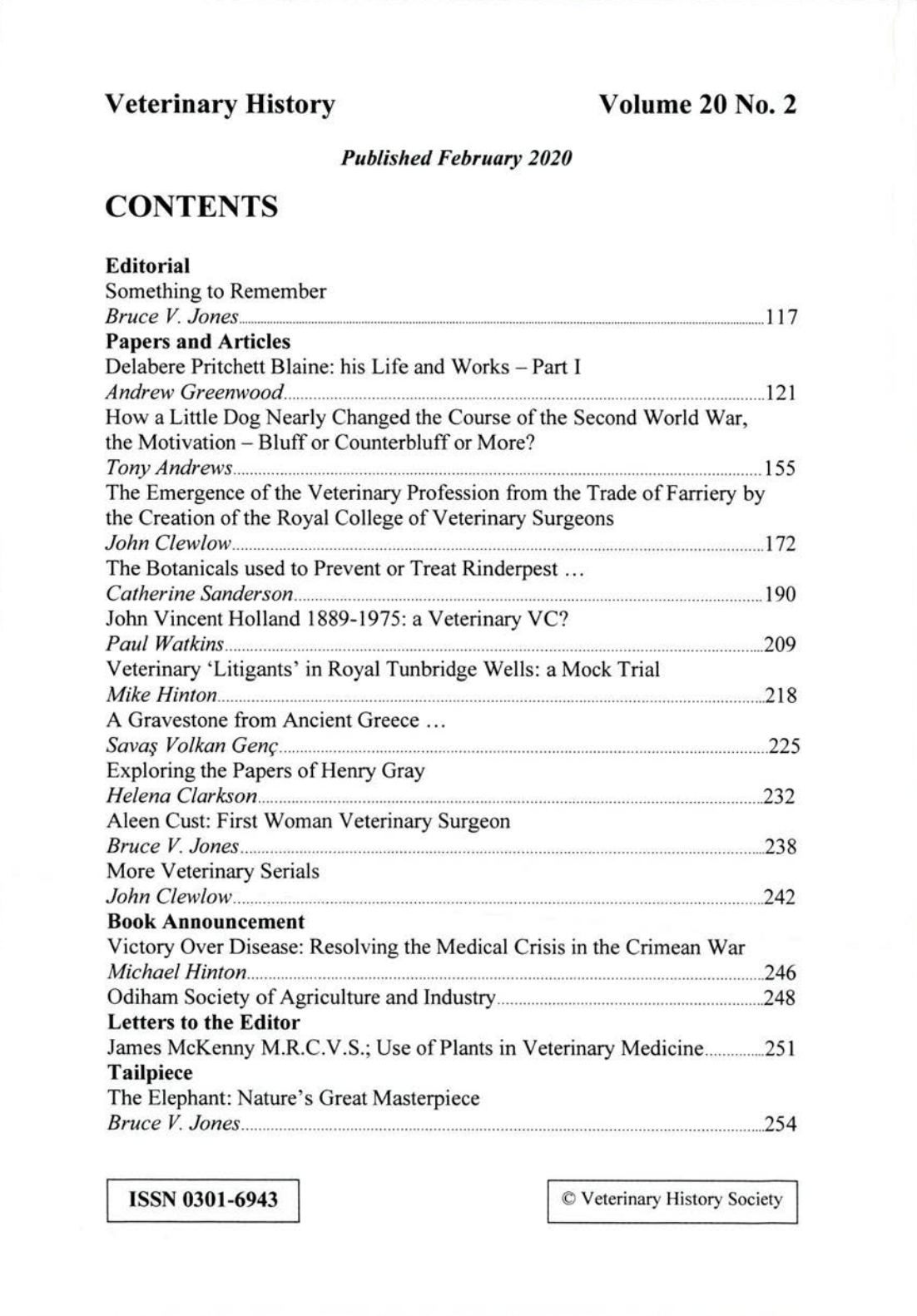
Delabere Pritchett Blaine: his life and works – part 1: early days to the Anatomy of the Horse
This article, the first of two articles on the life and works of Delabere Pritchett Blaine (1770-1845), covers Blaine’s life up to and including the publication of his Anatomy of the Horse in 1796/1797. Detailed information on the three published formats of the work is provided as well as descriptions of the individual monthly parts of the first version issued. Information on Blaine’s family, education and brief time as anatomy demonstrator at the London Veterinary College are also given.
Andrew Greenwood
How a little dog nearly changed the course of the Second World War, the motivation – Bluff or Counterbluff or more?
Nathalie “Lily” Sergueiew worked as a double agent, code name ‘Treasure’ for MI5 in World War II. This article gives an account of her life with a focus on her role in the deceptions about the location of the D-Day landings in 1944. Information is given on Sergueiev’s dog ‘Babs’, on her request to have Babs brought to Britain, and on her threat to stop working for the British when Babs did not arrive.
Tony Andrews
The emergence of the veterinary profession from the trade of farriery by the creation of the Royal College of Veterinary Surgeons
This article describes how the veterinary profession emerged from the work of farriers and other animal healers with the creation of the Royal College of Veterinary Surgeons. Information on animal healers, including farriers, in the 18th century is given. The changing agricultural practices of the time and the formation of Agricultural Societies, including the one at Odiham which called for formal training of farriers, is discussed. This call led to the founding of the London Veterinary College in 1791. The article then describes how Thomas Mayer and his son Thomas Walton Mayer led the campaign for reform at the London College following the death of its Professor Edward Coleman, this campaign ultimately led to the creation of the Royal College of Veterinary Surgeons by Royal Charter in 1844 and the creation of the veterinary profession. A brief history of the Royal College of Veterinary Surgeons following the granting of the charter until 1948 is also given.
John Clewlow
The botanicals used to prevent or treat rinderpest and murrain in 18th & 19th Century Europe: a knowledgeable choice of herbs?
This article considers the botanical ingredients used to treat rinderpest and murrain in Europe in the 18th and 19th century. A total of 253 recipes for treating these diseases were found in publications from the period, from these the botanicals used to treat each disease, and their prevalence, were identified. For rinderpest the most commonly used botanical ingredients were juniper berries, garlic and rue, for murrain they were rue, camphor, honey and treacle. Information is also given on the socio-economic consequences of rinderpest and murrain and actions taken by the state to control them, and on the preparation and administration of the remedies.
Catherine Sanderson
John Vincent Holland 1889-1975: a veterinary VC?
This article discusses the life and career of John Vincent Holland with focus on the actions that led to his nomination for the Victoria Cross, the highest award for gallantry. In February 1915 Holland was commissioned in the Leinster Regiment serving at Ypres, the Battle of Loos and on the Somme. In 1916 he was awarded the Victoria Cross for his actions at the Battle of Guillemont. Holland’s life before and after World War 1 are also covered.
Paul Watkins
Veterinary ‘litigants’ in Royal Tunbridge Wells: a mock trial
This article describes an account of a ‘mock trial’ which was staged as part of the 1928 Annual General Meeting of the South Eastern Division of the National Veterinary Medical Association. The article is an edited abstract of the proceedings of the meeting which were published in full in the Veterinary Record. Brief biographical details are given for the key ‘actors’ taking roles in the mock trial.
Mike Hinton
A gravestone from ancient Greece: an early example of the relationship between man and dog
This article discusses the ‘Grave Stele of the Dog Parthenope’ which is exhibited in the Museum of Archaeology in Istanbul. The gravestone is described in detail with accompanying illustrations; two possible translations of the Greek inscription are given. The article then discusses the gravestone as a historical example of the importance of human-animal relationships.
Savaş Volkan Genş
Exploring the papers of Henry Gray
This article describes material in the archive of Henry Gray, held at the Royal College of Veterinary Surgeons, focussing on his views, and those of veterinary surgeons, including E. Wallis Hoare and Harold Leeney, with whom he corresponded on the state of the veterinary profession in the early years of the twentieth century.
Helena Clarkson
Aleen Cust: first woman veterinary surgeon
Aleen Cust 1868-1937 was the first woman to join the RCVS Register, following the passing of the Sex Disqualification (Removal) Act 1919. This article discusses Cust’s life and career, with particular focus on her studies at the New Veterinary College in Edinburgh, the RCVS’ refusal of her application to sit the first Professional Examination in 1897, and her subsequent qualification as a member of the Royal College of Veterinary Surgeons in 1922. Cust’s time working in Roscommon, Ireland and her time serving in France from 1915-1918 are also briefly covered.
Bruce Vivash Jones
More veterinary serials
This article considers a number of early veterinary books which were originally published in weekly, fortnightly or monthly ‘parts’ or ‘numbers’. This includes W.J. Miles’ Modern Practical Farriery, James White’s A compendium of the veterinary art and A complete system of veterinary medicine as well as works by William Youatt.
John Clewlow
Please note
Buy now