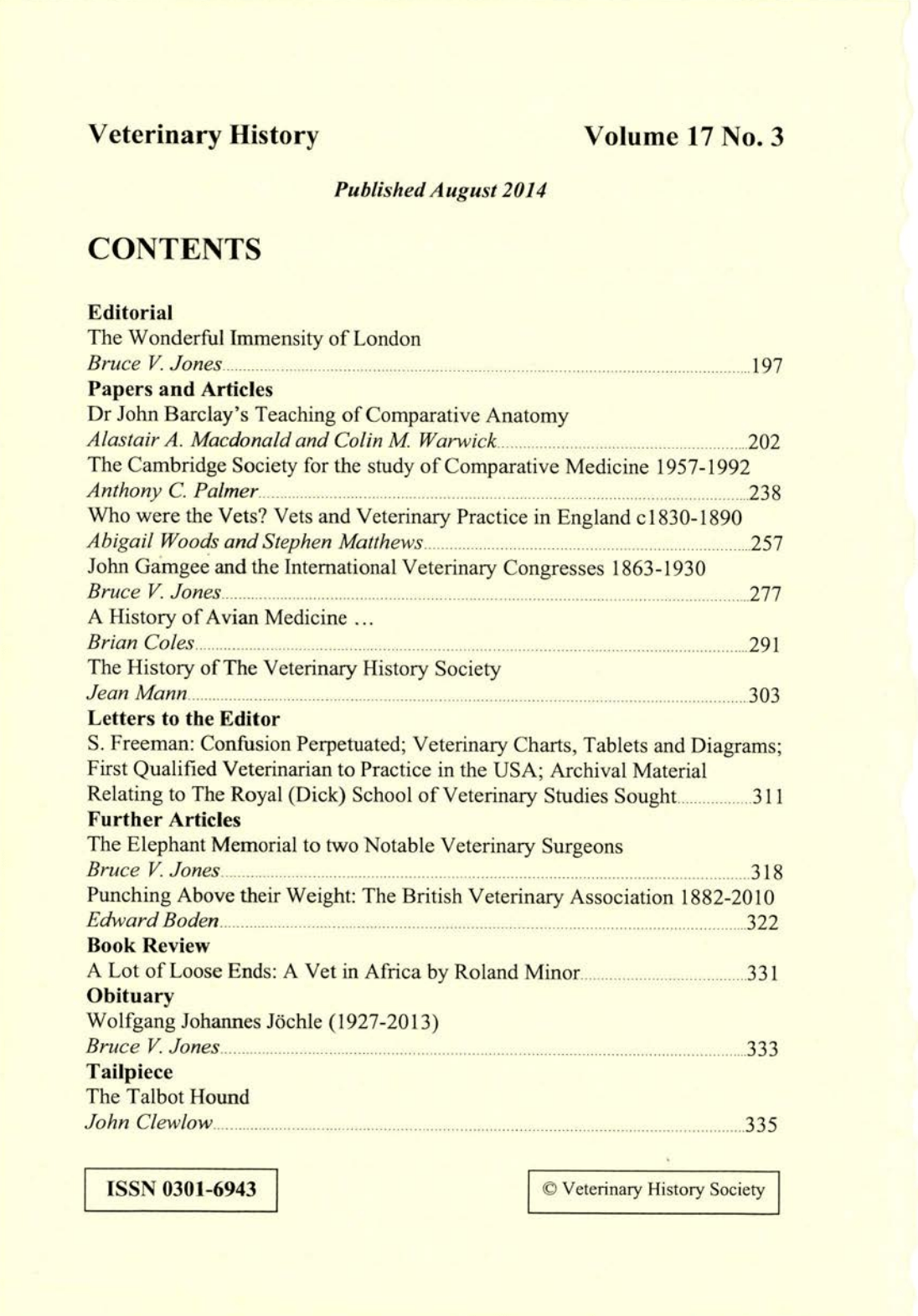
Dr John Barclay’s Teaching of Comparative Anatomy
Dr John Barclay (1758-1826), born in Perthshire, initially studied arts and divinity before attending medical school in Edinburgh. He became a well-respected teacher of anatomy in Edinburgh, providing courses from 1797 from his premises at 10 Surgeon’s Square. From 1802 until his death, he also gave a course in Comparative Anatomy, aimed at a range of professions, including farriers. It comprised 60 lectures given in the summer months (May to July). This paper, based heavily on lecture notes from Robert Grant in 1821, describes in detail both the lecture programme and the extensive dissection schedule undertaken by students. There is also a description of Barclay’s museum of comparative anatomy. Amongst those attended in 1815 was William Dick, who would subsequently provide some teaching on the course.
Alastair A Macdonald and Colin M Warwick
The Cambridge Society for the Study of Comparative Medicine 1957-1992: An Exercise in ‘One Health’
The origins of this society may be traced to 1919 and the vision of Sir Clifford Allbutt for a ‘central institute of comparative pathology’ in Cambridge. The society was formed in 1957 by both medical practitioners and veterinary surgeons, holding their first meeting the following year.
This paper provides a detailed overview of the society, its administration, and the scientific programme. Many of the speakers were eminent in their fields, at least one being a future Nobel Prize winner.
The author also provides an overview of comparative medicine in the UK, and provides a resume of the foundation and work of the Wellcome Laboratory for Comparative Neurology at Cambridge, combined with a synopsis of his own veterinary career.
AC Palmer
Who were the Vets? Vets and Veterinary Practice in England c 1830-1890
This paper provides a detailed analysis of the veterinary profession in the Victorian era identifying a disparate group of individuals with the general status of tradesmen. Initially, vets may or may not have had formal qualification, but the impact of the 1881 legislation on this is discussed. Work by vets primarily involved horses, although in private practice there was often a need to supplement income through a part-time public appointment, and /or establishing a veterinary infirmary or veterinary forge. The significant difference between provincial and London based vets is illustrated both by the fee structure and their involvement with the emerging fields of veterinary politics and governance.
Abigail Woods and Stephen Matthews
John Gamgee and the International Veterinary Congresses 1863-1930
Eleven congresses were held over 67 years, the first in Hamburg. The driving force for that meeting was John Gamgee (1831-1894) a man considered by many to be dogmatic, but of significant talent and foresight. The programme of the initial congress was dominated by discussion of infectious diseases of livestock. Over the coming years, the congress grew in size, both in respect of the programme and the number of delegates. All meetings were held in Europe. The paper provides a detailed overview of each congress, and traces the development of various themes in veterinary science. There is description of later developments and the subsequent formation of the World Veterinary Congress.
Bruce Vivash Jones
A History of Avian Medicine and How This Has Gradually Developed Together with Man’s Growing Interest in Ornithology
This paper reviews the history of avian medicine, carefully identifying the first treatments for birds in a Zoroastrian text from 6500 BC. A review of subsequent publications provides descriptions of further historical events from a range of civilizations who maintained and cared for a range of birds. The final section of the paper details more recent developments in avian medicine, especially since the 1960s.
Brian Coles
The History of the Veterinary History Society
In 1954 the first ideas for a veterinary history society took form, with the initial meeting held in 1962. The society itself was officially launched in 1964. Some 10 years later the first edition of Veterinary History was published. The paper details the development and activities of the society, its meetings (including links with the World Association for the History of Veterinary Medicine) and its philanthropic activities. A list of those who have served as Chairman and Secretary of the society and Editor of Veterinary History is provided.
Jean Mann
The Elephant Memorial to Two Notable Veterinary Surgeons
This paper provides details and provenance to the skeleton of an elephant which has been in the possession of the Royal Veterinary College since circa 1880. It is one of several elephants owned by Sanger’s Circus, housed near Westminster Bridge, which had died following diarrhoea. Postmortem examinations were undertaken by John Henry Steel and Frederick Smith (who had only recently qualified). The celebrated parasitologist, T Spender Cobbold, examined material from the animals and was able to identify twelve species of internal parasites. Both Smith and Steel would subsequently have exemplary careers in the veterinary profession.
Bruce Vivash Jones
Punching Above Their Weight: The British Veterinary Association 1882-2010.
Veterinary surgeon George Banham was the driving force behind establishing the National Veterinary Association (NVA) in 1882, having seen the success of the British Medical Association. George Fleming was the first president, and over 200 members joined. The NVA was responsible for an annual meeting whose programme encompassed current concerns of practitioners, clinical papers and educational topics. However, as it grew the machinery of organisation was noted to be cumbersome.
The NVA played an important role in World War 1, and in 1920 acquired the Veterinary Record and was renamed the National Veterinary Medical Association. The association became closely involved with numerous initiatives in the field of public health and hygiene.
The paper reflects on these and other developments of, since 1952, the British Veterinary Association and casts an eye to the future of the Association.
Edward Boden
Please note
Buy now