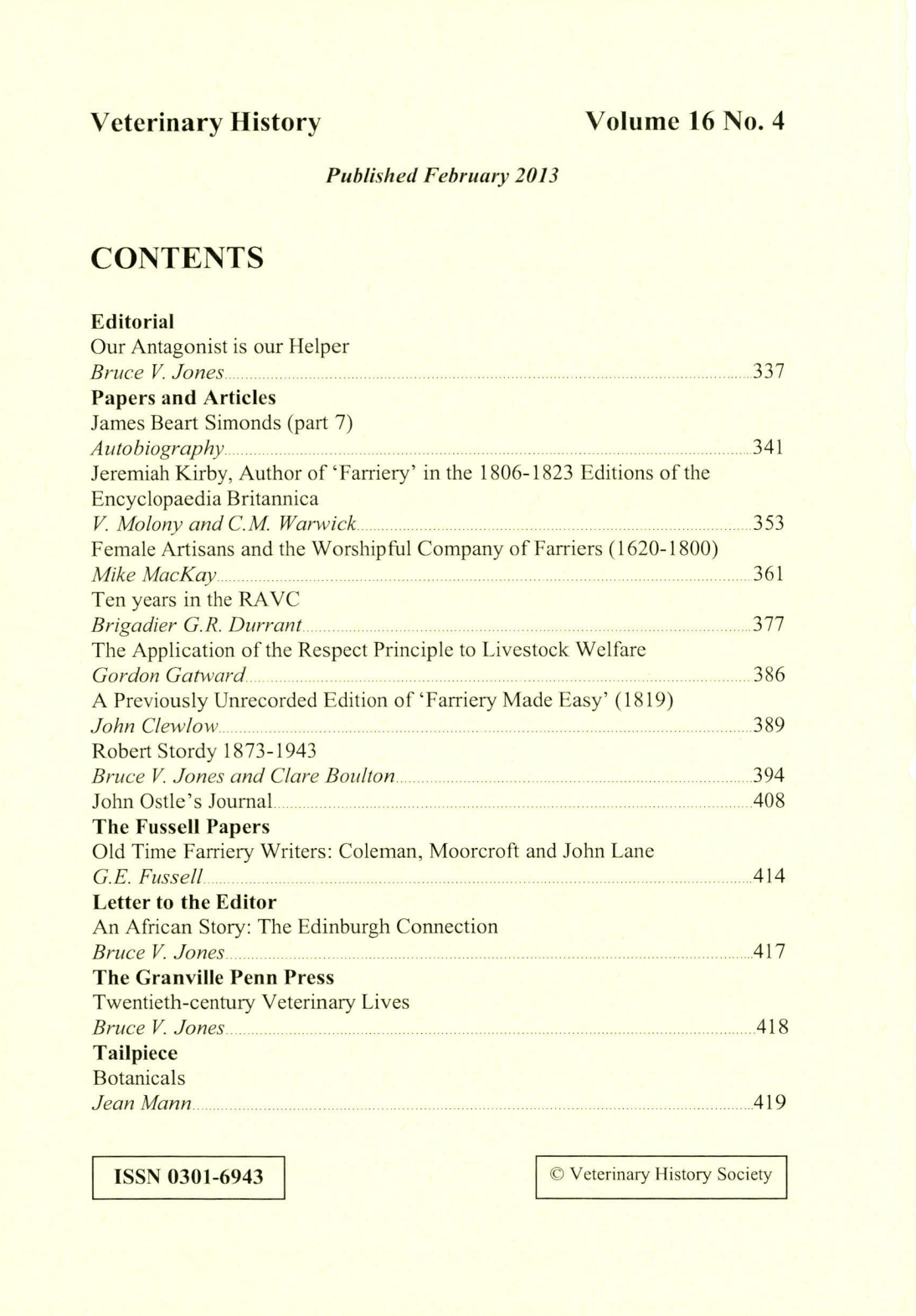
James Beart Simonds. Autobiography – Part 7
Part 7 of the autobiography of James Beart Simonds, covering the years 1865-1872, covering his personal observations and opinions about the Rinderpest outbreaks of 1865 and 1972 in the UK and Europe.
Jeremiah Kirby, Author of ‘Farriery’ in the 1806-1823 Editions of the Encyclopaedia Britannica
Jeremiah Kirby was born in 1774 in London and qualified in medicine in 1802 from Edinburgh. He was a significant author of medical and scientific works. He was commissioned to write an article on farriery and veterinary medicine for the 4th edition of the Encyclopaedia Britannica in 1806. This article was also used in the 5th and 6th editions. It had six sections: History; Anatomy of Horse; Operations Performed on Domestic Animals; preserving Health of Domestic Animals; Veterinary Materia Medica and Diseases of Domestic Animals.
V Molony and C M Warwick
Female Artisans and the Worshipful Company of Farriers (1620-1800)
A history of the Worshipful Company of Farriers, founded in 1673, although farriers (also called Marshals) had been recognised by the Mayor and Aldermen of London in 1356. The author looks at apprentices – their fathers’ occupations and their origins. There were legal attempts to control farriers and force them to be part of the Farriers’ Company. Despite this a lot of a farriers operated outside the control of the guild. There were a few women recorded as masters, usually following their husbands’ deaths. They enjoyed the privileges (but not the title) of freemen. They were able to have apprentices.
Mike MacKay
Ten Years in the RAVC
The personal recollections of Brigadier G R Durrant, who joined the RAVC in 1966 after two and half years in general practice. He was stationed at Melton Mowbray, responsible for the canine and equine patients as well as some form animals. He was transferred to Singapore to join the Gurkha Dog Company. There was a major outbreak of Tropical Canine Pancytopenia (caused by Ehrlichia canis) A lot of pets were owned by service families and were looked after by the RAVC. After a short spell at Melton Mowbray, Durrant was sent to Southern Oman and spent seven months there, responsible for veterinary care and improving husbandry of a large variety of livestock. He was then attached to the the King’s Troop, Royal Horse Artillery in London., involved in the ceremonial duties of the troop. The next posting was to Hong Kong and Nepal, working with the Brigade of Gurkhas.
G R Durrant
The Application of the Respect Principle to Livestock Farming
The Brambell Commission report of 1865 looking at the welfare of animals kept under an intensive livestock husbandry outlined the five freedoms of farm animal welfare. The welfare of farm animals is very dependant on the character, experience and knowledge of the stockmen. The author outlines the importance of both the quality of stockmanship and the empathy and care shown by the stockmen.
Gordon Gatward
A Previously Unrecorded Edition of ‘Farriery Made Easy’ by A Veterinary Surgeon (1819)
The description of a unique copy of the second edition of the book ‘Farriery Made Easy’, published in 1819. The author describes the contents and the differences from other editions.
John Clewlow
Robert Stordy 1873-1943
Robert Stordy can be regarded as the founder of the Colonial Veterinary Service, which made considerable improvements to the health and husbandry of livestock in the British Empire, especially Africa. Stordy was born in 1873 and qualified form Edinburgh and joined the RAVC. After service in Egypt and India, he returned to the UK and achieved an MD degree in 1893. he was sent to British East Africa in 1898, where he lived until the outbreak of the Great War in 1914. he was responsible for building up a veterinary service, to help combat the epidemics of Rinderpest, East Coast Fever and Pleuropneumonia. He was able to get the trust of most cattle owning chieftains and help to improve husbandry and also disease prevention and control. Stordy has left a unique description of his 2000-mile journey, on foot, across Abyssinia form Nairobi to the Red Sea in 1911. After the Great War, he spent ten years in Peru, setting up a model livestock farm. During the Secoind World war he was CHIEF Executive Officer for the National Air Raid Precautions Animals Committee, NARPAC.
Bruce Vivash Jones and Clare Boulton
John Ostle’s Journal 1865-67
Some diary entries about the Rinderpest outbreak of 1865 as it affected the community in Cumbria of the author.
Old Time Farriery Writers: Coleman, Moorcroft and John Lane
A review of the farriery writings of Edward Coleman, Principal of the London Veterinary College, William Moorcroft – a veterinary surgeon from London and John Lane – a veterinary surgeon from London.
G E Fussell
Please note
Buy now