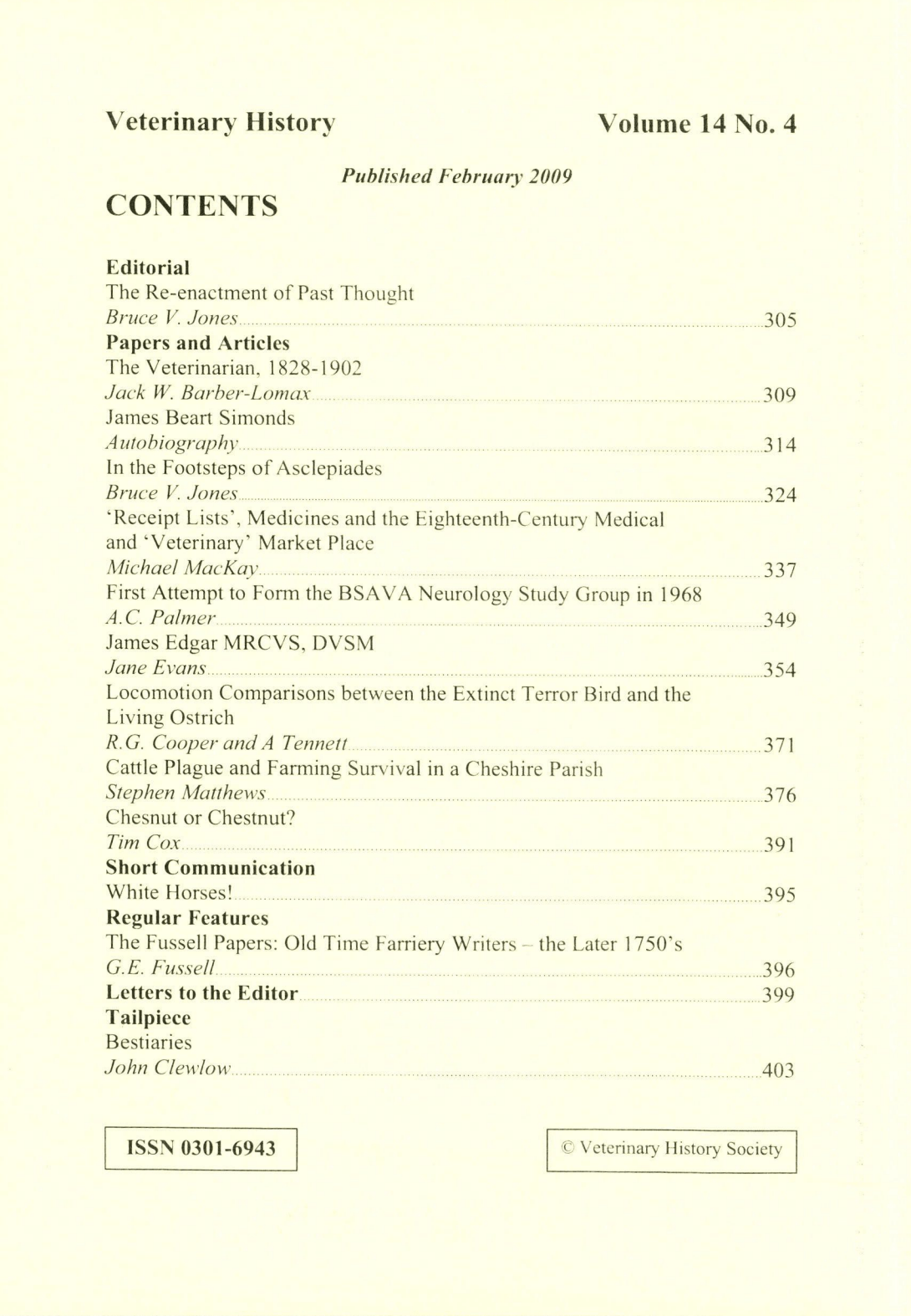
‘The Veterinarian’, 1828-1902
A history of the journal ‘The veterinarian’ which was published between 1828 and 1902. The journal was launched by William Percivall and received enthusiastic support form William Youatt. They were supported by John Percivall, father of William. William Percivall resigned in 1831 and Youatt was in sole charge until his death in 1847, when William Percivall took over again. In 1855 the journal was sold to the London College and became their journal. Its popularity declined and the journal was only published intermittently, with the last one in 1902.
J W Barber-Loma
James Beart Simonds, Autobiography – Part 1
James Beart Simmonds was born in 1810. An outline of his family history is given, including his descent from a Norman family, who arrived with William the Conqueror. He qualified from the London College in 1829 and went to work in Suffolk. He moved to London in 1836 ands built a new veterinary infirmary. He was involved in the early recognition of Foot-and -Mouth Disease in the UK.
In the Footsteps of Asclepiades
A transcript of a list of six cures for some equine and canine ailments, written in 1799. The conditions covered are: ‘staggers’ in horses – covering a range of possible conditions, ‘strangury’ in horses – problems with micturition, the use of diuretics, treatment of a ‘cold’ in the horse, probably equine influenza and mange in the dog. The author traces prescriptions back to Asclepiades, a physician in 1st-2nd century BC Rome. His maxim included four components to any prescription, whose actions should cure, quickly, safely and pleasantly. The components were called – basis, adjuvant, corrective and excipient.
Bruce V Jones
‘Receipt Lists’ Medicines and the Eighteenth-Century Medical and ‘Veterinary’ Market Place
Throughout the eighteenth century it was very popular to collect recipes for horse pills. These were called ‘receipt lists’. They were often written in small pocket-sized notebooks. They were kept by farriers, farmers, gentry and horse owners. Sometimes they recorded detailed information as to where any ‘recipe’ had come from. William Gibson published his ’The Farrier’s Dispensary’ offered a more scientific approach to treatments, drawing on a lot of earlier veterinary writers and his experience as a surgeon. Many aristocrats were spending large amounts of money on their horses and there was a lot of money to be earned by men treating horses and supplying treatments William Hunter, James Clark, WillIiam Moorcroft and Delabere Blaine are examples of wealthy practitioners.
Michael Mackay
First Attempt to Form the BSAVA Neurology Study Group in 1968
A history of the development of a veterinary neurology study group. This was first suggested in 1968 and was initially successful in holding meetings with good support. By mid-1970s attendance at meetings had fallen and the group stopped in 1976. Five years later, it started again and has been going strongly ever since.
A C Palmer
James Edgar MRCVS DVSM
James Edgar was born in 1893 and graduated, as a veterinary surgeon, from the ‘Dick’ School in Edinburgh. He served in the RAVC during the First World War. In 1924 he settled in Shanghai with his wife. He became a partner in a busy small animal veterinary practice. James’s great interest was dairy cattle and he became involved in the care a very large dairy herd. He eventually had his own dairy farm. Another project was the very active greyhound racing track and he was responsible for the veterinary supervision. He was arrested and interned by the Japanese after they seized Shanghai. He was in prison for three and a half years, in terrible conditions and suffering. After the was he returned to Scotland, where he had a dairy farm. He died in 1976.
Jane Evans
Locomotion Comparisons Between the Extinct Terror Bird and the Living Ostrich
A proposal of a model of limb strength supporting body weight during defence and predation. The Terror Bird is an extinct bird from the Palaeocene to Pleistocene Eras. The Ostrich developed in the Miocene period. Mathematical calculations are given of this model.
R G Cooper and A Tennett
Cattle Plague and Farming Survival in a Cheshire Parish (Astbury)
A detailed account of the Cattle Plague (Rinderpest) outbreak of 1865-66 as it affected the parish of Astbury in Cheshire. The Astbury parish magazine contained an article by the local Rector giving the figures of losses of cattle belonging to individual famers and in different village and townships. This provides an interesting account of how the effects of Rinderpest varied from place to place and farmer to farmer. Overall, in Cheshire 84,000 cattle died and 9,000 survived.
Stephen Matthews
Chesnut or Chestnut?
The original adjective for golden or yellowish-brown horses was sorrel. This gradually changed to chesnut because the roasted sweet chestnut more resembles the colour of these horses. Horse chestnuts and conkers were not introduced until 1600 and this has led to confusion between chesnut and chestnut. The colour of a conker would not be an accurate description of the pale brown horses. Wetherby’s, the keeper of the General Stud Book has been concerned about this confusion and they regard chesnut as the correct adjective for these pale-brown horses and bay for the darker coloured horse. They persuaded Oxford English Dictionary to change their entry for ‘chestnut’ with respect to horse colour.
Tim Cox
White Horses!
It has been discovered that white horses carry a defective gene which accelerates ageing and turns their hair coats grey. Today, about one in ten horses carry this mutation and this my have been the result of deliberate selective breeding for this characteristic. White horses have often been associated with kingship and legend.
Anon
Old Time Farriery Writers: The Later 1750s
An account of the farriery writings of Sieur La Fosse, William Osmer, John Wood and John Reeves. La Fosse’s work was translated from French and published in 1755.
G E Fussell
Please note
Buy now