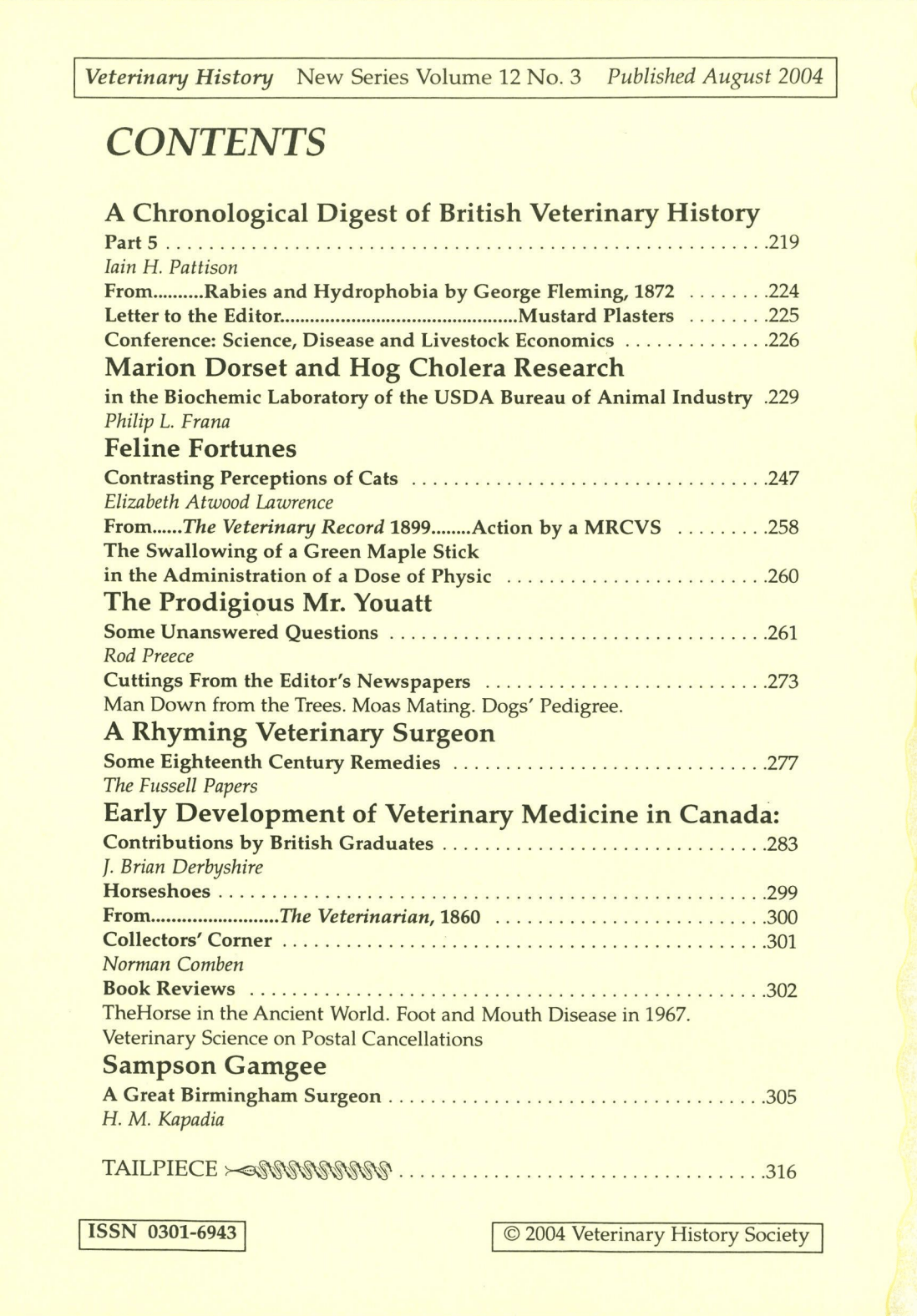
A Chronological Digest of British Veterinary History, Part 5: 1865-1876
This period covers the Cattle Plague epidemic; The death of William Dick; the foundation of the New Edinburgh School by William Williams; the Introduction of a preliminary examination to be accepted by the veterinary schools in London, Edinburgh and Glasgow; The arrival of Fitzwygram and Fleming at the RCVS and the 1876 charter.
Iain H Pattison
Marion Dorset and Hog Cholera Research
Marion Dorset was born in 1872 in Tennessee and became one of the foremost agricultural chemists of his day. He worked at the Biochemic Laboratory, where the two main problems were Tuberculosis and Hog Cholera. Hog cholera (Classical Swine Fever) was a devastating condition and killed six million pigs at the height of the epidemic in 1887. Attempts to isolate a bacterium, and apply Koch’s postulates to it, proved unsuccessful. Dorset was able to prove that the organism causing Hog Cholera was much smaller than a bacterium. Dorset carried out many experiments using serum from immune sows to protect susceptible animals, which proved to be successful. He combined this with the use of tuberculin and infective filtrate and was eventually able to produce life-long immunity.
Philip L Frana
Feline fortunes: Contrasting Perceptions of Cats
The changes in the way in which cats were perceived by human societies at different stages of history. Ancient Egypt was where Cat was first domesticated by second century BC. They were appreciated as killers of rodents and as pets. The goddess Bastet had a feline form and cats lived in the scared parts of the temples. Early modern Europe was not a safe place for cats and terrible tortures and killings were suffered by cats. The association with the Devil and witchcraft was one of the causes of this cruelty. The author describes the ‘Great Cat Massacre’ in Paris of the late 1730s. Pope Innocent III ordered the killing of every cat in Christendom, which may have been a contributory factor in the rapid spread of The Black death by rats. The author recounts the experience of veterinary training in the 1950s, when treating ats were regarded as being the dignity of most vets.
Elizabeth Atwood Lawrence
The Prodigious Mr Youatt: Some Unanswered Questions
William Youatt (1776-1847) was one of the accomplished and colourful characters in the infancy of the British veterinary profession. He was editor of The Veterinarian, a lecturer at the new University College, and a prolific writer, whose books were standard texts for decades. An account is given of a public disagreement between Youatt and Thomas Barnes, editor of The Times. Youatt had written a book about the cruelties and neglect suffered by racing horses once their careers were over. This was aggressively challenged by Barnes. Despite several letters of support from other veterinary surgeons and the SPCA (later RSPC), Barnes refused to back down. Some examples of this suffering are described. Youatt appeared to have had several enemies in the veterinary world and his bad relationships with Edward Coleman and Bracy Clark are recounted. In 1837 the SPCA offered a prize for the best essay encouraging greater kindness to animals. It was won by Rev Dr John Styles, who plagiarised extensively from the essays of Youatt and another entrant, William H Drummond in the book version of his winning essay. This was reported in The Veterinarian by William Karkeek. Youatt’s books were published under the auspices of the Society for the Diffusion of Useful Knowledge.
Rods Preece
A Rhyming Veterinary Surgeon: Some Eighteenth-Century Remedies
Ernest Thurston, a farmer from Suffolk, printed a manuscript with a collection of cures for various diseases of horses and cattle in c1767. It had an introductory poem of doggerel verse, quoted in full. The cures were later published in a little book by John Wilson in 1784. Some of the herbal and other chemical substances are discussed.
G E Fussell
Contributions by British Graduates to the Early Development of Veterinary Medicine in Canada
The first successful veterinary school in Canada was founded in 1862 as the Upper Canada Veterinary College. Prior to this date, the only vets working in Canda were small numbers of immigrant, mainly British, graduates. The first three qualified vets to settle in Canada in the 1840s in Montreal were James Mason, Joseph Turner and John Maybell. They tried to set up a veterinary college but this was not a successful venture. Two other early veterinary arrivals were Mari A Cuming and Edward Hagyard who set up practice in New Brunswick and Ontario respectively in about 1850. Griffith Evans, who was attached to the Royal Artillery and stationed in Canada, later had a distinguished academic career and discovered the cause of Surra as a Trypanosome. Andrew Smith was appointed in 1861 to set up a veterinary college in Toronto, which was very successful, although there were concerns over educational standards. Duncan McEacheran arrived in Montreal in 1866 and set up a veterinary college, initially successful but closed in 1902 due to lack of students and financial problems.
L Brian Derbyshire
Sampson Gamgee: A Great Birmingham Surgeon
Sampson Gamgee was born in 1828, whose father was the famous veterinary surgeon and teacher Jospeh Gamgee. Sampson was a graduate of the RVC, but had also been a student at University College Hospital, where he shared lodgings with his friend m Joseph Lister. Gamgee had a distinguished academic record, winning five gold medals. He was superintendent of a military hospital in Malta during the Crimean War. In 1857 he was appointed to the post of surgeon at the Queen’s Hospital in Birmingham. Initially, the only operations carried out were mainly for strangulated hernias, bladder stones, fractures and wounds His first major operation was the amputation at the hip joint to removes cancerous femur in 1862. He also carried out the first abdominal section in 1865. It is thought he was the first surgeon in Birmingham to wash his hands before operating. He revolutionised the treatment of fractures. His name is still associated with his famous dry absorbent dressing – Gamgee Tissue. Gamgee died in 1886.
H M Kapadia
Please note
Buy now