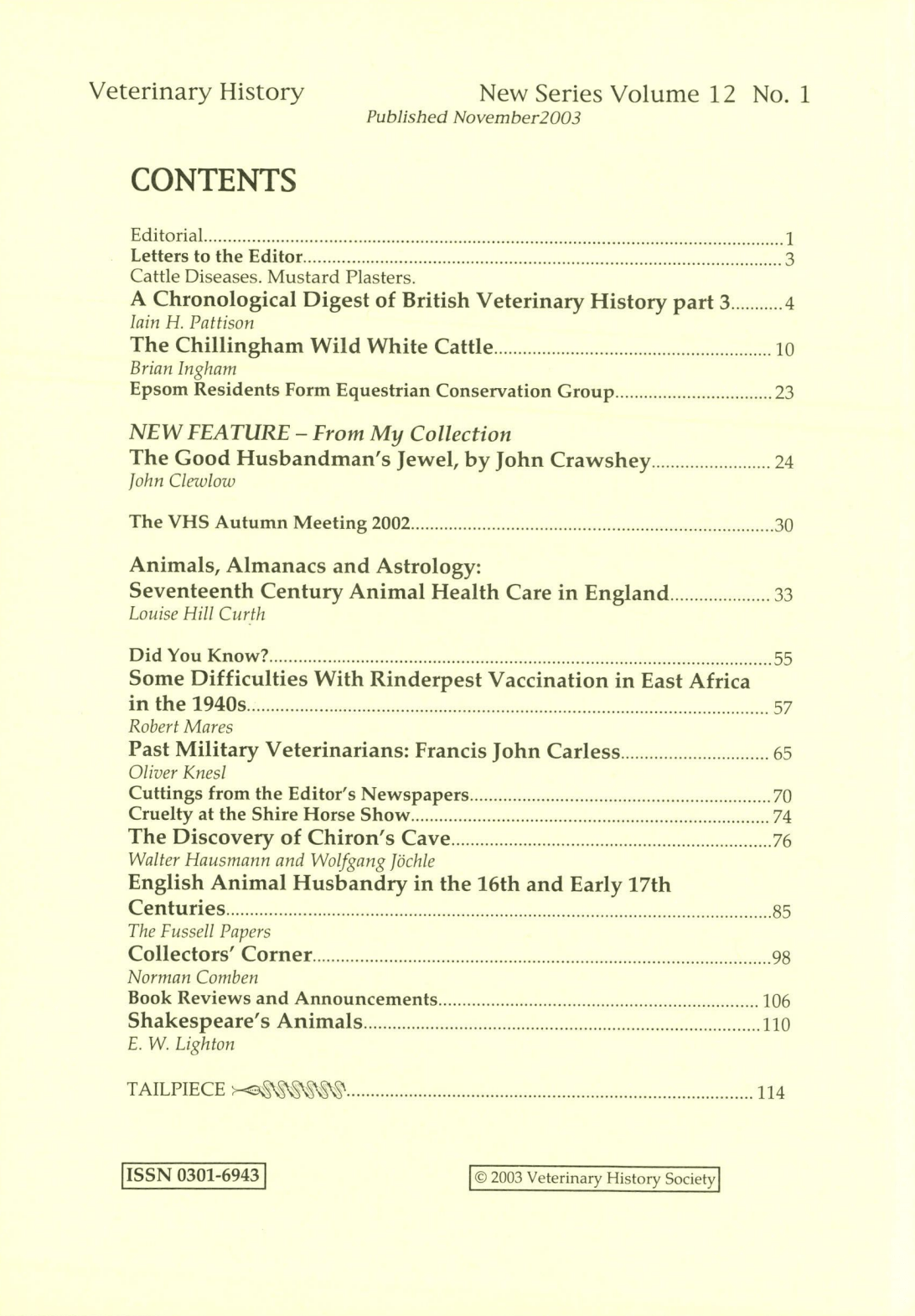
A Chronological digest of British Veterinary History, Part 3:1845-1848
A history of British veterinary history for the period of 1845 to 1848 covering William Dick and his Edinburgh School after the granting of the Royal Charter, the death of William Youatt and the first sheep anaesthesia case.
Iain H Pattison
The Chillingham Wild White Cattle
A history of the wild Chillingham cattle from Northumberland. The Chillingham cattle are probably descended from the semi-domesticated cattle of the Romans, Saxons and Ancient Britons before being contained with parks in the Medieval period. The Chillingham cattle were the property of the Earls of Tankerville until being transferred to the Chillingham Wild Cattle Association in 1971. There are now about 40 animals living on 134 hectares with no handling or veterinary involvement. The are provided with hay over the winter and mineral supplements. Following the Foot-and Mouth outbreak of 1967 a reserve herd was established in Scotland.
Brian Ingham
“The Good Husbandman’s Jewel” by John Crawshey
In 1636, John Crawshey published the first book on cattle practice in the UK – ‘The Country Man’s Instructor’. The same work was published, c1700, under a different title ‘The Good Husbandman’s Jewel’. This is an account of a plagiarised edition of this work published c1750 in Sheffield by Francis Lister.
John Clewlow
Animals, Almanacs and Astrology: Seventeenth Century Animal Health Care in England
An account of seventeenth century animal care in England, particularly focussing on the use of almanacs between 1640 and 1700. Almanacs were published annually reaching about 350-400,000 a year by 1700. They were first form of mass medium, cheap to produce and distribute. They contained a variable wide range of information, including astrological data and its effects on living creatures, prophecies, weather forecasts, political and legal information and dates of fairs and markets. 29% of almanacs of this period contain information on animal health and care. At this time, it was believed that astrology was a powerful influence on health and sickness. Different positions of the stars and planets could cause ‘imbalances’, which could cause disease. The resulting ‘noxious humours’ needed to be removed by purging and blood-letting. Saturn, comets and eclipses were particularly worrying. Herbal remedies were all associated with specific planets and constellations and were thought best suited to specific organs or parts of the body. Examples are given.
Louise Hill Curth
Gustav Jaeger, ‘Healthy Horse and Dog Clothing’
The famous Jaegar fashion clothes originated in a health fad, founded by Gustav Jaegar. He was born in 1832 and trained as a doctor. He was director of the zoological gardens in Vienna and became a professor of zoology and anthropology. He wrote many articles on healthy clothing, believing people and animals should only wear woollen clothing. An advert for his Sanitary Woolen System for dogs and horses is given.
John Clewlow
Some Difficulties with Rinderpest Vaccination in East Africa in the 1940s
An account of Rinderpest in East Africa and the attempts to control it by serum, vaccination and separation from wild game animals, which were believed to be a reservoir of infection. John Aspinall arrived in Tanganyika in 1944 and spent three years giving an inactivates spleen vaccine to the cattle of the Masai and cattle of colonial farmers. Mobile camps were used where all the local cattle came and it was possible for a single vet to vaccinate 5000 animals in a day. A 250-mile fence was built from Lake Nyasa to Lake Tanganyika to keep out wild animals. There was a change to Kabete attenuated goat vaccine. By 1948, it was realised the vaccine was no longer working. A commission of enquiry was set up. It appeared that some batches of vaccine were contaminated with live virus. It was recognised the difficulties in producing large amounts of vaccine in sub-optimal conditions. A new rabbit adapted Rinderpest vaccine was regarded as a safer option.
Robert Mares
Francis John Carless MRCVS JP (1869-1945)
John Carless graduated from the RVC in 1890 and went to South Africa, where he set up practice in Natal. He enlisted in the army at the outbreak of the Boer War and worked as a veterinary officer. An account of his experiences is given.
Oliver Knesl
Cruelty at the Shire Horse Show, from Veterinary Record 27/03/1897
A report of the use of ‘gingering’, which was the insertion of a piece of ginger into the anus of a horse to improve its appearance. This caused a painful stinging reaction in the horse and the person concerned was charged and was convicted of cruelty.
Anon
The Discovery of Chiron’s Cave, A Prehistoric School of Medicine for Animals and Humans
The centaur, Chiron, was regarded as the mythical inventor of medicine. His masher pupil was Asklepios (Asclepius to Romans). They were historical characters to Homer and the centaur creature of the torso of a man attached to a horse’s body was a much later myth. Chiron is now believed to be the chief of a tribe which invaded northern Greece on horseback. he became a teacher of his knowledge of disease and treatments, using a cave as his base. Asklepios was a prince of Trikke and was a student of Chiron. Using various sources, the author identifies a likely site for the cave of Chiron on the Magnesia peninsula near the village of Miliés (Miléae). The cave is 12 feet wide, 24 feet deep and 15 feet high. The various sources and local traditions and customs are given to support this identification of Chiron’s cave.
Walter Hausmann and Wolfgang Jőchle
English Animal Husbandry in the 16th and 17th Centuries
A review of the evidence for farming and husbandry practices in the sixteenth and seventeenth centuries England. There is discussion of attempts to improve the quality and strength of horses and of improvements in size and productivity of farm stock. Overwintering of breeding stock is covered.
G E Fussell
Shakespeare’s Animals
A brief description of some of the 3,000 mentions of animals, covering 200 species, in the plays of William Shakespeare.
E W Leighton
Please note
Buy now