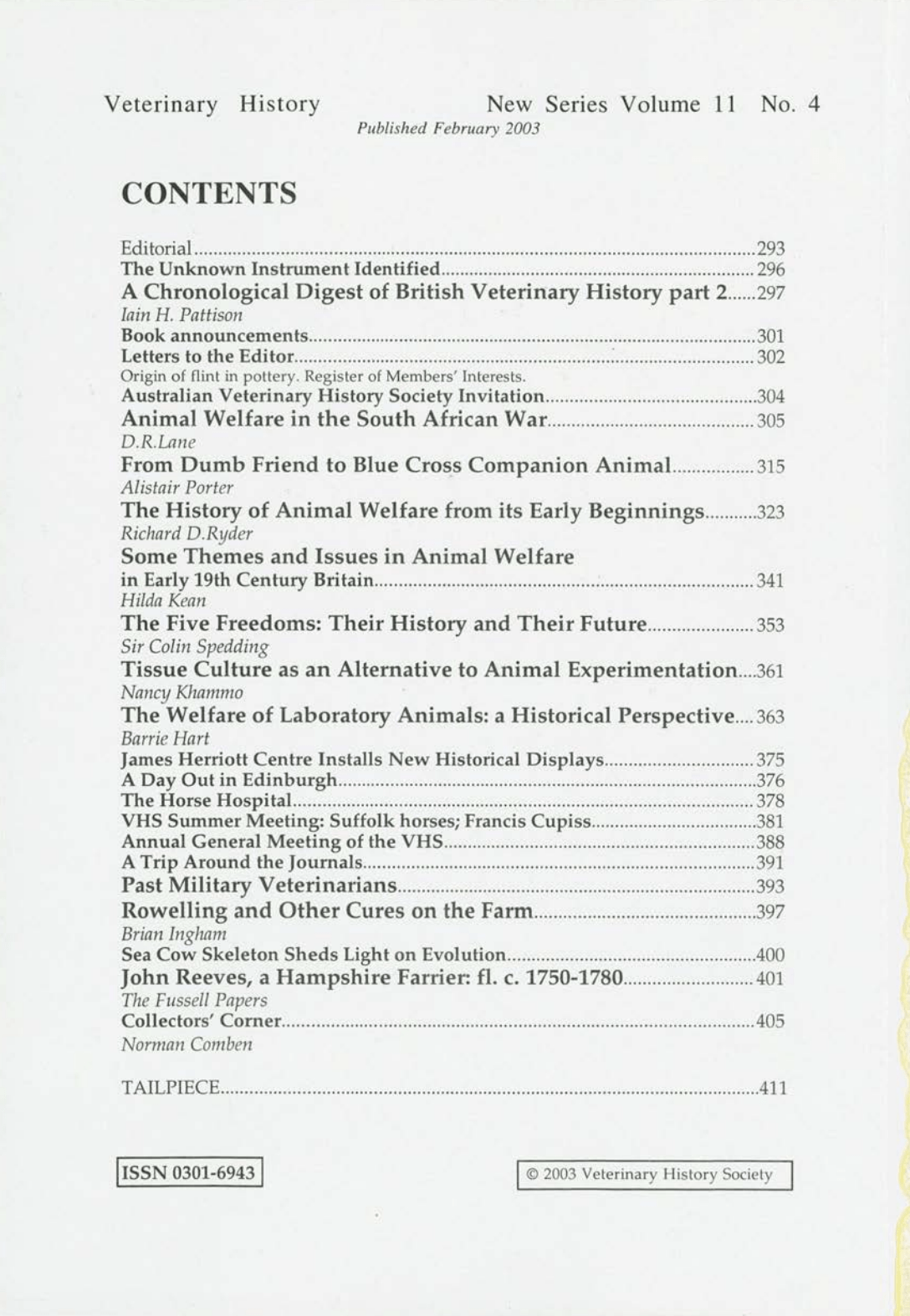
A Chronological Digest of British Veterinary History, Part 2: 1839-1844
A chronological list of the main developments in veterinary history from 1839 to 1844, which covers the changes at RVC after Edward Coleman’s death and the progression towards the charter of 1844.
Iain H Pattison
Animal Welfare in South African War
An outline of the veterinary problems of horses and mules during the Boer War of 1899-1902. There was virtually no veterinary provision at the start of the War and the importation of diseases Scabies, Glanders, Strangles and Influenza caused devastating consequences. The mixing of healthy horses with diseased animals resulted in the rapid spread of disease. Additional veterinary support was supplied by the Indian Army. A serious new disease, African Horse Sickness, appeared. The lack of enough healthy horses had a major impact on the troops’ mobility and probably resulted in a prolonged war. The total losses were 325,000 horses, 51,000 mules and 195,000 oxen.
D R Lane
From Dumb Friends to Blue Cross Companion Animal
A history of the foundation of ‘Our Dumb Friends League’ in 1897 and its development over the next hundred years to becoming ‘The Blue Cross’. Its original aim was to encourage kindness to animals. The Society’s activities during the first and second World Wars is described. An account of recent consideration of the Human/Companion Animal Bond and the Bereavement Service is given.
Alastair Porter
The History of Animal Welfare from its Beginnings
A history of animal welfare from the earliest times. Ancient Egypt and India showed some concern for the welfare of animals. This was not the case with the Roman Empire and this affected European attitudes up to the nineteenth century. Aristotle stated animals lacked reason and were not part of our moral community. The Renaissance was not a good time for animal welfare culminating in Descartes view that animals were mere machines unable to feel any pain at all. During the late eighteenth and nineteenth centuries public attitudes to animal cruelty began to change and increasing number of people were voicing their opposition to bearbaiting, bullbaiting, cock fighting and hunting with hounds. Famous individuals like Jeremy Bentham, Samuel Johnson, William Hogarth, William Wordsworth spoke out against cruelty to animals. Other writers in Uk and Europe started to suggest that animals had rights. The RSPCA was founded in 1824. The 1970s was when, throughout Europe and the English -speaking world animal welfare became a science in its own right. The campaign against the use of laboratory animals led to EU directives. Political Parties incorporated animal welfare issues in their manifestos. The EU now has legislation protecting farm animals, in zoos, at slaughter, in laboratories, the prohibited use of leg-hold traps. Also, there is legislation against the import of ivory, whale and seal products and furs. The phasing out of veal crates and battery hen cages is underway.
Richard Ryder
Some Themes and Issues in Animal Welfare in early Nineteenth Century Britain
The rapid development of London in the early nineteenth century led to a very large number of working animals, farm animals being seen in the city. As more people witnessed cruelty to animals, especially in association with Smithfield Cattle Market, opposition become more vocal. In 1822, parliament passed Martin’s Act and for the first time, it became on offence, punishable by fines and imprisonment, to beat, abuse or cruelly treat any horse, mare, gelding, mule, ass, ox, cow, heifer, steer or sheep. The RSPCA was founded in 1824, initially to enforce the 1822 Act. A detailed account of the opposition to the Smithfield Cattle Market is given as a result of the cruelty seen inflicted on the animals being driven to market and the slaughter in the streets. The market was shut down in 1868. Animal welfare became a middle-class concern and was a factor in social respectability.
Hilda Keen
The Five Freedoms: Their History and Their future
The original ‘five freedoms’ originated in the Brambell Report of 1965. In 1993 The Farm Animal Welfare Council developed the more general form, widely accepted across the world as a framework for considering ‘positive’ animal welfare. A consideration is given to the concept of animal rights and human responsibilities.
Colin Spedding
Tissue Culture as an Alternative to Animal Experimentation
A short account of the use of an ‘epidermal model’ of tissue culture, which could be used to test the toxicity of topical medications and cosmetic products.
Nancy Khammo
The Welfare of Laboratory Animals; A Historical Perspective
A growing concern about the care of laboratory animals led to the publication, in 1947, of a handbook published by the Universities Federation for Animal welfare (UFAW). Various societies were founded, from the late 1940s onwards, to raise the educational standards of laboratory technicians. The Laboratory Animal Veterinary Association was founded in 1963. Symposia with publications of the welfare of primates, rabbits and rodents appeared. A Royal Commission was appointed in 1906 and it reported in 1912. One of the main recommendations was that an inspector should be appointed to oversee the experiments and licences and certificates were required before any experiment could proceed. An advisory committee was set up by the Home Office in 1962 to oversee the recommendations of the Littlewood Report. Form 1971 onwards the EU produced directives aimed at protecting laboratory animals, which by 1986 were binding on all EU states. The Animals (Scientific Procedures) Act received Royal assent in 1986 and fully implemented by 1992. works by means of two separate licences: a personal licence and a project licence. This act protects primates, dogs, cats, mice, rats, guinea pigs, hamsters, rabbits, pigs, quail and the octopus.
Barrie Hart
The Horse Hospital, Camden
James Burton was the designer and builder of the Veterinary College in Camden, London, which was in use from 1793. In 1794, he started the construction of a large stable, to accommodate 24 horses, and forge nearby to the College. This building was being used as a veterinary practice from 1823. It was in use as a veterinary clinic until 1913. A description of the building is given.
Jean Mann
Draught Horses in early Modern England (resumé)
A brief account of the use of draught horses in England in the Early Modern period. The Suffolk Punch is the only pure native breed of a draught horse. The Shire horse was the result of crossing native mares with imported European stallions.
Peter Edwards
Francis Cupiss
Francis Cupiss was born in 1798. He was apprenticed to a chemist and druggist in London, before attending the London Veterinary College, from where he qualified in 1822. He moved to Diss in Norfolk, where he worked as a veterinary surgeon. He also produced horse medicines which became very popular in the UK and around the world. He died in 1888.
Ray Hubbard
Past Military Veterinarians, William Robertson (1872-1918)
William Robertson was born in 1872 in Scotland, graduated from the RVC in 1893. He worked at the Jenner Institute in London, before moving to South Africa in 1896, where he worked at the Bacteriological Institute and involved with inoculation stations. He was involved with research into African Horse Sickness, which continued after he returned to London in 1899. He returned to South Africa during the Boer War and remained there until his death in 1922. Robertson served as a veterinary officer in the Army.
Oliver Knesl
Rowelling and other Cures on the Farm
A personal recollection of the use of Rowelling in cattle in the1950s. Rowelling, also called pegging or seton involved creating a wound in the dewlap of cattle and inserting various plants, herbs or materials and the wound allowed to fester for a few weeks. A later development involved a needle pulling a string or tape through the dewlap and tying into a loop.
Brian Ingham
John Reeves, A Hampshire Farrier (fl c 1750-1780)
John Reeves, a Hampshire farmer, published a book ‘The Art of Farriery’ in 1757/8. It went through four editions, the last published in 1778, which suggests its popularity.
G E Fussell
Please note
Buy now