Delabere Pritchett Blaine
Delabere Pritchett Blaine (1770-1845) was the son of a dissenting minister. He started medical training at the Borough Hospital in Southwark. He gave this up and started treating animals. He became an assistant to Sainbel and newly founded veterinary college in London, teaching anatomy. He left the college after a disagreement with Sainbel and went to Lewes, where he persuaded the local farmers to let study the diseases of their livestock. He became assistant surgeon to the Regiment of Middlesex Militia, which allowed him to examine all the sick horses. In 1795, he set up in practice, but following a large inheritance, gave this up. Losing this wealth led him back to army work and setting up in practice, where he later took on William Youatt as a partner. He wrote many books, including ‘Canine pathology’ the first rational attempt at the treatment of the dog.
G E Fussell
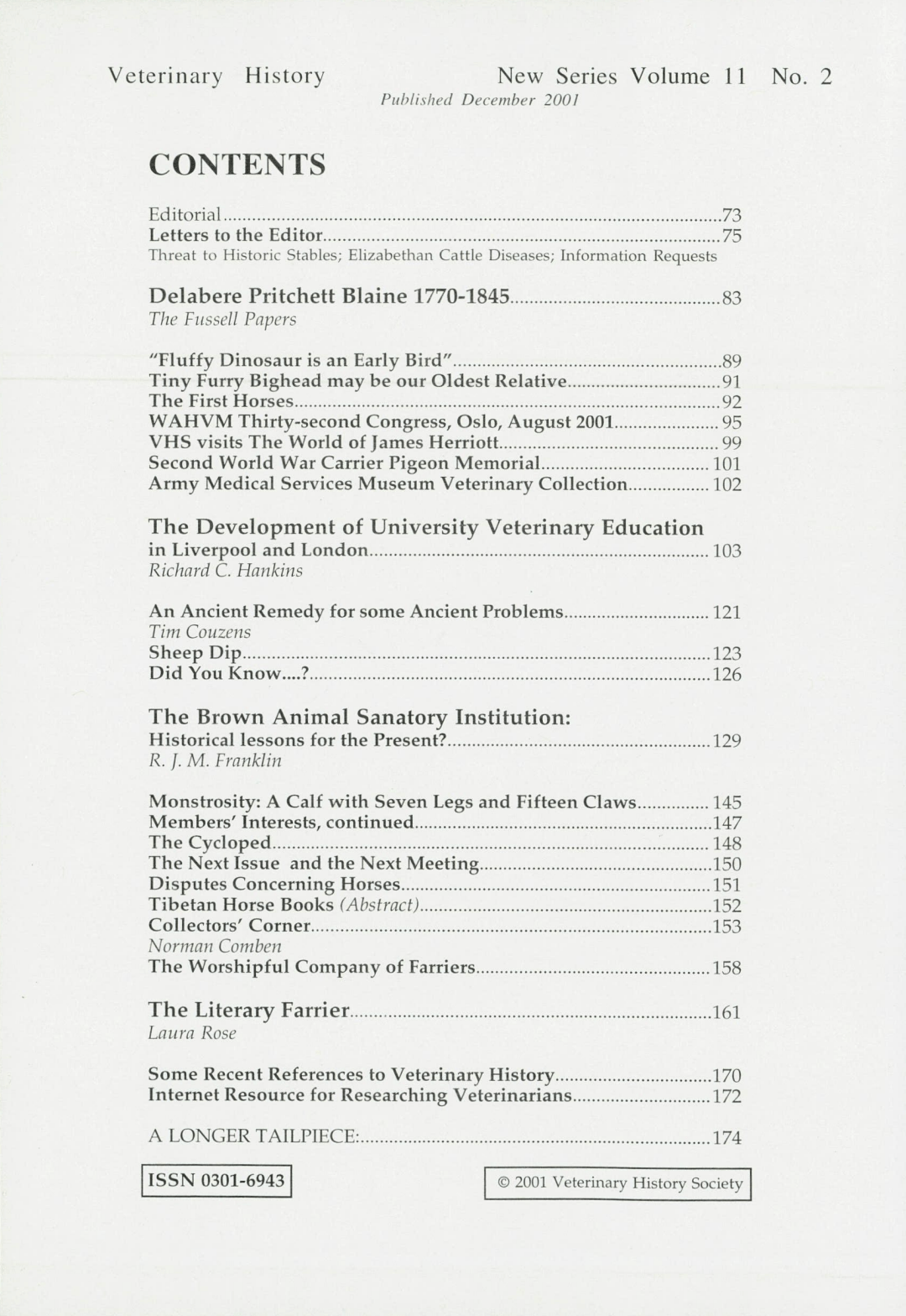
The Development of University Veterinary Education in Liverpool and London
A history of the development of veterinary university education in the UK, particularly in relation to London and Liverpool colleges. The Loveday report of 1938, contained a damming assessment of the quality of veterinary education offered by the veterinary colleges. The significant differences in the way veterinary education developed in other European countries are described. The RCVS maintained the single portal system, where they set the only exam available to enter the profession. They were very reluctant to give up this right and was a major cause in the delay of veterinary colleges being incorporated into the university system. Lack of a university education perpetuated the low social and professional status of veterinary surgeons. An account is given of the very different histories of the how the Liverpool and London colleges were incorporated into their local universities.
Richard C Hankins
An Ancient Remedy for some Ancient Problems
Dandelions, Taraxacum officinale, have been used for a very long time as medicinal herbs. The milky sap has been used to treat warts. The root has a powerful effect on bile production, allowing it to be used as a mild laxative. The leaves were used for their significant diuretic effects.
Tim Couzens
Sheep Dip, William Cooper and Nephews, Berkhamsted
William Cooper was working as a veterinary surgeon in Berkhamsted from the 1840s. He developed a sheep dip, which contained arsenic and sulphur. He developed methods of producing a standardised product that was easy to store, package and transport. It became very popular, William was joined by his nephew William Farmer Cooper, who initiated the overseas trade. Other family members joined the company. The arrival of synthetic insecticides during the Second World War and production ceased in 1955.
Anon
The Brown Animal Sanatory Institution: Historical Lessons for the Present
This article briefly reviews the history of the Brown Institution (1871-1944) a remarkable but short-lived and now largely forgotten veterinary centre of research and clinical practice. As well as providing a broad-based clinical service for the surrounding area of London, the Brown Institution was also the home for some of the most distinguished contributors to comparative medicine and physiology.
R J N Franklin
The Worshipful Company of Farriers
The farriers of London joined in a fellowship in 1356, but their modern history, as a livery company, starts with their Royal Charter of 1674.
Anon
The Literary Farrier
A list of early works on farriery in the collection of the National Sporting Library in Middleburg, USA. They included works by Jaques de Solleysell, Henry Bracken. Jeremiah Bridges, Thomas Wallis, Augustus Franklin, Francis Clater, William Miles, William Douglas, G Fleming, William Russell, William Hunting and Robert Means Lawrence.
Laura Rose
Please note
Buy now