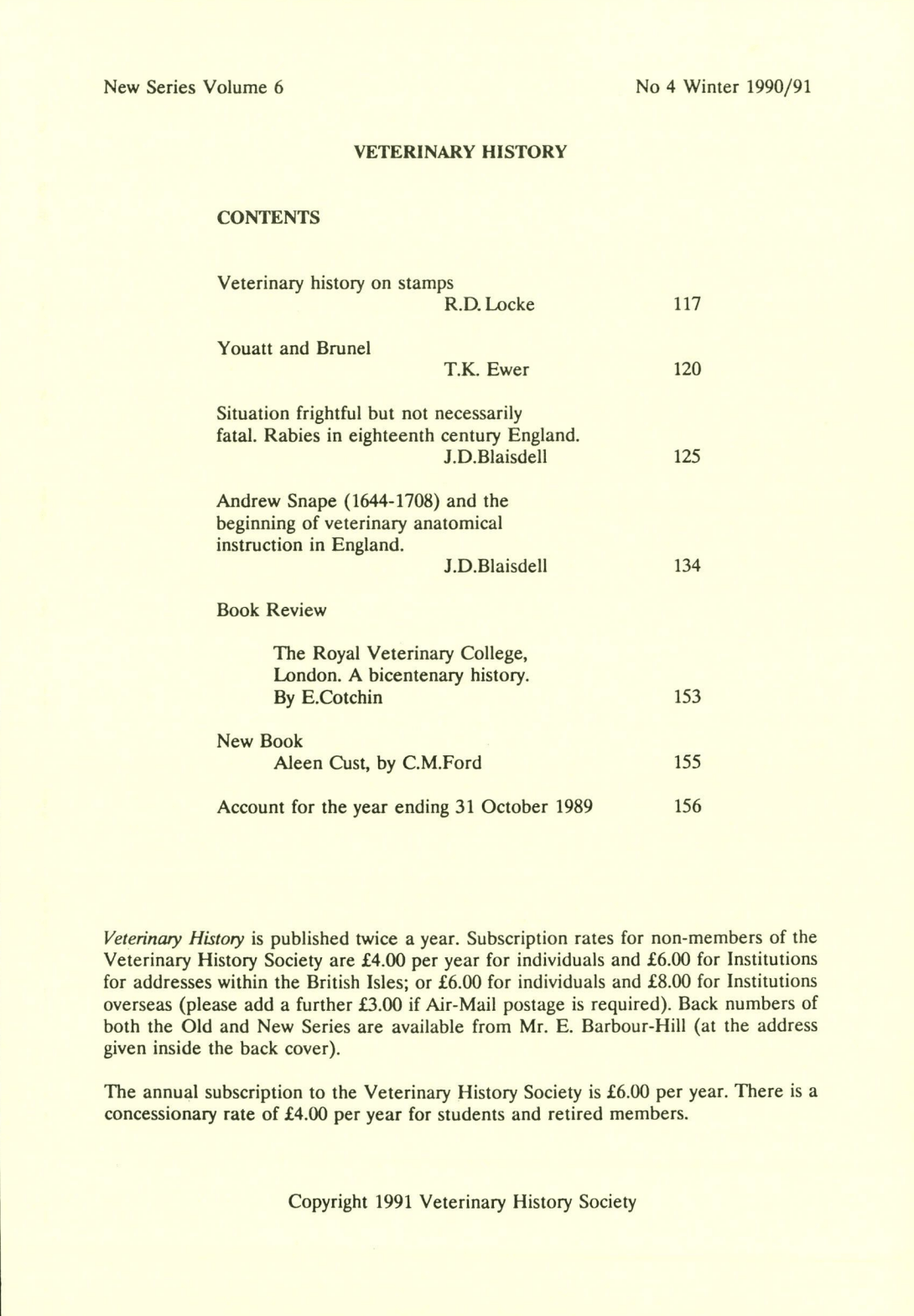
Veterinary History on Stamps
Descriptions and Illustrations of veterinary surgeons depicted on postage stamps.
R D Locke
Youatt and Brunel
In 1831 a famous first edition of the book ‘The Horse with a Treatise on Draught’ was published. Two of the contributors were William Youatt, the distinguished veterinary surgeon and Isambard Kingdom Brunel, the eminent engineer.
T K Ewer
Situation Frightful but not Necessarily Fatal. Rabies in 18th Century England
Rabies had always received a disproportionate amount of attention in both medical and veterinary literature and journals. Although it was recognised that it was the bite of a rabid dog which spread the disease (through a poison), it was believed to spontaneously develop in the dog. The two main symptoms seen in both man and dogs was hydrophobia and deterioration in mental state. A condition of ‘hysterical rabies’ was described where a person showed symptoms after having been bitten by a dog, showing no signs of Rabies. Some people were diagnosed with Rabies simply by showing neurological symptoms, which were unlikely to have been associated with Rabies. Initial treatments were focussed on the bite wound. The use of leeches and bleeding was very common. Purgatives and emetics were also used with deleterious effects.
John D Blaisdell
Andrew Snape (1644-1708) and the Beginnings of Veterinary Anatomical Instruction in England
Andrew Snape was born in about 1644 into a family of farriers. His book ‘Anatomy of An Horse’ was the first text of any value for the veterinary practitioners of the seventeenth century. Some was plagiarized from a fifteenth century text of Carlos Ruini, but the book does contain Snape’s own observations. It appears to have been based on a lecture course on anatomy.
John D Blaisdell
Please note
Buy now