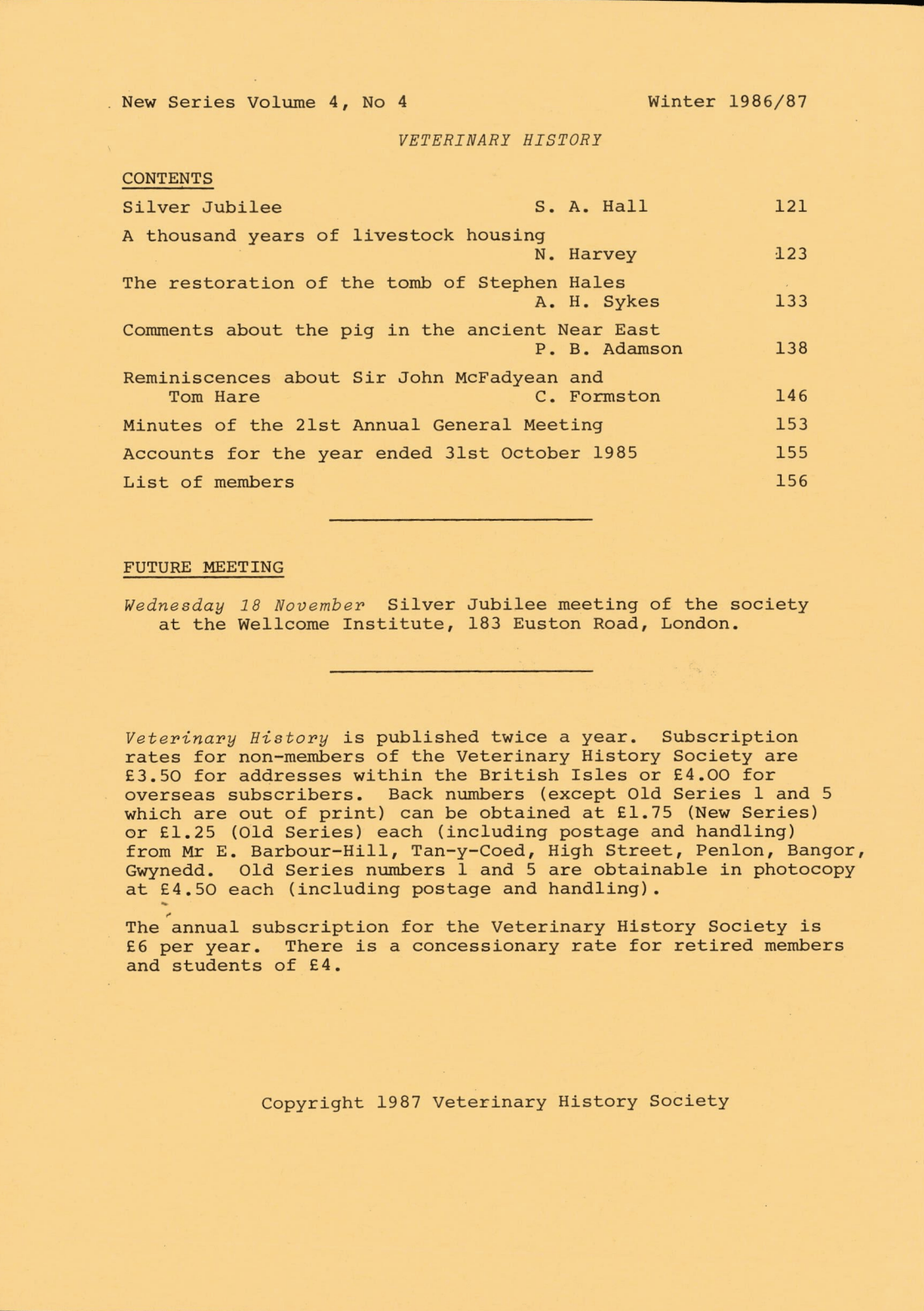
A Thousand years of Livestock Housing
The earliest surviving evidence of livestock housing to be found in England are pigeon houses, dating from before 1600. Longhouses were an early form of animal housing with the farmer and his family in one end and the cattle in the other end. A sheephouse at Bolton Abbey dates from before 1290. Pigs were originally woodland animals, but were often moved into pig sties by 1800. Very intensive systems of housing were to be found in London and other big cities. The first concrete building, in the world, was an intensive cattle-fattening house built in about 1870.
Nigel Harvey
The Restoration of the Tomb of Stephen Hales
Stephen Hales (1677-1761) was the first scientist to measure blood pressure in animals. He was the vicar at St Mary with St Alban in Teddington, where he is buried. He was one of the most famous British scientists of his time. His researches into the fundamentals of animal and plant physiology and on the nature of air provided a theoretical framework for scientists for the best part of a century. By 1980, his tomb had become badly worn and barely legible. A campaign to raise funds was initiated and a new memorial floor and ancillary works were completed in 1986.
A H Sykes
Comments about the Pig in the Ancient Near East
The history of the domestication of the pig in the ancient Middle East. The pig was domesticated in ancient Egypt by about 3200BC, but the earliest evidence of domestication is to be found in Anatolia/Kurdistan areas, dating to about 6000BC. In Egypt the pig was sacred to the god Set (Seth). Under the Assyrians, pig gradually disappeared from the diet. Mosaic Law prohibiting the consumption of pork was only enforced after the flight from Egypt.
P B Adamson
Reminiscences about Sir John McFadyean and Tom Hare
Personal memories of Professor Clifford Formston about Sir John McFadyean and the Royal Veterinary College in London in the 1920s. His lectures were popular and he was a brilliant teacher.
Clifford Formston
Please note
Buy now