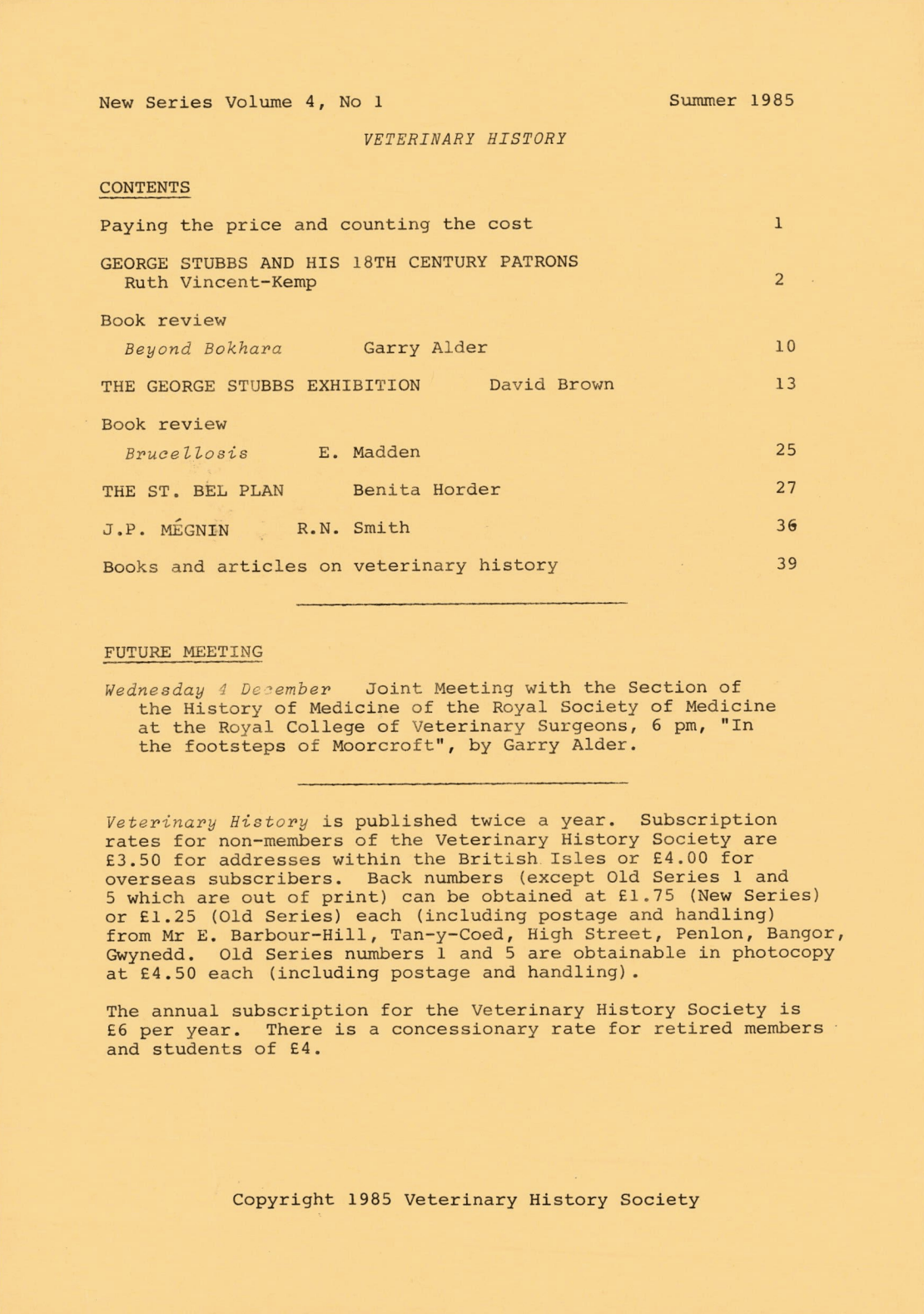
George Stubbs and his 18th Century Patrons
George Stubbs (1724-1806) is chiefly remembered for his horse paintings but he also pursued the science of anatomy and natural history. His medical patrons included John Hunter, Vice-President of London Veterinary College. He was born in Liverpool and showed artistic talent from an early age. He spent eighteen months dissecting horses in preparation for his great work ‘The Anatomy of the Horse’ published in 1766. Many aristocratic patrons, including the Prince Regent, commissioned Stubbs to paint their favourite horses. Stubbs had a close relationship with the brothers William and John Hunter, both eminent surgeons. John Hunter had a particular interest in comparative anatomy. Stubbs had financial problems in later life., his final work on comparative anatomy never published.
Ruth Vincent-Kemp
The George Stubbs Exhibition (at Tate Gallery)
A description of the exhibition of paintings and drawings by George Stubbs held at the Tate gallery in 1985. An account of his painting techniques is covered.
David Brown
The St Bel Plan (including facsimile)
A facsimile of the proposal, by Vial St Bel, to set up a veterinary college in London, published in 1790, with some history of the plan and its publication.
Benita Horder
J-P Mégnin
Jean-Pierre Mégnin was a French Veterinary Surgeon, who had a particular talent in producing illustrations for textbooks. He was also and author and for many years edited the journal ‘L’Eleveur’. He was born in 1828 and graduated from the Alfort school in 1853. He was made an honorary associate of the RCVS in 1880.
R N Smith
Please note
Buy now