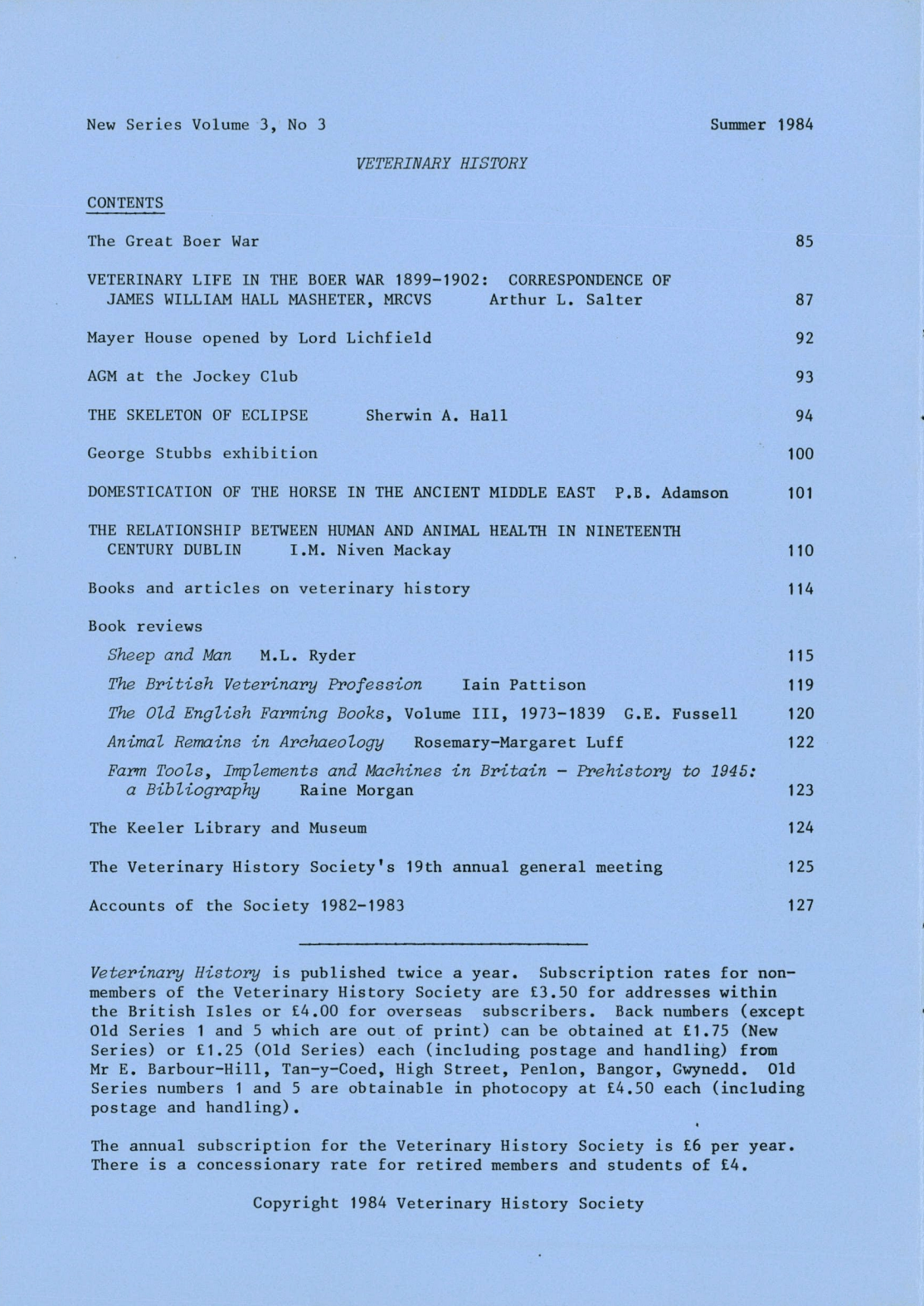
Veterinary Life in The Boer War 1889-1902
James William Hall Masheter qualified as a veterinary surgeon in 1893 from RVC. He travelled to South Africa in 1900. He gives an account of his experiences of caring for horses during the Boer War.
Arthur L Salter
The Skeleton of Eclipse
The celebrated racing horse Eclipse died in 1789. A post-mortem examination was carried out by Saintbel. The skeleton was cleaned and mounted for display. Its ownership was passed through various people until John Gamgee bought it in 1860 and took it to his new Edinburgh New Veterinary College. Gamgee returned to London in 1865 and presented the skeleton to the Royal College of Veterinary Surgeons in 1871. It was passed to The Natural History Museum in 1920. In 1983 it was moved to the National Horseracing Museum in Newmarket.
Sherwin Hall
Domestication of the Horse in the Ancient Middle East
The earliest evidence of horses in the ancient Middle East come from Syria and date to 3700BC. The earliest Written records date from 3000BC in Iraq. Domestication of the horse is known to have occurred in the late fourth millennium BC. Various objects depicting horses date from 2300BC onwards. The horse chariot was developed in the second millennium BC. Development of domesticated breeds spread form the areas of the Caspian and Black seas into Asia-Minor and the Middle East.
P B Adamson
The Relationship between Human and Animal Health in Nineteenth Century Dublin
Nineteenth century Dublin experienced a great an increase in population, especially after the potato famine of 1840s. Overcrowding, poor public health and disease become pressing problems. There were many urban dairies and slaughterhouses in the city. Tuberculosis was a major problem. Sanitary Inspectors were employed by 1899 and all milk vendors had to be registered.
M Niven MacKay
Please note
Buy now