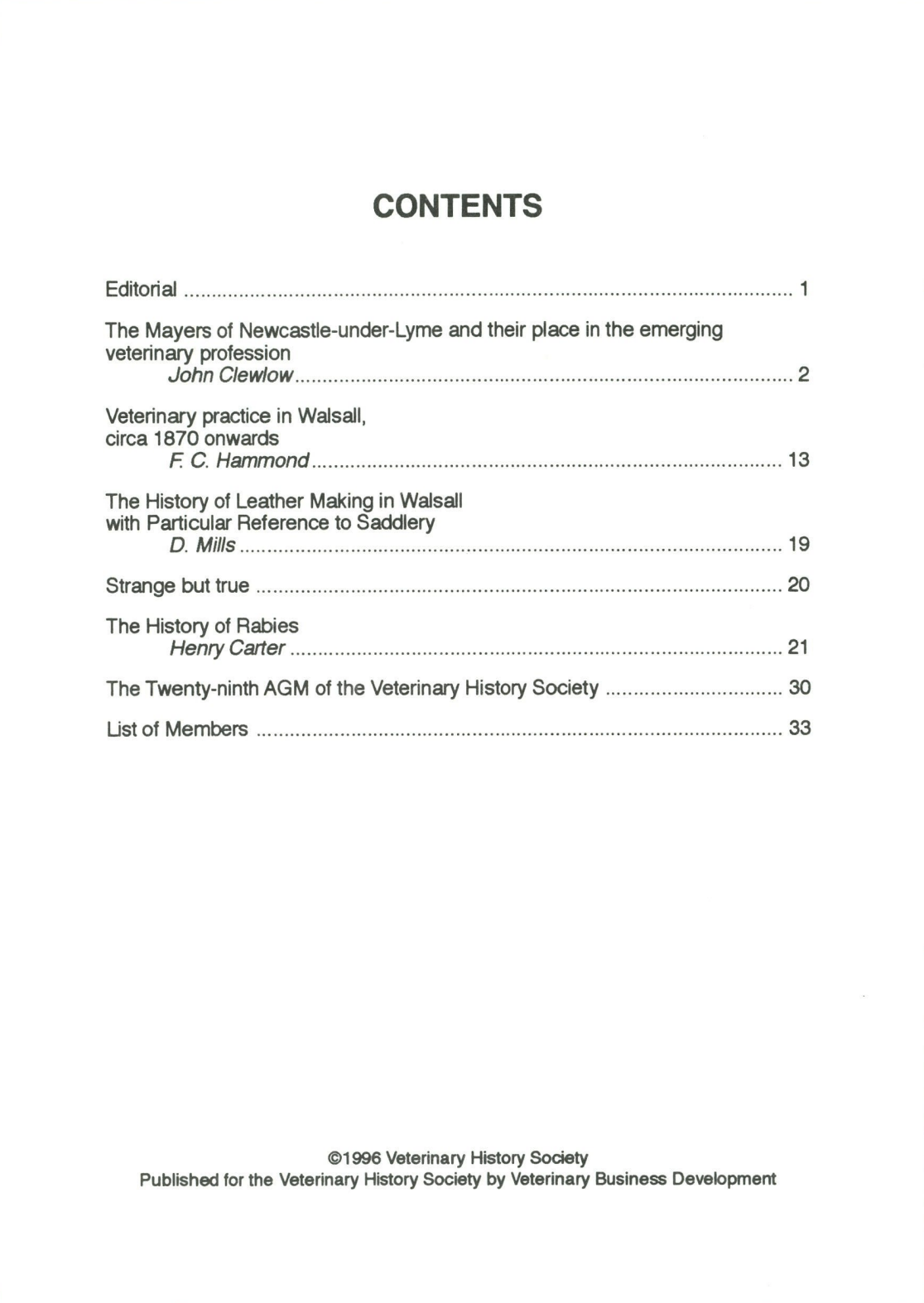
The Mayers of Newcastle-under-Lyme and Their Place in the Emerging Veterinary Profession
A history of the Mayer family of Newcastle-under-Lyme, two generations of farriers and two of veterinary surgeons. Thomas Walton Mayer qualified form the London Veterinary College in 1835. He and his father led a campaign to break the grip of medical men on London Veterinary College, headed by Coleman. After Coleman’s death in 1839, the Mayers wrote to all 700 graduates of the London School. 400 vets replied and they drafted a petition to suggest: A professor of farm animals be appointed, lecturers should be paid more, fees for students should be increased and the course should be two-three years, depending on basic education. The college governors rejected the proposals. The Mayers then led a campaign to achieve a Royal Charter, which was achieved in 1844. It was the efforts of Thomas Walton Mayer in persuading leading vets at the London and Edinburgh schools to support the petition, which guaranteed its success.
John Clewlow
Veterinary Practice in Walsall, circa 1870 onwards
A history of a veterinary practice in Walsall. The premises were built in 1874, although there are pharmacy records going back to 1872. The buildings included a loose box and stabling for seven horses. Branch surgeries were set up in mid twentieth century. A list of some veterinary surgeons working at the practice is given. Staffing records are described. The changing economics of the practice passed from mainly equine to farm practice and then to the inclusion of small-animal work.
F C Hammond
The History of Leather Making in Walsall, with particular reference to Saddlery
A short account of the leather industry in Walsall.
D Mills
The History of Rabies
The earliest references to Rabies are in a Mesopotamian Law Codes (Eshunna and Hammurabi). The Greeks used the term Lyssa or Lytta and recognised hydrophobia as a sign of Rabies. Rabies was recognised from Anglo-Saxon times in the UK. In his 1610 book, Gervase Markham realised the venomous spittle was the method of spread of the disease. Quarantine was proposed, as a means of eradication, in 1793, but this was not implemented for a hundred years. A dog tax was proposed to pay for quarantine. Delabere Blaine claimed he was seeing several cases a day of Rabies in the early nineteenth century. Local outbreaks were dealt with by euthanasia of stray dogs. Rabies was finally eradicated from the UK in 1902, although an outbreak followed soldiers returning, with dogs, from the Greta War in 1918.
Henry Carter
Please note
Buy now