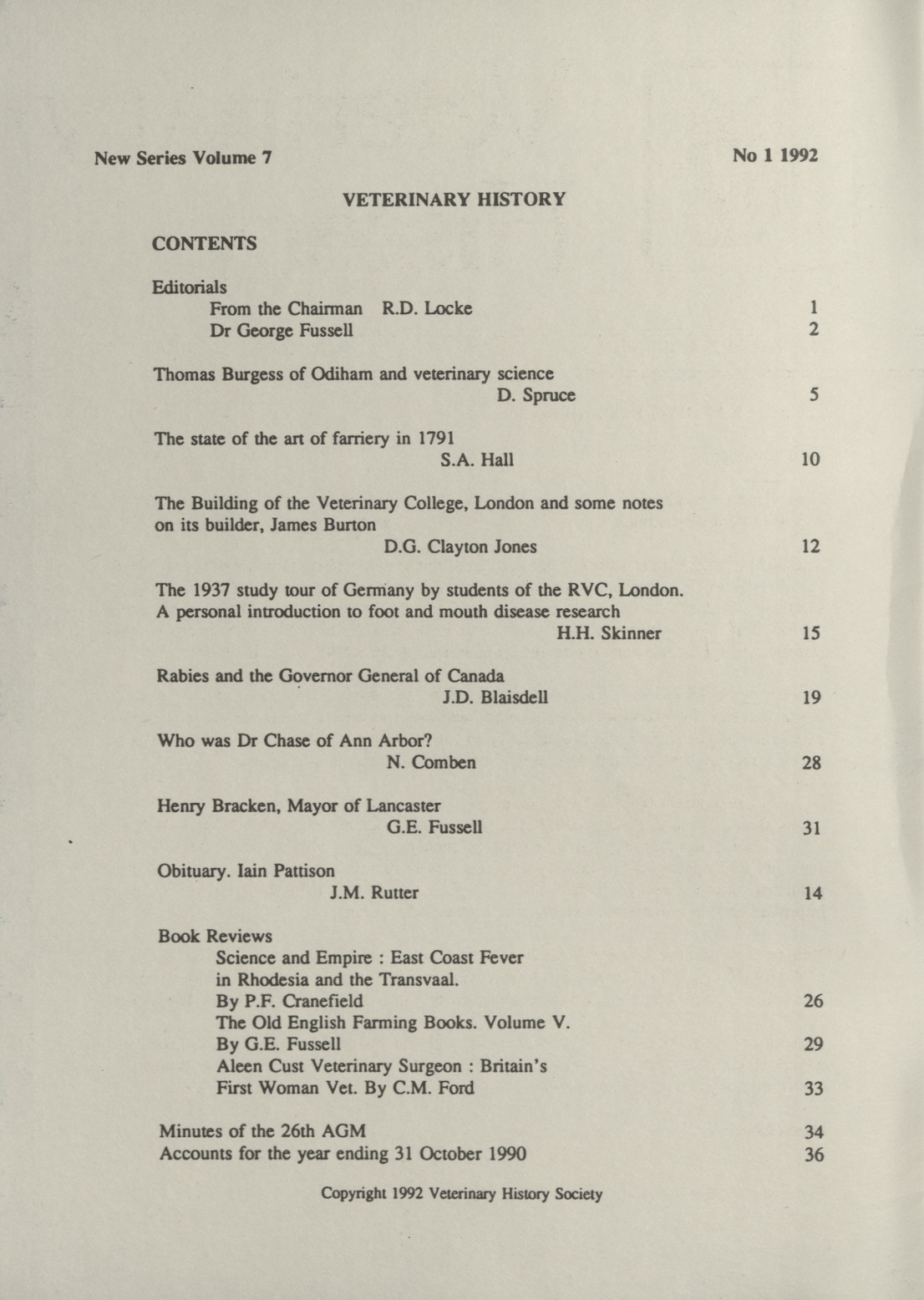
Thomas Burgess of Odiham and Veterinary Science
The role of the Agricultural Society in the Hampshire town of Odiham in the bringing to the fore the need for improvement in the treatment of animals has long been recognised. Thomas Burgess was a fellow of Corpus Christi College. Oxford. He was not involved in agriculture but his brother was a farmer in Odiham. He attended many meetings of the Society and took a great interest in the campaign for improvements in farriery and in the study of diseases affecting horses and farm animals. This eventually led to the foundation of the London Veterinary College in 1791. Burgess probably visited the French veterinary School at Charenton, when he visited Paris in 1787. Burgess became Bishop of Salisbury, having translated from St David’s, where he founded St David’s College, Lampeter.
Derek Spruce
The State of the Art of Farriery in 1791
There is a scene in Shakespeare’s ‘Taming of the Shrew’ where a descriptive list of horse ailments and physical problems is given. Farriery was medieval in concept and the ignorance of farriers was notorious. In London, a company of Farriers was founded in 1356, which received a Royal Charter in 1674. One of its powers was to ‘search for and finde defective works and medicines’ to maintain standards of farriery practice. The economic and technical developments of the agricultural revolution of the eighteenth century led to a demand for better farriery and care of horses and farm animals.
S A Hall
The Building of the Veterinary College, London and Some Notes on its Builder, James Burton
James Burton was born in 1761 and worked as a successful builder in London, erecting many houses and covering 250 acres of north London with buildings. Work started on the construction of the London Veterinary College in 1791 with the erection of a temporary dissecting room. Temporary stabling was erected in 1792. James Buron was asked to submit plans for a lecture theatre and dissecting rooms. The first horse was led into the infirmary in January 1793. Nothing remains of the original buildings on the Camden Town site after the construction of present building in the 1930s.
D G Clayton-Jones
The 1937 Study Tour in Germany by Students of the Royal Veterinary College, London. A personal Introduction to Foot and Mouth Disease Research
A personal account of the visit to Germany by a group of RVC students in 1937. H Skinner describes the travel Hannover and their visit to the veterinary college, where they were impressed at the quality of the facilities. They visited a pharmaceutical firm and a model farm of Friesian cattle. The group then travelled to the Baltic coast and visited the Foot-and -Mouth research centre on Insel Riems. The main function of the centre was the production of serum, which was used in the management of FMD outbreaks. A visit to Berlin, where they visited the veterinary faculty of the university and also the veterinary instrument manufacturer, H Hauptner.
H H Skinner
Rabies and the Governor-General of Canada
The Duke of Richmond was governor-general of Canada and was supposed to have died of Rabies in 1819. There is some doubt that he died of Rabies and the various reports and sources are reviewed and other neurological conditions are considered as the cause of his death. Earlier deaths from Rabies in Canada in 1814-1819 are described.
John D Blaisdell
Who was Dr Chase of Ann Arbor?
Alvin Wood Chase published several very popular books on medicinal recipes and cures for people and animals. He was born in 1817 and settled in Ann Arbor, Michigan. By the time of his death, over one and half million copies of his books had been sold.
Norman Comben
Old Time Farriery Writers, Henry Bracken, Mayor of Lancaster
Henry Bracken (1697-1764) had a successful medical practice in Lancaster. He wrote a popular book on Farriery. He gave advice on the purchase of horses and gave a selection of medical and veterinary medications. Ha also proposed a system of certification of stallions, to improve horse quality.
G E Fussell
Please note
Buy now