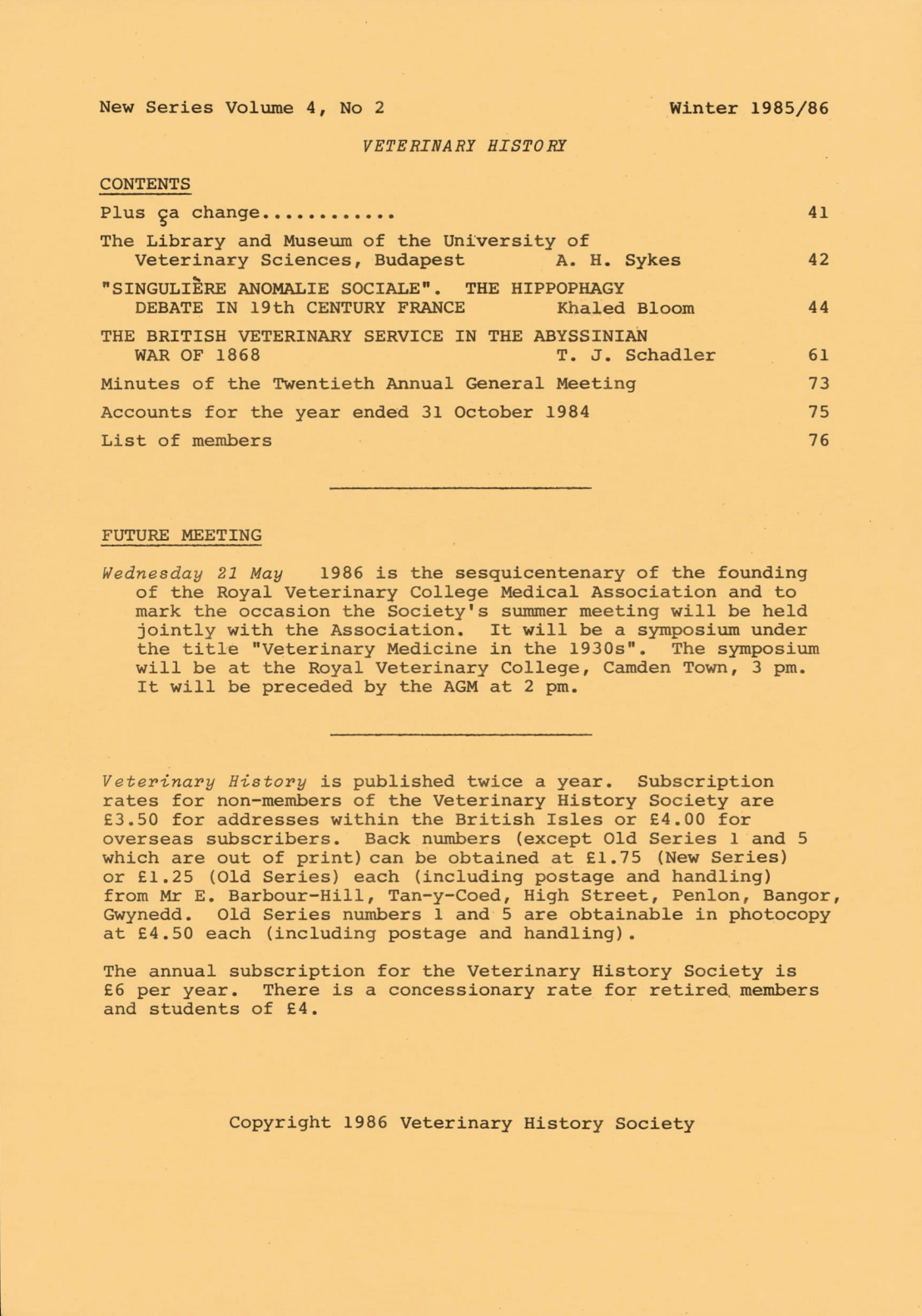
“Singulière Anomalie Sociale” The Hippophagy Debate in 19th Century France
The sale of horsemeat was legalised in Paris in 1866, but required veterinary inspection both before and after slaughter. Before this time there had been a vigorous debate around the consumption of horsemeat. There were concerns about the status of the horse, and about the safety and palatability of horsemeat. Horsemeat was advocated as being suitable for poor people and a way of improving diets. Vets and Doctors were on both sides of the argument. The zoologist Isadore Geoffrey Saint-Hilaire led the campaign for hippophagy. By 1880 10,000 horses were consumed in Paris each year, rising to 15,000 ten years later. The consumption of horsemeat has declined dramatically, mainly related to the horse population only being an eighth of its peak numbers.
Khaled Bloom
The British Veterinary Service in the Abyssinian War of 1868
The 1868 Abyssinian Campaign was in response to the imprisonment of Europeans by King Theodore. The British Army, led by Lord Robert Napier, had to march across very inhospitable terrain to reach Magdala. 36,000 animals were used in the campaign, including mules, bullocks, horses, camels and elephants, imported from India. Only 7,000 survived the campaign, the rest dying of disease, malnutrition and extremes of heat and altitude. This was the first use of dedicated veterinary sick depots for the animals in a war zone. Descriptions of the unrecognised diseases is given. J H B Hallen led the team of vets.
T J Schadler
Please note
Buy now