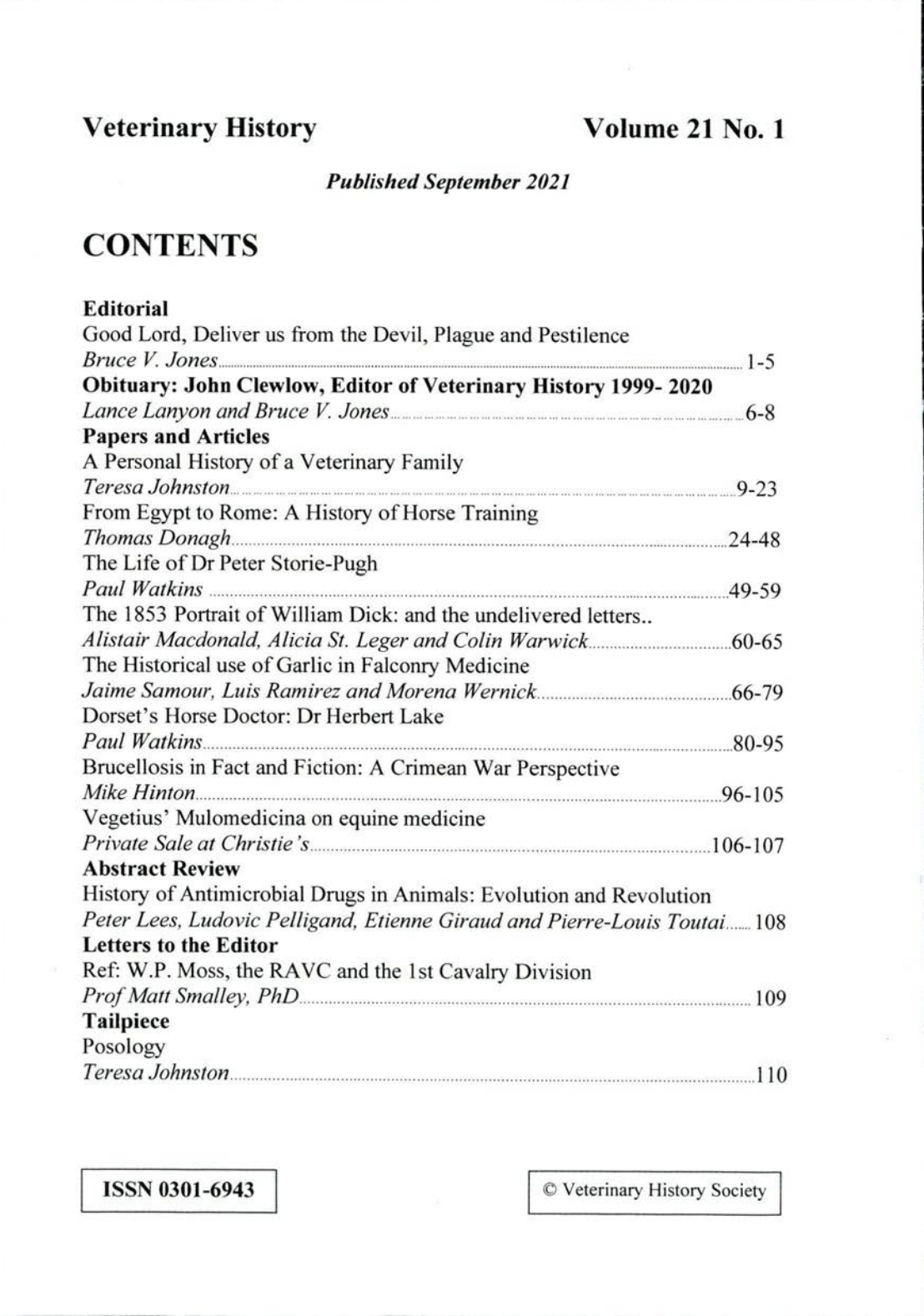
A Personal history of a Veterinary Family: The Dier Family
Commencing with Joseph Dier (1791-1868) the author describes the history of four generations of the Dier family in the veterinary profession. All worked in and around Crowborough, East Sussex. Many of the earlier generations were farmers and/or veterinary practitioners. The author describes the lives and education of many members of the Dier family and reflects on the changes which have taken place within the profession over nearly 200 years of records.
Teresa Johnston
From Egypt to Rome: A History of Horse Training
The paper provides a detailed review of horse training from 15th Century BC to 4th Century AD. It draws on many ancient texts, and highlights how training methods described many centuries ago have been used in more recent times with apparent success.
Thomas Donaghy
The Life of Dr Peter Storie-Pugh, CBE, MC, FRCVS –
From Sevenoaks to Spangenberg and Beyond
Peter Storie-Pugh (1919-2011), son of Leslie P Pugh of Sevenoaks, Kent, was a student at Cambridge University at the outbreak of World War 2. He was commissioned into the Queen’s Own West Kent Regiment and in early 1940 was sent to France. His regiment was initially deployed in working parties assisting on the French railways. With the invasion of France he was involved in fierce fighting at Doullens, where he was injured. His father was later to receive news that his son had been killed in action. Taken prisoner by the Germans, he was held at Spangenberg prison but escaped, was recaptured and subsequently incarcerated in Oflag-IVC, Colditz Castle.
Paul Watkins
The 1853 Portrait of William Dick and the Undelivered Letters
The paper details the provenance and background of a 1853 painting of William Dick by Elizabeth Holden, a lady from Cork, Ireland. Both her father and brother qualified from the Edinburgh Veterinary College in 1839, having been taught by William Dick. By referring to undelivered letters written by Miss Olden, the authors are able to describe the life and career of the artist and her relatives. Her later work was under her married name of ‘Madame du Gue.’
Alastair A Macdonald, Alicia St. Leger and Colin Warwick
The Historical Use of Garlic in Falcon Medicine
Although the medical use of garlic was first reported in 3700BC, it was not until the medieval period that it was used in veterinary medicine. The paper provides a chronological review of the use of garlic in birds, with particular focus on falcons. Reviewing a number of historical texts the authors provide details and how and why garlic has been used as a veterinary medicine.
J Samour, LAC Ramirez and MB Wernick
Dorset’s Horse Doctor: Dr Herbert Lake
Herbert Lake was born a short distance from the Royal Veterinary College, where he later studied from 1901 to 1905. As a veterinary surgeon he pursued a career in veterinary public health, but at the same time studied medicine, qualifying in 1913.
At the outbreak of World War 1 he was commissioned in the Royal Army Medical Corps, and served in France. Here he provided medical care to the injured but also gave advice on the care and husbandry of horses. His artistic talent led to him painting many scenes from the battlefield.
After the war he entered general medical practice In Dorset, undertaking his rounds on horseback, and enthusiastically pursuing field sports. With the outbreak of World War 2 he commanded the mounted section of the local Home Guard. He remained on the veterinary register for over 50 years.
Paul Watkins
Brucellosis in Fact and Fiction: A Crimean War Perspective
The paper considers the possible role of Brucellosis in the causation of Crimean Fever occurring in the British Army during the Crimean War (1854-6). Providing details of numerous infectious causes of fever, many of which are zoonotic, the author concludes that, in retrospect, Brucella melitensis may have been responsible for some cases of Crimean Fever, although this was probably only a small proportion.
Mike Hinton