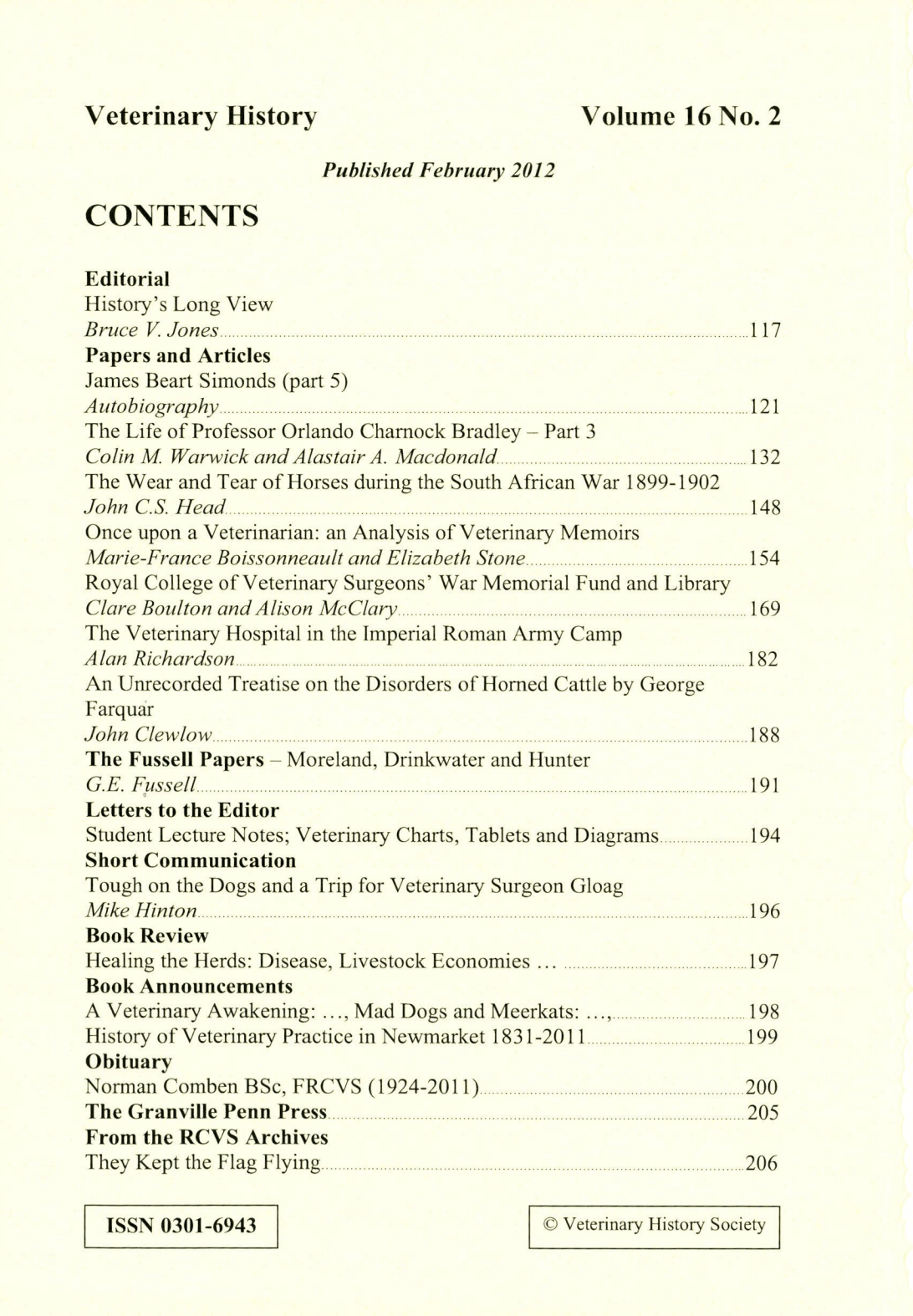
James Beart Simmonds: Late Principal of the Royal Veterinary College, Professor of Cattle Pathology, &. Autobiography – Part 5
This part deals with outbreaks of Splenic Apoplexy, later recognised as anthrax in the mid-nineteenth century. Simmonds describes various outbreaks, their symptoms and some epidemiology.
The Life of Professor Orlando Charnock Bradley (1871 – 1937): Diary Entries 1902 – 1937 Part 3
This part covers Charnock Bradley’s life from 1918 to his death in 1937. The move to Summerhall was completed by 1918. The centenary of the Edinburgh college was celebrated in 1923.An account is given of his love of music and concerts attended. He went on a visit to Germany in 1928 to celebrate the 150th anniversary of the Hannover Veterinary School. He set up the Diploma in Tropical Veterinary Medicine in 1930. He died in 1937. There are accounts of his memorial services and an overview of his life.
Colin M. Warwick and Alastair A. Macdonald
The Wear and Tear of Horses during the South African War 1899 – 1902
Based on the records of Lieut. A. S. Head, who served with the 6th Inniskilling Dragoons in South Africa from October 1899 to May 1902. In that time the Regiment had 4,290 horses and lost (‘expended’) 3,750 leaving 540 at the end of the War.
John C. S. Head
Once upon a Veterinarian: An Analysis of Veterinary Memoirs
Explores the common themes in twenty-seven veterinary memoirs published from 1951 to 2009. Common themes were the impact of a veterinary career on personal life, communications with clients, gender roles, cost of care, fallibility, veterinarians treating humans, euthanasia, the veterinarian’s sense of humour.
Marie-France Boissonneault and Elizabeth Stone
Royal College of Veterinary Surgeons’ War Memorial Fund and Library
Sixty-seven members of the RCVS lost their lives in World War I. The RCVS War Memorial commemorates the sacrifice made by members of the College. An accompanying table records the names of those members and how they died. Part of the fund-raising for the Memorial set aside money for an endowment to the RCVS Library to enable it to catalogue its collection and introduce a lending library. Eventually the War Memorial Library was established. The catalogue forms the basis of the current Library’s Historical Collection.
Clare Boulton and Alison McClary
The Veterinary Hospital in the Imperial Roman Army Camp
A text by Hyginus (c.64 BC – AD17) established a standard layout for a Roman Army Camp. Space was included for a veterinary hospital and workshop. Richardson points to Roman ‘animal husbandry of a very high order’.
Alan Richardson
An unrecorded Treatise on the Disorders incident to Horned Cattle by George Farquar
This previously unrecorded book from about 1836 is considered to be a plagiarised version of a book with the same title that was produced by Joseph Downing in 1797. In turn Downing’s book is considered to be a plagiarised version of Thomas Topham’s A New Compendious System on Several Diseases Incident to Cattle (1787). There is no record of Farquar as a qualified veterinary surgeon.
John Clewlow
Tough on Dogs and a Trip for Veterinary Surgeon Gloag
On 24 January 1856 during the Crimean Campaign a General Order was issued that repeated the Admiralty order forbidding dogs on board ships carrying sick passengers. Any dog found would be thrown overboard.
Mike Hinton
They kept the Flag flying
The red flag with white inverted triangle was flown by the No 1 Cavalry Mobile Veterinary Section (CMVS). The unit was formed in 1938 to provide veterinary and remount services to two cavalry regiments and served during World War II in the Middle East and Mediterranean before it was disbanded in 1945.
Clare Boulton and Bruce Vivash Jones
Please note
Buy now