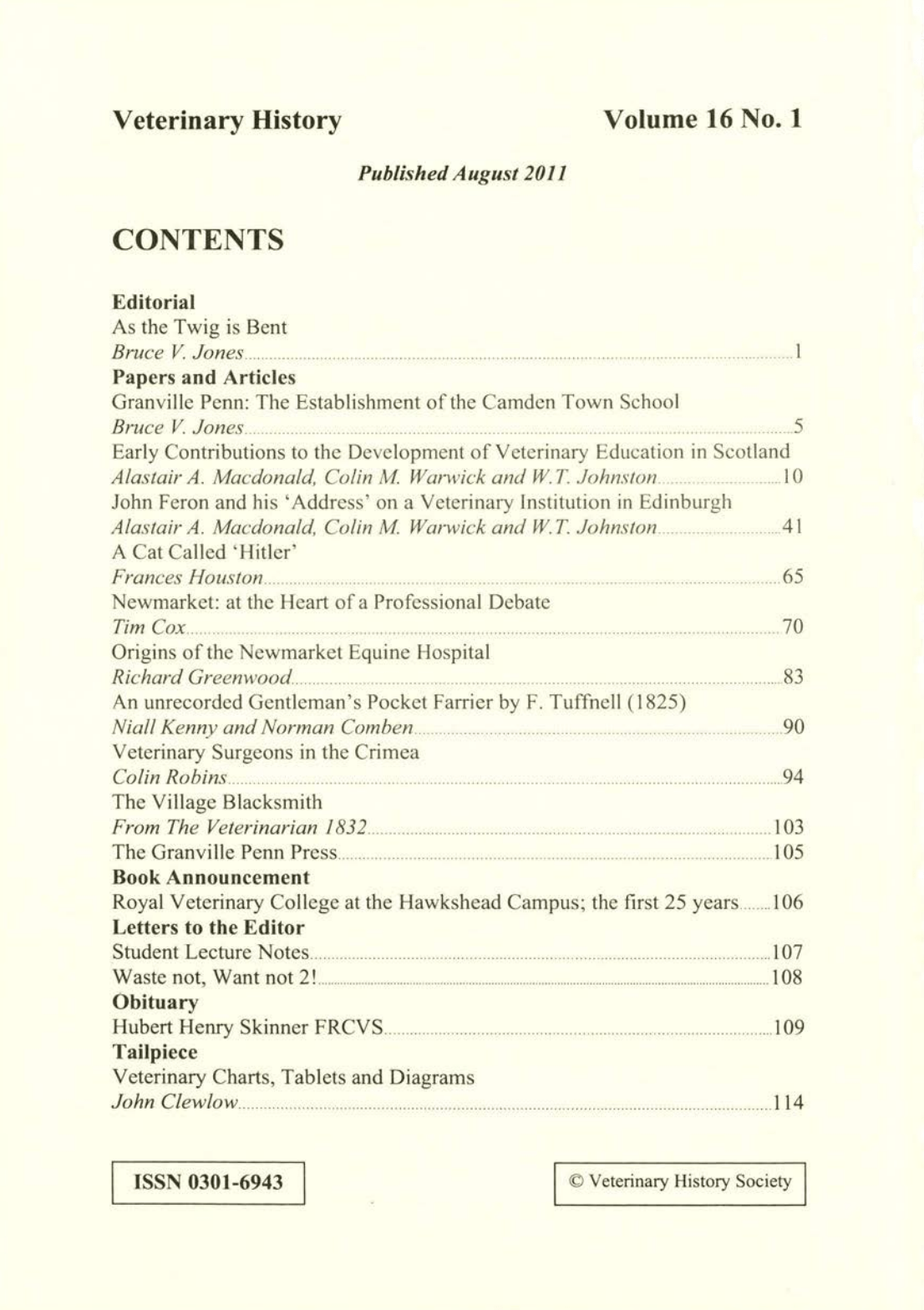
Granville Penn: The Establishment of the Camden Town School
The Odiham Agricultural Society was formed in 1783 to discuss and crystallise ideas of agricultural and social importance. In 1785 the Rev. Thomas Burgess suggested that ‘the improvement of Farriery established on a study of Anatomy, diseases and cures of cattle…will be an essential benefit to Agriculture’. In 1789 the Society began to solicit funds to send two boys to the Veterinary School at Charenton near Paris. A London Committee was formed under the eventual Chairmanship of Granville Penn. Influenced by Charles Vial (later Charles Benoit Vial de St Bel), a graduate of the Lyons Veterinary School, the Society campaigned ‘to create an animal hospital and to provide regular education based on medical and anatomical principles’. The first general meeting of ‘The Veterinary College, London’ took place on 8th April 1791 with Vial as Professor of the College.
Bruce V. Jones
Early Contributions to the Development of Veterinary Education in Scotland
In 1823 William Dick established the first Veterinary College in Edinburgh. But for over a hundred years before, there was a lively debate about the need for veterinary education in the city. In 1696 Sir William Hope published his translation of Solleysel’s Parfait Marechal in Edinburgh and expressed the wish that farriers could receive a more formal education in veterinary practice. Hope was followed by Alexander Monro and his son and grandson, the new School of Medicine in the University of Edinburgh, John Clark and his family, James Jeffray, John Feron [Jean Féron], Edward Harrison, The Highland Society and John Barclay.
Alastair A. Macdonald, Colin M. Warwick and W. T. Johnston
John Feron and his ‘Address’ on a Veterinary Institution in Edinburgh
In 1796 John Feron, a French Royalist refugee, proposed the setting up of a Veterinary Institution in Edinburgh. His Introductory Lecture to a select group of potential subscribers is reproduced followed by scant biographical details that could be gleaned about his life. ‘Circumstances at the time were not sufficiently supportive of the plan’. He joined the British Army as a veterinary surgeon and appears to have spent the Napoleonic War in England.
Alastair A. Macdonald, Colin M. Warwick and W. T. Johnston
A Cat called ‘Hitler’
In 1933 a Professor Hinz wrote to Sir Frederick Hobday to reassure him that what the foreign newspapers were writing about Germany was untrue, that the government had been elected constitutionally, and that ‘the public life relative to the Jews…is entirely normal in Germany’. This is one of the letters found in a trawl through the archives of The Royal Veterinary College to find examples that went beyond the usual veterinary debates. In 1933 a lady wrote asking if the College could spay her cat called Hitler.
Frances Houston
RVC Archive Newmarket: At the heart of a Professional Debate
Throughout the Nineteenth Century veterinary surgeons were fighting to establish their profession. There were debates about ‘What is the veterinary profession? and ‘Who could be a member of it?’. A formidable foe was the trainer/groom at Newmarket ‘The Home of Horseracing’. In the 1830s there were four hundred horses in training in the town, a ready market for a newly qualified vet. But vets found it difficult to establish themselves. Various arguments were put forward to explain what was going on – the poor quality of graduates coming out of the Veterinary College and the need for better teaching staff, a reliance of the tried and trusted methods of the trainer/groom, and, perhaps most importantly, the need to protect stable secrets at a time of heavy gambling. By the end of the century vets were welcomed into Newmarket when the ‘new’ methods proved successful in curing champion racehorses.
Tim Cox
Origins of the Newmarket Equine Hospital
In 1900 there were six vets working in Newmarket, including William Livock, an Edinburgh graduate. Livock was joined by Brayley Reynolds in 1923. Reynolds had been in the Royal Veterinary Corps in World War I and developed a special technique for the laryngeal ventriculectomy operation. After Livock’s retirement in 1926 Reynolds built the practice with the help of other named vets. By 2008 the practice had outgrown its premises on Newmarket’s High Street and moved to its new site on the outskirts of town.
Richard Greenwood
An unrecorded Gentleman’s Pocket Farrier by F. Tuffnell (1825)
Apart from the addition of the names of the publisher and the supposed author, this previously unknown book is ‘virtually identical to a paraphrased version’ of the 1772 edition of William Burdon’s The Gentlemen’s Pocket Farrier. This book was an unexpected success in the USA with local editions being published in 1832, 1833, and 1834 (Boston), and 1836, 1838, and 1844 (Baltimore).
Niall Kenny and Norman Comben
Veterinary Surgeons in The Crimea
In 1796 Veterinary Surgeons were introduced into all mounted regiments in the British Army. They replaced the Farrier Major and his farriers, who continued as assistants. Edward Coleman, who succeeded Vial de St Bel as Professor of the Veterinary College was appointed Principal Veterinary Surgeon to the cavalry and Veterinary Surgeon to the Ordnance Corps. Sir Frederick Smith argues that ‘he was appointed improperly, was appallingly ignorant and acted dishonestly’. He survived for forty-three years before he was replaced by Mr Cherry who achieved more in fifteen years than Coleman in forty-three. The veterinary arrangements at the beginning of the Crimean War were ‘primitive’, but conditions improved as more vets were sent to the theatre of war. In 1856 John William Gloag was appointed Principal Veterinary Officer to the Land Transport Corps.
Colin Robins
The Village Blacksmith A description of the Village Blacksmith reprinted from The Veterinarian 1832
Veterinary Charts, Tablets and Diagrams
Veterinary ‘charts’ or ‘tablets’ emerged in the 1830s. They came in various forms but all could be hung on a wall or folded into a more compact state. The earliest example is Small’s Veterinary Tablet: being a synopsis of the diseases of horses, cattle, and dogs, with their cause, symptoms, and cures by Matthew Small (1833).
Please note
Buy now