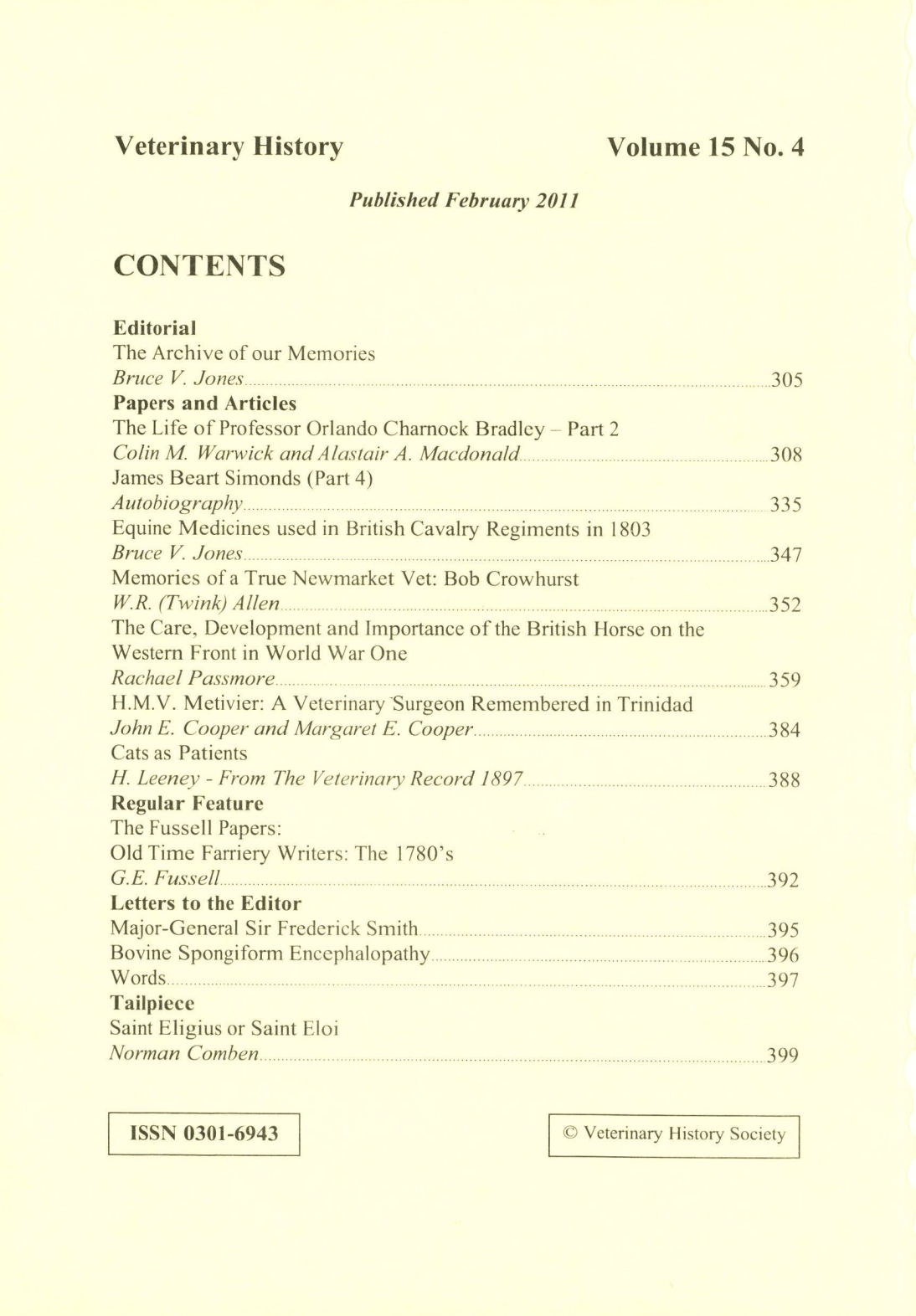
The Life of Professor Orlando Charnock Bradley, (1871-1937): Building the Summerhall Site, Part 2
This part deals with the construction of the veterinary college at Summerhall in Edinburgh, which was given an impetus by the appointment of Charnock Bradley as principal in 1911. He was involved in the detailed planning of the buildings. He had to oversee the raising of the money for the building to go ahead – half from central Government and half by public subscription. Construction started in 1913 and was not fully complete until 1925, although students had moved in from 1916.
Colin M Warwick and Alastair A Macdonald
James Beart Simonds. Autobiography – Part 4
James Beart Simonds was principal of the RVC and Professor of Cattle Pathology. This is a transcript of an article which was originally published in 1894 in The Veterinarian. His appointment in 1871 after the dearth of Professor Spooner, who succeeded Professor Sewell. He lists various staffing changes and appointments. He describes his identification of a new parasite, which caused death in lambs and sheep. It was found in the abomasum and was named Filaria hamata, but later changed to Strongylus contortus (now Haemonchus contortus). Simmonds discusses his interest in Sheep Scab and sheep Rot.
Equine Medicines Used in British Cavalry Regiments in 1803
This is a transcript of a letter, written in 1803, listing the only medication approved by Professor Coleman for use in the treatment of army horses. Coleman was the principal of the London College. Ther are 28 drug compounds listed, which is identical to a list published, forty years earlier, by J Bartlet in his Pharmacopoeia Hippiatrica, with the addition of five extra compounds.
Bruce V Jones
Memories of a True Newmarket Vet: Bob Crowhurst
Bob Crowhurst was born in 1915 into a veterinary dynasty, eventually spanning six generations. He qualified from the RVC in 1937 and went to work in Newmarket. He spent five years in the army during the war, becoming Lt Colonel by 1945. He spent time in Syria, Crete and Italy. He was involved in successfully transporting 11,000 horses to Palestine and running large veterinary hospitals in Italy caring for thousands of mules and horses. After the war, he spent a year in Lexington, Kentucky studying equine reproduction. He returned to Newmarket and, with his partners, built up a very successful large equine practice, with many famous and distinguished clients, including HM Queen Elizabeth. He was official vet form the equine team for three Olympic Games. He retired in 1983 and he died in 1995.
Twink Allen
The Care, Development and Importance of the British Horse on the Western Front in World War One
Despite the increasing mechanisation of the army techniques of warfare, the horses remained essential to the war effort and ultimately to its success for the Allies. Tijs was in contrast to the Axis Powers, whose equine resources were limited and poorly managed. There were three main types of equine work during the Great War: cavalry, gun and transport and the pack animal. The Cavalry became less relevant as the war progressed, but still remained useful in some specific circumstances and both sides maintained large numbers of cavalry soldiers to the end of the war. Horses were much more effective at transportation using wagons, where the roads were poor to allow the use of lorries. Pack animals using panniers were even poor useful in the worst conditions and transporting ammunition to the front line. Recruitment of horses was a massive operation. 165,000 horses were impressed from Britain in the first days of the war, but it quickly became apparent that horses would need to sourced abroad. A major campaign to buy horses form Canada and USA was undertaken, with very strict rules on the quality and health of the horses bought. Very careful testing and veterinary examinations were carried out before the horse were transported to the UK and the Western Front, including seven-week quarantine periods. A detailed account of this process is given here. By 1917, the Army had over a million horses. There was a careful and organised transportation of horse, which was very effective and with minimal losses. Aft er the terrible losses of horses during the Boer War, the Army Veterinary Corps was founded. This proved to be very well managed and the 1688 veterinary officers, were able to return 78% of the horses were returned to duty. Over 2.5 million horses were treated during the war. Major illnesses managed were periodic ophthalmia, limb and foot problems related to the wet muddy conditions, battle wounds, mange and ringworm. An account is given of the workings of the veterinary hospital and mobile units.
Rachel Passmore
H V M Metivier: A Veterinary Surgeon Remembered in Trinidad
Harry Vincent Mercer Metivier was born in Trinidad and graduated from the RVC in 1915, when he joined the Army Veterinary Corps. He returned to Trinidad and had a long and distinguished service in public service, eventually being appointed a lecturer at the Imperial College of Tropical Agriculture. He was a founding member of the (British) Caribbean Veterinary Association. After he died in 1956 a memorial plaque was erected to him.
John E Cooper and Margaret E Cooper
Cats as Patients (From Veterinary Record 25/12/1897)
A transcript of an article, published in 1897 and written by a veterinary surgeon, about the veterinary care of cats. An interesting account of feline veterinary care of that time.
H Leeney
Old Time Farriery Writers: The 1780s
A review of farriery writing in the 1780s. The writes considered are William Perks, J Watson, William Forrester, Thomas Topham, Thomas Prosser and Richard Foot.
G E Fussell
Saint Eligius or Saint Eloi. The Patron Saint of Farriers and Veterinarians
An account of the life of Saint Eligius or Saint Eloi, patron saint of farriers and veterinarians.
John Clewlow
Please note
Buy now