Fundraising to Rebuild the Royal Veterinary College
By 1932 the buildings of the Royal Veterinary College were in a dilapidated state and need ed urgent replacement. This was estimated to cost £250,000. A nationwide campaign to raise money was launched. Money was given by raffles and collections at horse shows and dog shows, fund raising events such as fetes and concerts. Donations were received from a wide range of sources – from individuals to clubs and societies, pet food manufacturers, proceeds from the International Horse Show Ball. The ’Daily Herald’ ran a competition offering a £15,000 prize for a 6d ticket. A film of the work of the RVC was shown in cinemas across the country with a collection afterwards.
Frances Houston
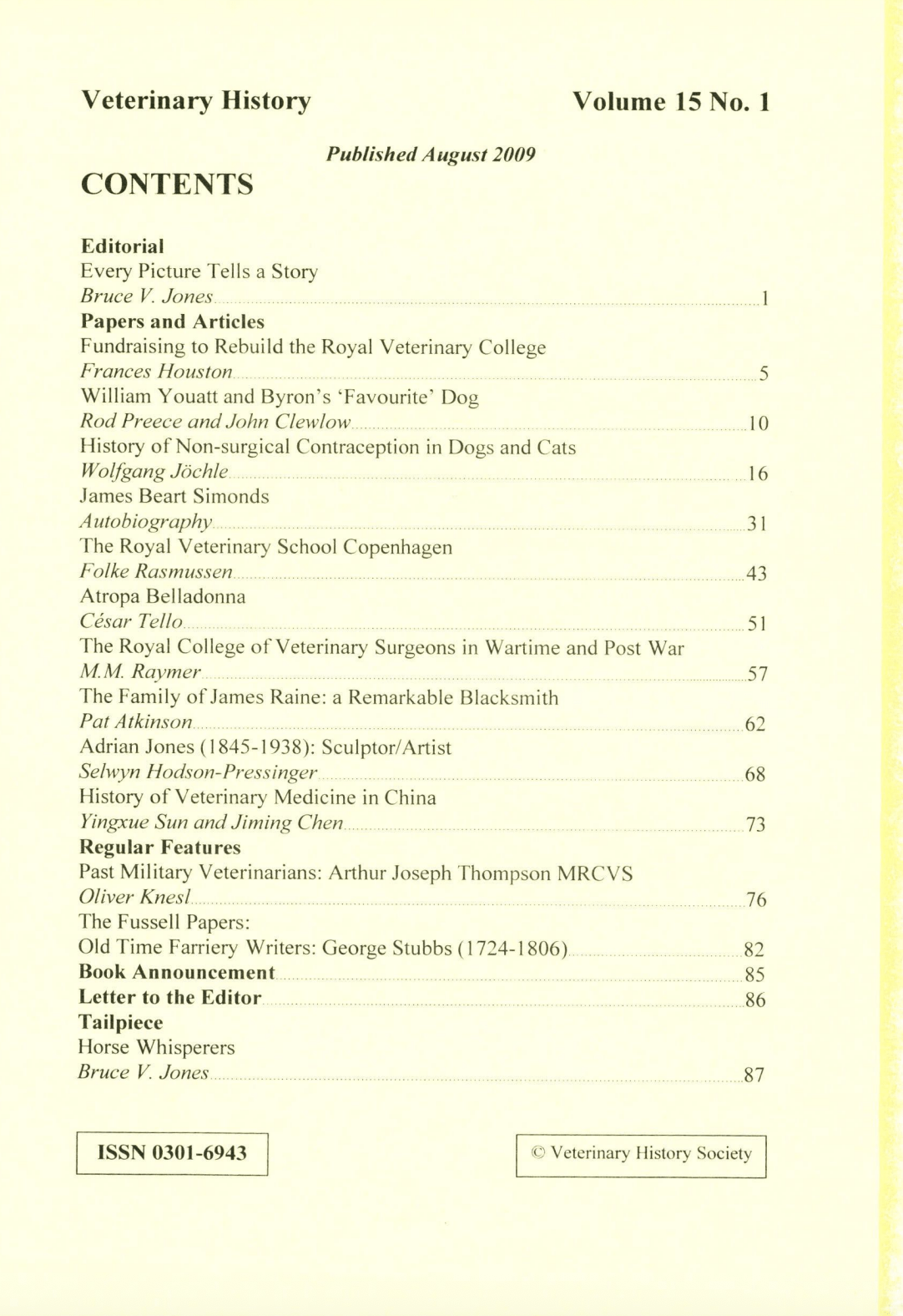
William Youatt and Byron’s ‘Favourite’ Dog
After Lord Byron died in 1824, his dogs were inherited by John Cam Hobhouse, later Lord Broughton. Three dogs came back to the UK with Byron’s coffin – Lyon, Moretto and Geone. Hobhouse chose William Youatt to provide veterinary care for the dogs. Byron’s ‘favorite dog’, believed to be Lyon, was treated by Youatt and returned to Hobhouse cured of the ailment, but the dog died shortly afterwards. Youatt submitted a bill to Hobhouse, which resulted in a vituperative response from Hobhouse. Two letters were written by Youatt to Hobhouse, the first one, written in anger was very offensive. The second later contained an apology for his intemperate language. The matter was settled with a payment, by Hobhouse, to the ‘Western Philanthropic Institution’. The authors also consider the possibility Youatt used the pseudonym, Edmund Boyce, who authored and translated books about Napoleon.
Rod Preece and John Clewlow
History of Non-Surgical Contraception in Dogs and Cats
Surgical castration of dogs can be traced back to 7-6000BC. The research into non-surgical control of female reproduction started in the1960s. The use of progestins was tried but this appeared to cause an increase in the incidence of pyometra. this led to a loss in confidence in the idea of chemical contraception in the USA, but its use persisted in Europe. Other progestins were developed with lower dosages and more accurate timing advice for the injections. Initial attempts with implants were not successful. Attempts were made to find GnRH analogues suitable for dogs. Recent developments have been with the use of contraceptive vaccines, aimed at the zona pellucida, but this caused irreversible infertility in dogs. Vaccines against hormones can be used. Intrauterine devices have been considered but would require anaesthesia to insert and this would make them expensive.
Wolfgang Jőchle
James Beart Simonds. Autobiography – Part 2
James Beart Simmonds was involved in research into Rabies and whether one animal could pass the infection on to another animal of the same or different species. A transcript of a circular produced by the Royal Agricultural Society in 1840 about the diagnosis, control and treatment of Foot-and-Mouth Disease. Simmonds was appointed Professor of Cattle Pathology at RVC in 1842. In 1849, he started a survey of diseases affecting famers, using a questionnaire.
The Royal Veterinary School, Copenhagen 1773
Peter Christian Abildgaard (1740-1801) graduated from the Lyon Veterinary School in 1766. He had been a medical student and he qualified as a physician in 1768. He was asked to establish a Danish veterinary school, which opened in 1773, with twenty students, who qualified 2 years later. It became the Royal Veterinary School in 1777. Abildgaard was joined by Erik Nissen Viborg (1759-1822) in 1783. Viborg was a botanist and very interested in fodder and medicinal plants. Viborg qualified as a veterinary surgeon and was appointed professor in 1796 and Principal of the school after Abildgaard died in 1801. Viborg revised the whole curriculum and widened the range of species studied. The Royal Veterinary and Agricultural University opened in 1858. this institution became part of the University of Copenhagen in 2007.
Folke Ramussen
Atropa Belladonna
Atropa Belladonna, also known as Deadly Nightshade is the source of Atropine and Scopolamine. Belladonna was used by ancient Greeks as a poison and anodynes for pain relief. Atropine was first isolated in 1831 and its main use was to suppress secretions associated with the used of gas anaesthetics – Chloroform and Ether. Initially, veterinary use was as a mydriatic in horses and dogs. During WW1, Morphine and Atropine were given half an hours before surgery, to reduce secretions and allow the patient to sleep post-surgery. It also became a standard pre-medicant in veterinary medicine. Its use has declined in recent years, due to newer anaesthetics causing less problems. Its use is retained for ocular surgery and as an emergency remedy for Organophosphate poisoning.
César Tello
The Royal College of Veterinary Surgeons in Wartime (1939-1945) and Post War
The personal reminiscences of Miss Raymer, who was employed as a librarian at the RCVS, in Red Lion Square when WW2 started. She describes most of the staff moving to Wimbledon to live and work with Fred Bullock. In 1941 a bomb nearby caused the roof of the library to catch fire. Water caused more damage than the fire and a lot of the library was lost. The RCVS staff, including Miss Raymer, moved to Harrogate to avoid bombing. The library was transferred there. Miss Raymer describes some social events during the Blitz. In 1942, she was called up and worked at an outstation of Bletchley Park. She returned to Red Lion Square to sort out the library and archives. This took many years. Miss Raymer left the RCVS in 1959.
M M Raymer
The Family of James Raine: A Remarkable Blacksmith
The family history of William Raine, a veterinary surgeon in Ovington, Yorkshire. He was born in 1789 and initially apprenticed to his father, a blacksmith. He qualified as a veterinary surgeon in 1812, from the RVC. He died in 1841.
Pat Atkinson
Adrian Jones (1845-1938): Cavalry Officer, Veterinary Surgeon and Distinguished Sculptor/Artist
An account of the sculptures of Adrian Jones, including his most famous one the ‘Peace Triumphant and Quadriga’ sitting on the Wellington arch in London. The history of the commission and execution of this sculpture is given. It was put into position in 1912. Other sculptures by Jones are listed, including the ‘Cavalry Memorial’ and a memorial to the Royal Marines in St James’s Park. A statue of Duke of Cambridge and memorial to ‘the Carabiniers’ are described.
Selwyn Hodson-Pressinger
History of Veterinary Medicine in China
First mention of veterinary treatment in China, appeared 5,000 years ago, when a horse doctor of the emperor cured some diseases of ‘dragons’. In the first millennium BC, herbal treatments and surgery were applied in veterinary medicine, Veterinary Medicine was one of four medical professions. A demand for more horses and their care led to the further development of Veterinary medicine in China and by 700AD there were 600 vets, 4 veterinary teachers and 100 students. During the Song Dynasty, official veterinary hospitals were established. A pharmacy publication of 1608 listed 229 veterinary remedies. There were very few advances by the nineteenth century until the establishment of a veterinary institute in 1905 – The Baoding School of Horse Medicine.
Yingxue Sun and Jiming Chen
Arthur Joseph Thompson MRCVS (1880-1948)
Arthur Joseph Thompson was born in 1880 and qualified from the RVC in 1902. In 1905 he was commissioned as a lieutenant in 1905. He was sent to the North West Frontier in India, where he was involved in the various skirmishes at that time. He was promoted to Colonel and became head of Veterinary Services, India in 1917. He returned to the UK in 1919 and, almost immediately dispatched to Archangel, in Russia, the headquarters of the North Russian Force. He returned to UK and was stationed at Aldershot until he retired from the army in 1931. He then moved to New Zealand, where he joined the Meat Hygiene Service. He died 1948.
Oliver Knesl
Old Time Farrier writers: George Stubbs 1724-1806
A brief account of the life and works of George Stubbs, including his great work ‘The Anatomy of the Horse’.
G E Fussell
Please note
Buy now