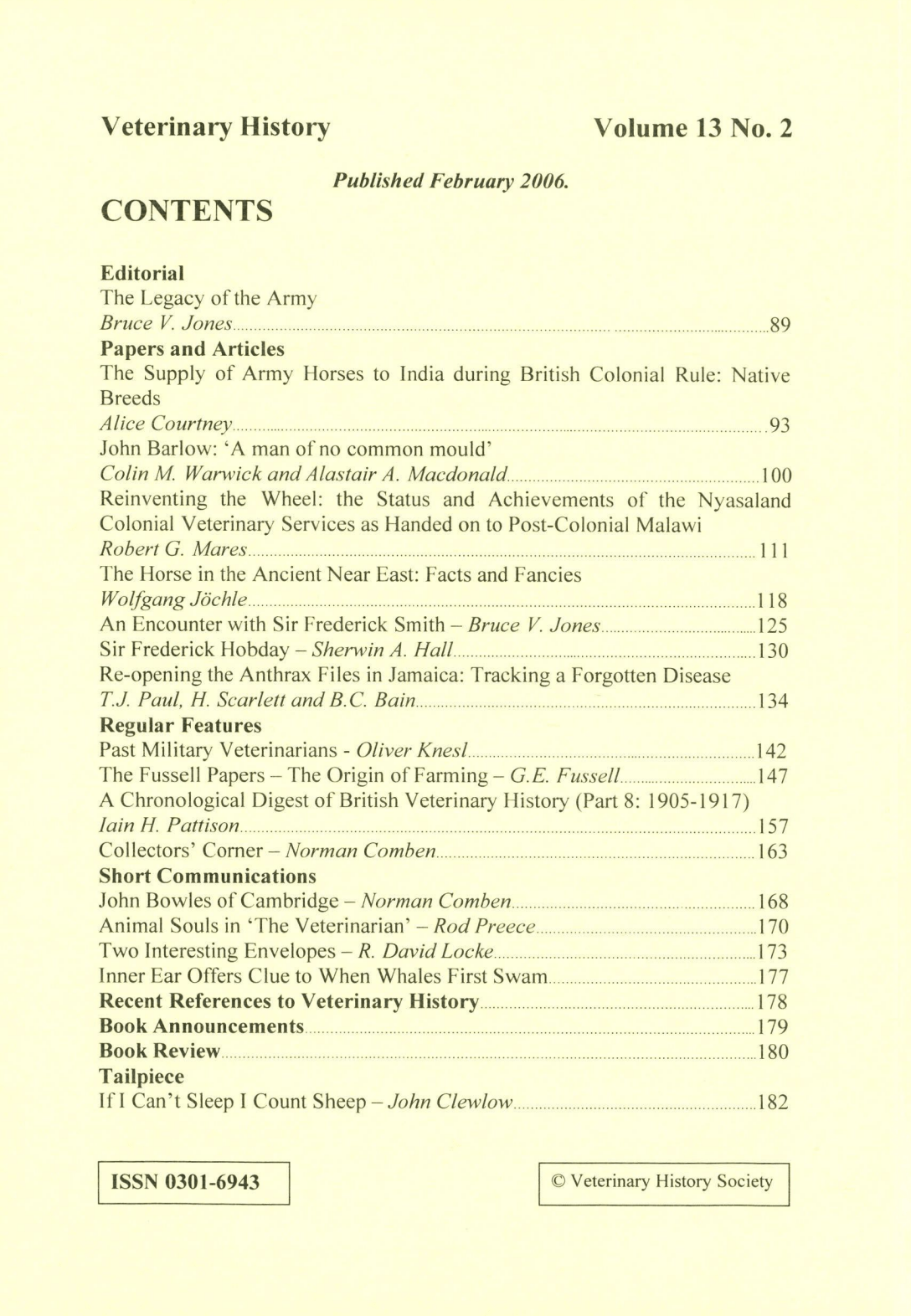
The Supply of Army Horses to India during British Colonial Rule: Native Breeds
Horses originally came into India with the Aryans from the north. Over time many sturdy native breeds were developed. These country-bred horses were not suitable for the British Army, although sturdy, acclimatised with tremendous staying power, they were too small and their conformation was not suitable to long strides and high speeds. They also had a bad temperament. The British Army were impressed with the Belooch mares, which had Arab blood and traits. Horses from the desert tracts of southern Punjab were also deemed suitable for military use.
Alice Courtney
John Barlow; ‘A Mind of no Common Mould’
John Barlow was born in 1815 and graduated from William Dick’s Edinburgh School in 1844. Due to his distinguished academic record, he was appointed a lecturer in Zootomy (Anatomy and Physiology), where he remained until he died at the age of forty in 1856. He was a follower of the Society of Friends (Quakers). He was well respected and several famous vets recalled their lectures from Barlow.
Colin M Warwick and Alastair A Macdonald
Reinventing the Wheel: The Status and Achievement of the Nyasaland Colonial Services as Handed on to Post-Colonial Malawi
The first vet to work in Nyasaland arrived in 1911. There was a gradual expansion in the provision of veterinary services working to control and treat diseases and improve quality of livestock. Hastings Banda became President in 1966 after independence was achieved in 1964. There was a lot of effort in training local staff to take over form ex-patriate personnel. They were sent to Europe to obtain qualifications. There was a continuing programme of improvements in quality oof livestock, with AI breeding scheme. The veterinary department were involved in auction markets, abattoirs and meat inspection. There was a major dipping programme to aid the control of East Coast Fever. TB remained an intractable problem. A brief analysis of current situation is given.
Robert G Mares
The Horse in the Ancient Near East: Facts and Fancies
The author discusses two pictogram charts showing equids from Susa, found in the nineteenth century. They were produced by the Elamite Empire in c2800BC. Before this time there were no horses in the middle East. The quid which was used was the onager. This was replaced by the horse throughout this area and Ancient Egypt from 1700BC onwards. The chart appears to show breeding records for various different stallions and mares. It has usually assumed to show horses, but the author shows how they cannot be horses, but are onagers.
Wolfgang Jőchle
An Encounter with Major-General Sir Frederick Smith
A personal recollection by the author of his time at the RVC, when he was given the job of sorting out the collection of the pathology museum, which had been packed away at the start of WW2 and not been looked at since. One of the items was the heart from Sir Frederick Smith, bequeathed in his will to the RVC, to show ‘cardiac asthma’ and congestive cardiac failure. The heart is still kin the possession of the RVC. The author gives a brief account of the life of Frederick Smith.
Bruce V Jones
Sir Frederick Hobday
Frederick Hobday was born in 1870. He qualified from the RVC in 1892 and spent the next few years at the college, where he developed his famous surgical procedure for relieving ‘roaring’ in horses, known as ‘hobdaying’. He became a partner in an equine practice in Kensington. During World War 1 he was in charge of the large veterinary hospital in Abbeville. In 1927, he was appointed to be Principal and Dean of the Royal Veterinary College. His main challenge was the very poor state of the buildings and he mounted a very effective campaign to raise money to build a replacement. There was a nationwide campaign and widespread public support. The new buildings were opened in 1937. Hobday was knighted in 1933. For reasons that are not clear, Hobday was forced to retire, by the Governors, on the very day that George VI opened the new college buildings.
Sherwin A Hall
Re-opening the Anthrax Files in Jamaica: Tracking A Forgotten Disease
A history of Anthrax in Jamaica in the twentieth century. Records for the period 1947-1977 were examined and this showed nine outbreaks between 1949 and 1955, mainly affecting cattle. Very fe3w human deaths were recorded. Large numbers of cattle were vaccinated and the eradication can be seen as a public health success story.
T J Paul, H Scarlett, B C Bain
Major John Miller Tate MRCVS (1862-1933)
John Miller Tate was born in 1862 and qualified from the RVB in 1899. After a short period in practice, he was appointed as a civil veterinary surgeon (in the Army Veterinary Department) in South Africa during the Boer War. An account of the action at Sannah’s Post in 1900 is given. In 1901, Tate joined the South African Constabulary, who were responsible for the control and eradication of livestock diseases – Glanders, East Coast fever, Lung Sickness and others. In 1908, he joined the Transvaal Civil Veterinary Department until 1914, when he was gazetted to join the South African Police and remained there until retirement in 1925 as a Major.
Oliver Knesl
The Origen of Farming
A review of the early literature about the origins and history of the development of agriculture. The author looks at many examples of early writings which are products of the limited knowledge of their times, particularly relying on biblical sources.
G E Fussell
A Chronological Digest of British Veterinary History, Part 8 1905-1917
This period covers; the opening of the Liverpool Veterinary School, the appointment of Stewart Stockman as CVO, the appointment of Fred Bullock as secretary of the RCVS, the death of William Hunting – founder of Veterinary Record, the outbreak of War in 1914, the foundation of the veterinary laboratory at Weybridge.
Iain H Pattison
Two Exhibitions of the Works of George Stubbs 2005
A brief biography of George Stubbs is followed by a review of two exhibitions of works by Stubbs in London in 2005. The exhibitions were at the national Gallery and at the galleries of Bonhams. The former was organised by two American museums and the latter by the British Sporting Art Trust.
Norman Comben
John Bowles of Cambridge
A brief history of John Bowles, a medical practitioner, who was personal physician Sir Frank Standish, but who also called himself a veterinary surgeon and looked after Standish’s race horses. There is an account of the poisoning of three of Sir Frank Standish’s horses at a race in Newmarket in 1811.
Norman Comben
Animal Souls in The Veterinarian
A review of seven articles published in The Veterinarian in 1839/40 about whether animals had immortal souls.
Rod Preece
Please note
Buy now