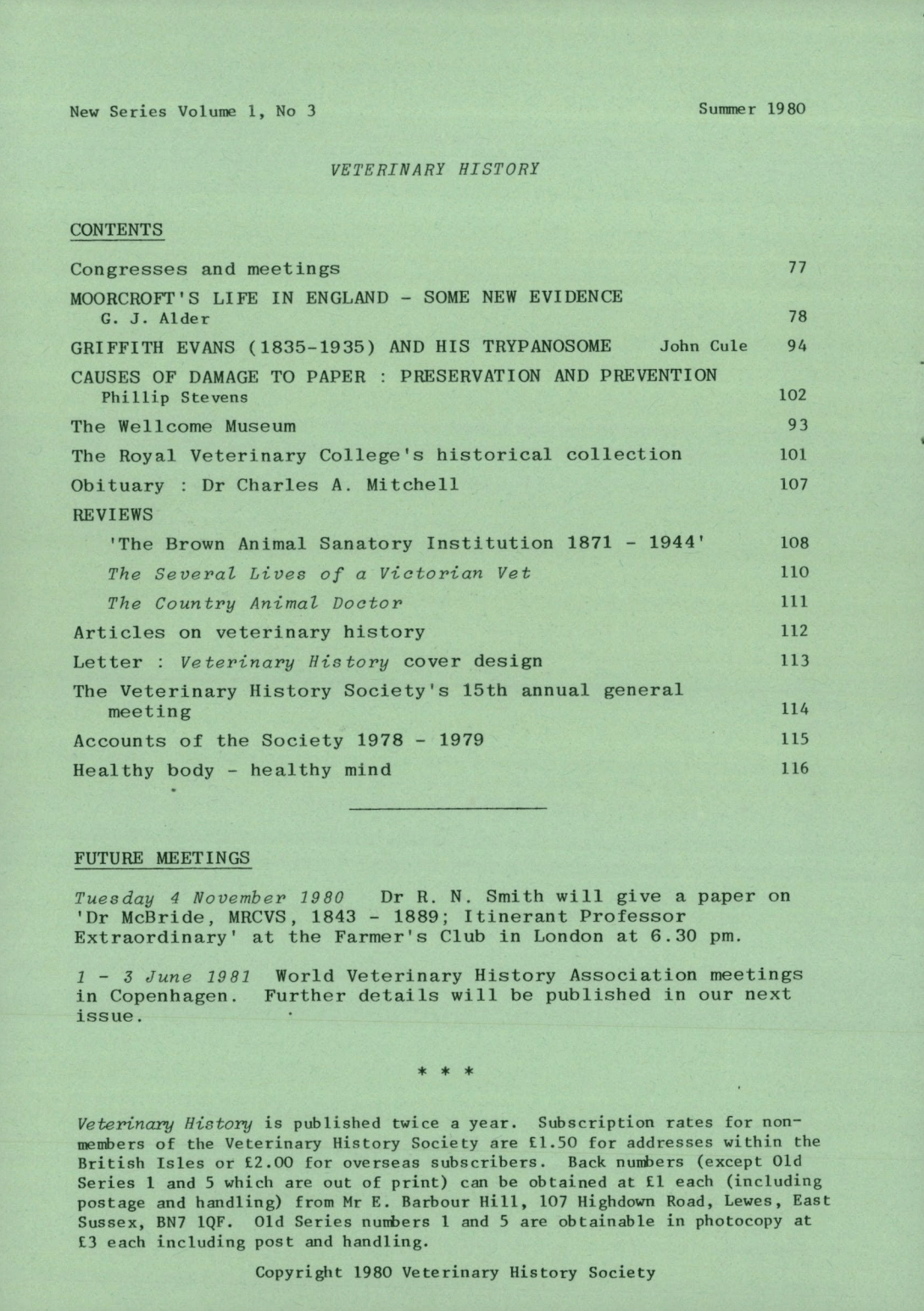
Moorcroft’s Life in England- Some New Evidence
William Moorcroft was the first Englishman to qualify as a veterinary Surgeon. He was born in Ormskirk, the illegitimate grandson of a local landowner, Richard Moorcroft. This is an account of his early life and friendship with Thomas Eccleston, a renowned experimental agriculturalist of his day. Moorcroft travelled to France in 1789 and pursued his veterinary studies in Lyon. He returned to UK and set up in practice on Oxford Street in London, where he joined the Westminster Volunteer Cavalry. He patented a horseshoe manufacturing machine, which turned out to be a costly failure. He travelled to India in 1808, where he spent the rest of his life.
G J Alder
Griffith Evans (1835-1935) and his Trypanosome
Griffith Evans was born in Merioneth in 1835 and trained as a Veterinary Surgeon in London, qualifying in 1855. He was commissioned into the Royal artillery and was sent to Canada. He qualified as a doctor in Montreal in 1864. He spent time in the American Army during the civil war. Returning to the UK in 1870, he married and transferred to Army Services Corps in Woolwich. In 1877 Evans went to India, where he was involved in research into causes of Anthrax and Surra. He identified the organism causing Anthrax and the Trypanosome which caused Surra in horses. He returned to the UK and retired from the army, becoming a lecturer in veterinary hygiene in North Wales. He died in 1935.
John Fisher
Causes of Damage to Paper, Preservation and Prevention
Different causes of damage to paper are described and advice on preventions.
Phillip Stevens
Please note
Buy now