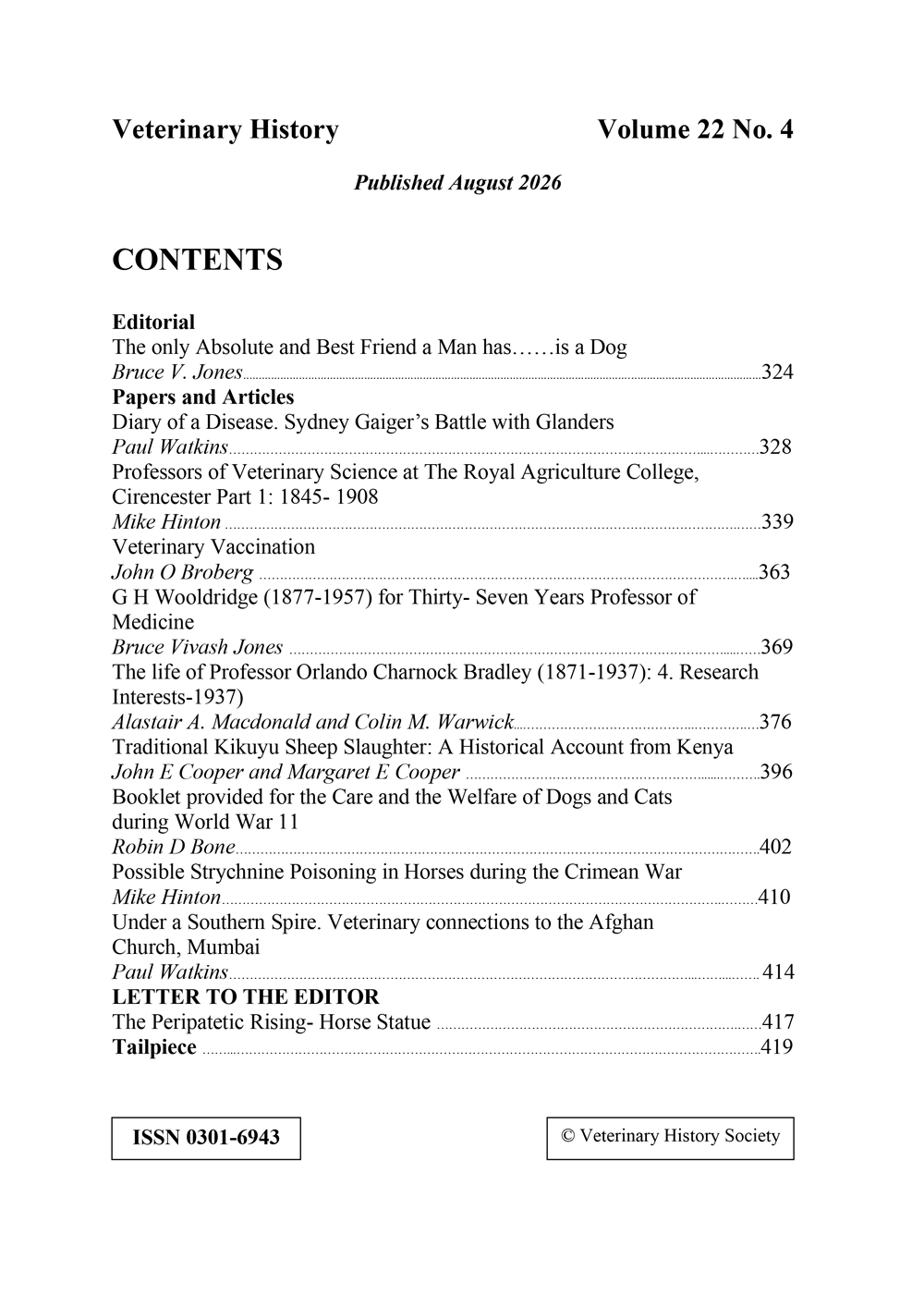
Editorial
A brief History of the Human-Dog relationship and the development of veterinary care.
Bruce Vivash Jones
Diary of a Disease. Sydney Gaiger’s battle with Glanders
Sydney Gaiger was born in 1884 in Linlithgow, Scotland. He attended the New Veterinary College in Edinburgh and was one of eleven students to transfer to Liverpool in 1904, from where he qualified in1906. He joined the Indian Civil Veterinary Department and was professor of Sanitary Science at Lahore Veterinary College. His main areas of research were Haemorrhagic Septicaemia in cattle, Surra, parasitology and Glanders. In 1911 he caught Glanders from a pony, which he was treating. Over the next five years he suffered many relapses of the condition and had many surgical procedures to lance abscess and amputate an arm. He died in 1916. The article describes, in some detail, the progression of his disease..
Paul Watkins
Professors of Veterinary Science at the Royal Agricultural College, Cirencester, Part 1 1845-1908
The Royal Agricultural College was opened in 1845. The first Professor of Veterinary Science was appointed in 1845. There was a total of fifteen men in this post. They were John Robinson, George Thomas Brown, Alexander James Murray, William Hunting, John Adam McBride, Edward Nettleship, Thomas Walton Mayer, William Frederick Garside, Nicholson Almond, William Thomas Wilson, Joseph William Brittlebank, Harold Addison Woodruff, George Henry Wooldridge, Vere de Vere Hunt Woodley and Alexander Charles Duncan. Brief accounts of the careers of these professors are given.
Mike Hinton
Veterinary Vaccination
An account of early experiments and trials of vaccination in Rabies, Rinderpest and Blackleg.
John O Broberg
G H Wooldridge (1877-1957) for thirty years Professor of Medicine
George Henry Wooldridge was born in 1877 near Stoke-on-Trent. He graduated from the RVC in 1899, with a very distinguished academic record. He was appointed as Professor of Veterinary Science st the Royal Agricultural College at Cirencester, where he remained for three years before moving to Dublin as Professor of Medicine. In 1908 he moved to the Royal Veterinary College in London, becoming a leading teacher and clinician in the College’s internal practice. He was involved in many veterinary organisations, including president of RCVS IN 1939. He was a prolific author, including as editor of the Veterinary Journal 1906-14. Wooldridge published his Encyclopaedia of Veterinary Medicine, surgery and Obstetrics in 1923. with forty-seven international authors. He retired from the RVC in 1943. He died in 1957.
Bruce VIvash Jones
The Life of Professor +Orlando Charnock Bradley (1871-19370: Research Interests
The fourth part of the life of Orlando Charnock Bradleyvabout his research interests. The paper is based on a collection of twenty-two volumes of scientific reprints collected by Bradley. His early interests were on neuroanatomy, especially of the cerebellum. He was interested in exotic species and wild animals. Later research involved the internal organs of the dog.
Traditional Kikuyu Sheep Slaughter: A Historical Account from Kenya
The Kikuyu are a Bantu speaking people, living Mainly in central Kenya and the Rift valley. They have a special method of slaughter of sheep for special occasions. This is an account of that method.
John Cooper
Copy of a Booklet Produced During World War II: Care and the Welfare of Dogs and Cats
A facsimile copy of a booklet produced by ‘Bob Martin Ltd’ to advise on caring for dogs and cats during wartime. This included air raid protection, wartime feeding, exercising during blackout, first aid, protection box for cats.
Possible Strychnine Poisoning in Horses During the Crimean War
An account of a, possible malicious, poisoning of horses using Strychnine. In 1856, a group of horses, stationed in Constantinople, was taken to be watered and fed, but rapidly developed a variety of symptoms, including spasms, convulsions and pain. Thirteen of this group died within twenty-four hours. Another group showed similar symptoms but none died. Initial post-mortem examinations revealed nothing significant, but the suggestion was made of malicious Strychnine poisoning
Mike Hinton
Under a Southern Spire. Veterinary Connections to the Afghan Church, Mumbai.
The church of St John the Baptist in Mumbai, commonly known as the Afghan Church, was built between 1843 and 1865. It was built to commemorate the officers killed during the Afghan Wars of 1838-1843 and 1878-1880. The veterinary surgeons are commemorated here: James Willis, William Frederick Blanshard and Francis Friend Smith Constant.
Paul Watkins
Please note
Buy now