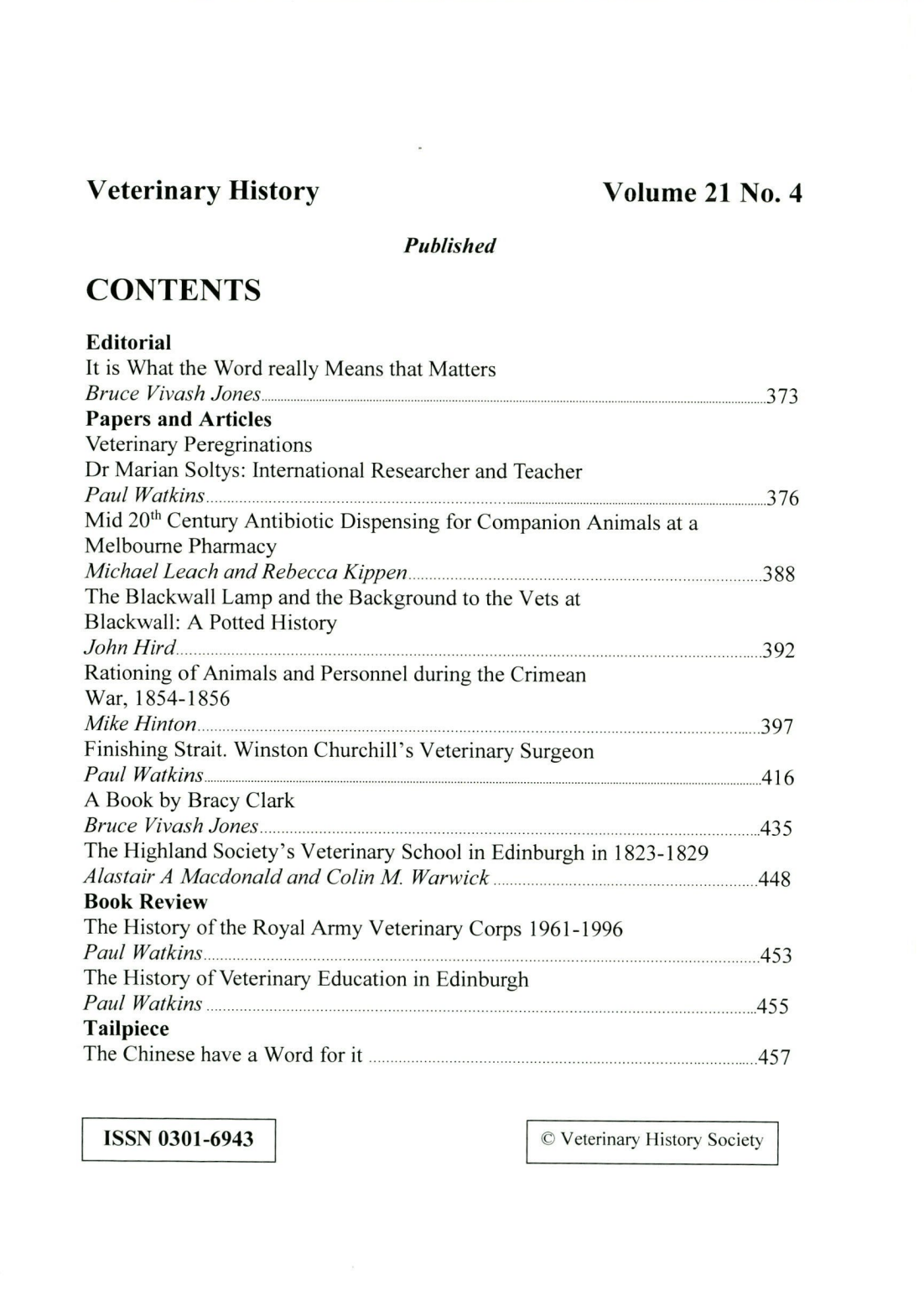
Veterinary Peregrinations. Dr Marian Soltys: International Researcher and Teacher
Marian Soltys was born in Lwow in 1907. Lwow was part of the Austro-Hungarian Empire at that time but was later in Poland. He graduated as a veterinary surgeon in 1933, completing a PhD in 1936. When the Russian army invaded in 1939, he fled to Romania, but in 1940 all foreign national were ordered to leave Romania. He arrived in France, but with the capitulation of France, he escaped to Britain on a coaling ship. He gained a position at the Moredun Institute in Scotland and also taught at the Polish Veterinary School, established in Edinburgh. He moved several times over the next few years to Cambridge, Weybridge and Manchester. He was appointed lecturer in animal Pathology in 1945 moving in 1947 to the same position in Liverpool. In 1952 he went to Kenya, developing an interest in Trypanosomes. He was back in Cambridge in 1954 as lecturer in Animal Pathology, again focussing on research on Trypanosomes. In 1966 he was appointed to be Professor of Microbiology at Ontario, Canada; retiring in 1974, but he then spent a few years at a new veterinary school in Malaysia. He died in 1997.
Paul Watkins
Mid-20th Century Antibiotic Dispensing for Companion Animals at a Melbourne Pharmacy
This is an investigation into antibiotic usage for companion animals in Melbourne, Australia for the years 1935, 1943, 1954 and 1961. The information was obtained from prescription books from a community pharmacy in Melbourne. Most of the veterinary prescriptions were for dogs. The percentage of prescriptions for antibiotics rose from 0% in 1935 to 37% in 1961.
Michael Leach and Rebecca Kippen
The Blackwall Lamp and The Background to the Vets at Blackwall: A Potted History
A history of a veterinary practice at Blackwall in Halifax, Yorkshire. A vet was first established at this site in 1834 A history of some of the vets who worked at this site is given, including the author. A large lamp was positioned above the gates to a yard at the veterinary practice. It dates from the mi-nineteenth century. The lamp was removed and restored in 2015 and is now mounted on a wall at a new equine hospital. It is also part of the practice’s logo.
John Hird
Rationing of Animals and Personnel During the Crimean war, 1854-1856
As the British forces were confined to a small area in the Crimea, it was essential to supply the army by sea. After a severe gale in November 1854, the supply of supplies, stores, equipment and forage was severely disrupted as a result of the loss of ships and roads being impassable. Forage for the horses and other livestock had to be rationed and this led to serious losses due to malnutrition and overwork. It also meant there could be no replacement horses sent to Crimea until this situation had improved. There was a reduction in the rations for the soldiers. There are lists, included, of general orders issued by the army covering forage for horses and other animals and also for the rations for the soldiers, listing the amounts allowed. There is an account of the preparation and supply of forage material and also an account of the transport of horses by sea.
Mike Hinton
Finishing Strait. Winston Churchill’s Veterinary Surgeon. Arnold Edward Carey-Foster
Arnold Foster was born in 1908 and graduated from the RVC in 1934. He adopted the name Carey-Foster. HE WORKED IN devon, where he had a few minor brushes with the law. In 1937 he went to Singapore as the veterinary surgeon for the Singapore Racing Association, where he was responsible for four horse tracks in Malaya. In 1940 he was driving a car, which was involved in accident and resulted in the death of the passenger. Carey-Foster was convicted and given a prison sentence of four months and a five-year driving ban. He escaped from Singapore, reaching India, where he enlisted with RAVC in 1942; and was assigned to a unit of soldiers training for guerilla warfare under Brigadier ‘Orde’ Wingate. He was successful in caring for the mules which were essential for the mission. He developed a technique for removing vocal cards from 2000 mules to avoid their braying being heard by the enemy. Carey-Foster was part of the Chindit expeditions in 1943. He returned to the UK as a Major and settled in Surrey. By 1950 Carey-foster was providing veterinary care to racing horse belonging to Winston Churchill, including the successful horse Colonist II. Churchill purchased Newchapel Stud in 1955 and asked Carey-Foster to be manager. Carey-Foster was a regular guest at Chartwell. After Churchill died in 1965, the stud was sold and Carey-Foster lived in central London, where he ran a small animal clinic.
Paul Watkins
A Book by Bracy Clark
Bracy Clark was born in 1771 to a Quaker family in Chipping Norton. He was apprenticed to a surgeon In Worcester. He was one of the first group of veterinary students at the new London College under Sainbel, (St Bel).and received his diploma in 1794. After qualifying, he studied gad flies before travelling on the continent visiting other veterinary schools. Clark set up his own practice in London and he developed a particular interest in shoeing of horses. He retired in 1828 and spent the rest of his life writing; a total of forty-five books, mainly on horses, shoeing and entomological studies. He had a terrible temper and made life long enemies. The article then describes a book assembled by Clark of five booklets and leaflets, written by veterinary authors, in c1834, William Moorcroft, Dr Brocklesby, Frederick Cherry, John Kent and John Howship. The subjects being, respectively; shoeing, cattle murrain, army transport, legal advice for court cases involving horse and the bot fly.
Bruce Vivash Jones
The Highland Society’s Veterinary School in Edinburgh 1823-1829
The Highland Society had a veterinary school in Edinburgh, which used a room in a building – the Calton Convening Rooms in Waterloo Place (now demolished). William Dick lectured in this building between 1823 and 1829, when he moved to his own premises in Clyde Street. Illustrations and a plan are given in the article and a list of the vets given a diploma by the Highland Society, between 1824 and 1829, is given.
Alastair A Macdonald and Colin M Warwick